Sunday, February 02, 2014

Hornbill Heights (Part 1) - The home wars


Urbanization has its evils. Destruction of patches of green that causes habitat loss for creatures living in it and displaces them. But, it also proves that Nature can take over an heal the damages wrought by man. This is the tale of one such green patch in Palakkad, my hometown in Kerala, and its inhabitants. The main characters in this tale are the Indian grey hornbills, a very common bird seen in our urban areas. They are true survivors and they pair up for life. This is their story.


In the heart of my town, Palakkad there is a bit of land on which stands the Palakkad town railway station. In the old days this was the junction for the meter gauge track from the Palani-Madurai route. There used to be a depot of the Indian Oil Corporation Corporation (IOCL) on the western side of the tracks and we had, and still have, a retail outlet of IOC on the eastern side opposite the Municipal bus stand.
 
The depot is long since gone as IOCL apparently found its running nonviable. They shut it down in 2004 and dismantled the huge storage tanks. Soon after, the meter gauge to broad gauge conversion work was started by the railways but that is not progressing even at snail's pace, because a snail would have crawled from Palani to Palakkad and back a 100 times in the intervening period! To cut the long story short, because this is a bird story and not a railway story, these two happenings had a beneficial effect.

The green belt in the middle is the railway land. Click the link above to go to Google Maps

The railway's yard already had huge trees in it's premises. With the stoppage of rail traffic the goods yard was shut down and human activity came to a standstill. Once the IOCL depot too was dismantled the rear approach to the railway station became an abandoned area. The only activity now is after 9 PM when passengers bound for Thiruvanathapuram come directly to the platform from that side. The IOCL depot is a wild unkempt area now with anti-social elements prowling around within its crumbling walls and poor people using it as a large open air lavatory! The trees grew with gay abandon, till some were cut recently for widening of the tracks. (The photos were clicked with my cellphone camera)
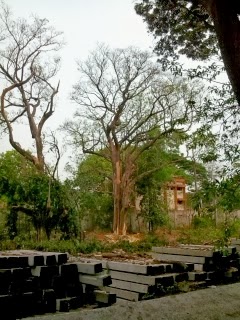


This tree still stands and our story plays out on it


 The buildings are overgrown now and wear a haunted look. However, there are still many that provide shelter for a variety of birds in the heart of my town. These trees were used for nesting by a large number of birds. Egrets were in plenty but after the trees were cut they have not returned.  Barbets too have gone. The drongos, kites, mynas and cuckoos are still around. There is however one tree, a rain tree (albizia saman), that has, mercifully, been spared the wood cutter's power saw. I hope it stays that way because that is where the real estate wars are going on. 

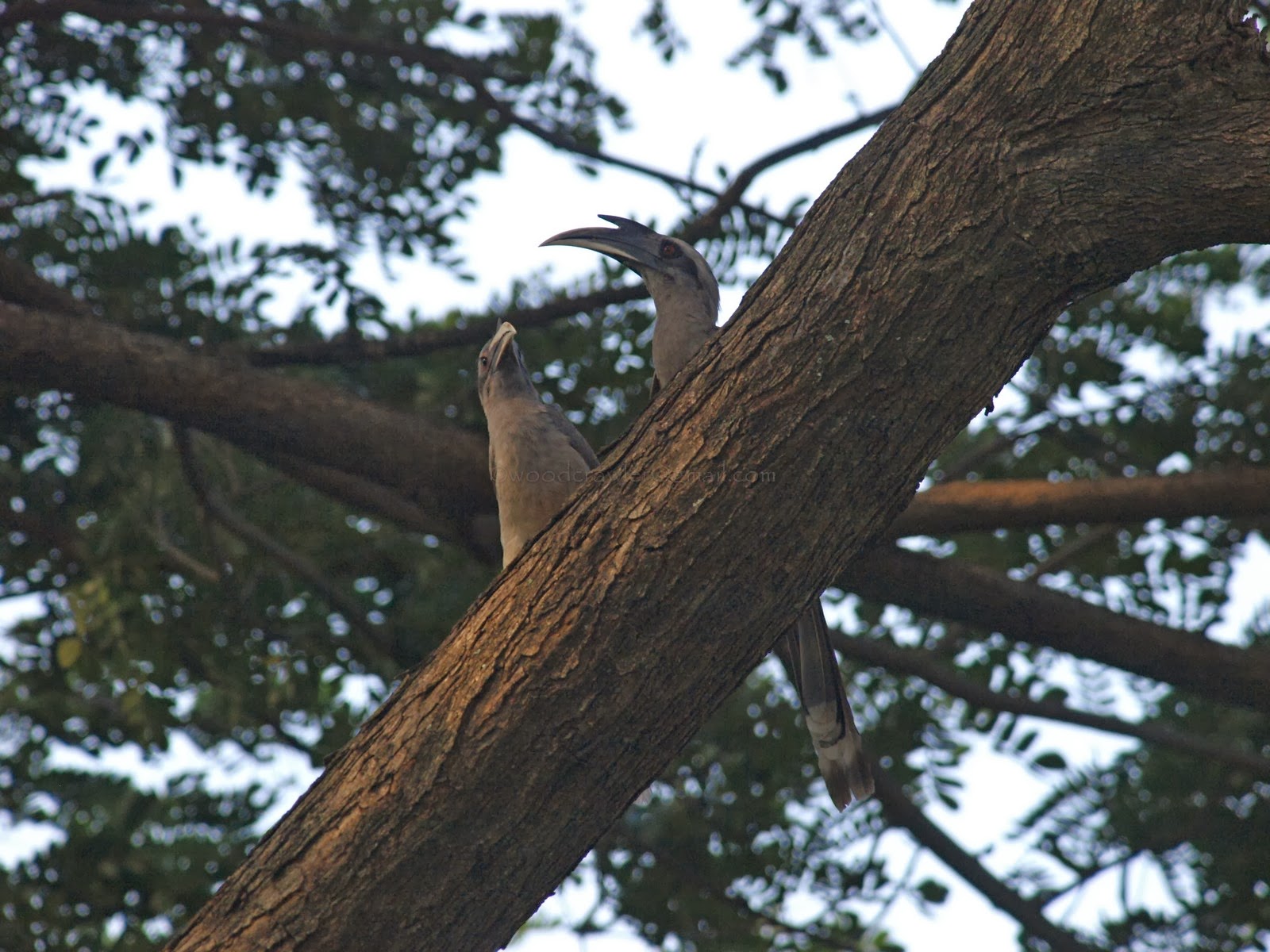
This tree has a hole in a strategic location some 30 feet up on its trunk. For any self respecting bird that would be the hole to which he would bring his mate to! It has been a prized nesting location for a generation of Indian grey hornbills. Come the breeding season, they make a beeline for it and there is serious competition. Of course, only one pair will have the privilege of occupying that cozy little hole!


Of course, such a strategically placed tree hole would have attracted the attention of 'encroachers' when the hornbills were away. This hole was no exception. I noticed a pair of mynas flying around agitatedly. Obviously they had occupied it and now they were about to get 'evicted'!


When the season arrived, as usual,  the annual 'house hunting' started in earnest. It was in late October that I noticed the first pair. They were the earliest to stake claim and inspection went on in earnest. I'm not sure if they are the same pair that nested there last year. Technically this is not the breeding season for the Indian grey hornbill. That comes later between March to June. However, courtship, pair feeding, mating and nest searching starts in November or December.

30th October, 2013


For the next few days they were the main pair, identifiable by a single white tipped black feather on the right side of the male's tail.


8th November, 2013

Then there was a flow of 'couples' to inspect the new 'apartments' on this tree. I counted nine pairs on one morning. They were sitting on different branches of the tree and would patiently wait for one pair to finish their inspection before moving in for their turn.
Pair 2

Pair 3

"Ok. The doorway is fine...."

".......and the inside looks cozy, except for those darned myna's poo!"

Pair 4

Pair 5

While they waited, some of them would go around looking for other tree holes with potential to be their next home.
"No hole here."

"Hmmm.....this place has potential."

"Hey! There is a hole here!"

"Anybody home?"

"Darn it! My beak barely fits!"

Pair 6

"Nice hole here baby!"

".....and a nice view too."

Pair 7
I couldn't get pics of two other pairs.

Eventually it dwindled down to two pairs. The second pair has found another hole on a branch on the same tree but I'm unable to get a clear view because photography is not allowed in railway land! I have one distinct advantage though, my retail outlet lies adjacent to this green patch so I have an unhindered view of the tree and the activity that goes on around it.

Every year the pair that got the right for this tree hole would occupy it for the rest of the season. I have seen the nesting pair go in and out setting it up for living but the mynas too were not giving up. Every opportunity they got they'd also get inside and stake claim.
"Ok! They've gone!"

"Mine!Mine!Myne!....Myna's!"


Over the last few weeks this drama is played out every morning. I'm not sure who gets to occupy the hole at night. Every morning the main protagonists are always in action. When the hornbills are around the mynas keep a safe  distance. Perhaps they are aware that a vicious knock with that huge beak could be fatal. Once the hornbills go on their foraging flights in the morning the mynas scamper back trying to establish their claim. I'm not sure how long they can hold out but they are not giving up just yet.

31st January, 2014

It seems that the first pair have agreed that this hole was where they were going to start their family. Every morning they would do some cleaning despite the mynas raising a ruckus around their heads. 


Even if the female left the vicinity of the hole the male would hang around a little longer.

Then he too would move off after her.....

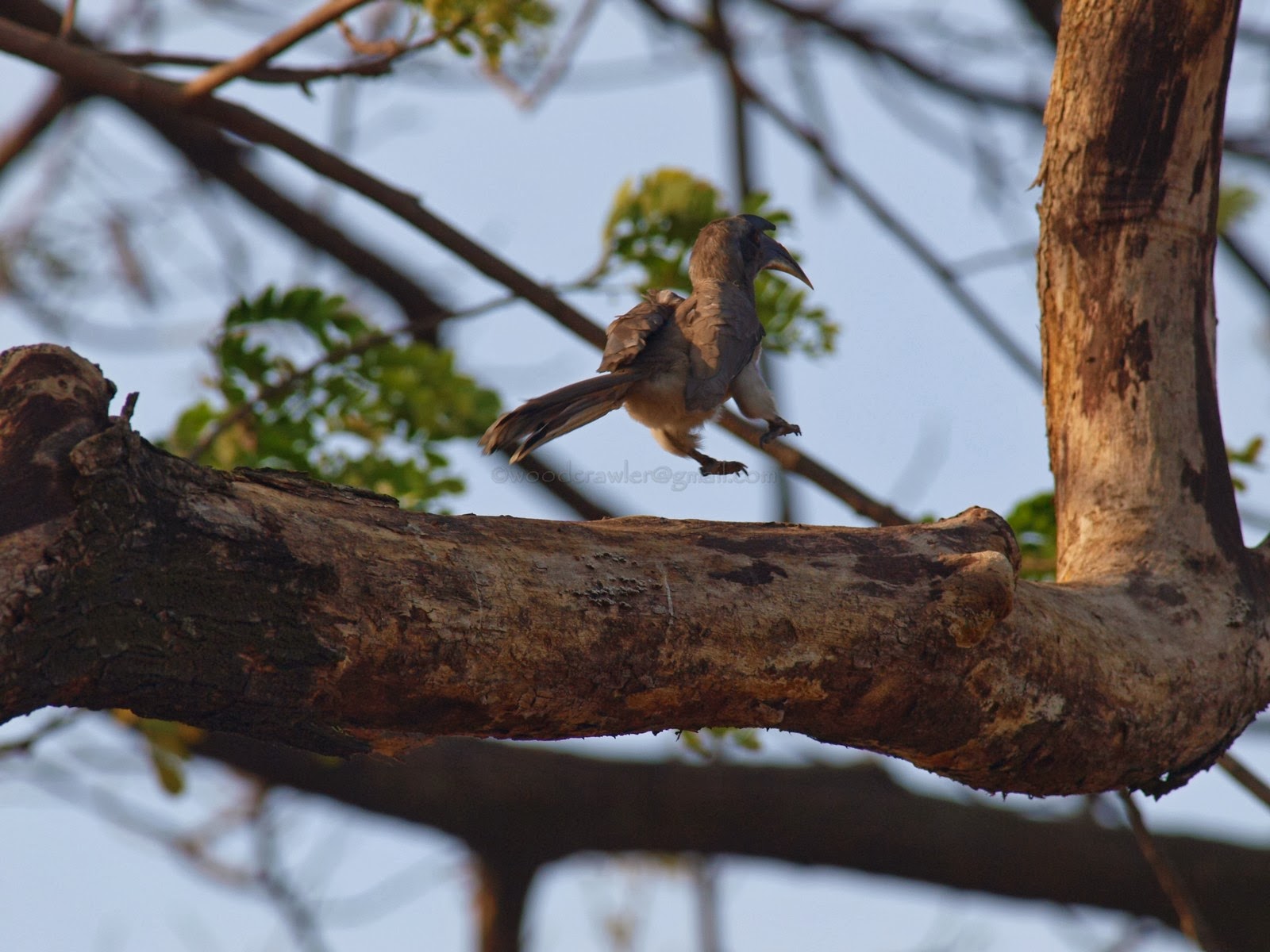
...hopping and flying in short spurts..

...to bask in the morning's sunshine.
The hornbills didn't seem unduly concerned about the mynas. Maybe they knew that when push comes to shove the mynas wouldn't stand a chance. They were more worried about other birds in the area, the black kites.


The male was giving looks at the kite feeding above it. It seemed more worried about the kites than the mynas looking to occupy their nesting hole.

The initial hesitation passed and it seemed to make up its mind that the kite was no threat to his mate. After all it had a very nice meal to finish.


The mynas were a different kettle of fish. They were more hawk like in their attitude. Hanging around for the opportunity to get back their hole.


The mynas are also probably in their breeding mood and like the hornbills, a myna pair is mated for life. I read somewhere that mynas are messy so the hornbills can be expected to have a hard time cleaning up!

Seeing the mynas hanging around, the male flew down and stuck about the hole for a while. 


Eventually both of them settled on a branch nearby, making sure the mynas did not get back into the hole. 


It is going to be long summer for both the pairs. Who will eventually retain this prime piece of real estate remains to be seen. My bet is on the hornbills. Not because they are bigger and have a formidable looking bill but also because once the female gets in to lay her eggs, she gets sealed in for the rest of the incubation period and while the chicks are in their early days. 

As for the second pair on this tree. They were a very contented looking couple. They had a nest on another branch which was away from prying eyes and my camera's lens. I could just about see them go in and out occasionally
.
A nest that is already setup is a catalyst for romance. It was evidenced by their courtship on the branches. She had a morsel in her bill, and was offering it to him.


 He would take it in his bill gently......

.... then return it to her without swallowing it.

Sometimes he'd take it again, chomp on it.....

......hold on for a few seconds.....

....before returning it to her lovingly again! I thought romancing was old fashioned! After all romance nowdays, is confined to social networking sites and is usually very brief and eminently forgettable! Paired for life seems very strange term as far as us humans are concerned. Perhaps we can take a leaf out of the hornbill's life story.

These two pairs will be under my constant surveillance. I can't wait for the females to get walled in. I'm only worried the mynas will try to break the wall even as the first hornbill pair starts building it. It is a story that is building up. We have another five months to go for it to play out to its end.

5th February, 2014
Things have been happening at the Nesting Tree. 

The Pair No: 1 still continues their war with the mynas and they are still struggling to assert their claim on the best hole in the tree. 

Meanwhile Pair No: 2 have no such problems. They are busy with their courtship and house cleaning. I hope to get a closer access to their hole soon. It also means that the Trilogy is going to have more sequels than I have planned. 

Watch this space closely


Thursday, January 30, 2014

Evolution of a Birder -2: Transition from the Tiger to Trogon

From a 'tigertracker' to a 'woodcrawler', it has been a long journey. I guess it is not unusual for a normal person to fall in love with something exotic or unattainable. It is a human trait to reach for the moon even when we know that all of us will never get there. I'm a normal human being and so I think I will forgive myself for such simple mindedness.

During my initial years looking at nature with a careful eye, my attention was always drawn by the tiger. No doubt, as the apex predator in all the jungles I visit, the tiger deserved the its place in my mind and consequently all my thoughts about India's wilderness was centered around the king of the jungle. As the years passed and after many a trip into the jungle I realized that the tiger was really like a 'film star'. I saw it more on the screen than in real life!

Most trips to Bandipur and Nagarahole were in search of the elusive tiger or leopard but they were elusive as always. It was then I started noticing the birds. They were everywhere. I did not have to search for them. They just keep appearing every now and then. Crested serpent eagles, Changeable hawk eagle, hoopoes, bee eaters and woodpeckers. Creatures that I chose to ignore in the hope of laying my eyes on the tiger. Even a pug mark was celebrated back then!

The upside of these frequent trips was that I learnt to enjoy the jungle for what it is; a jungle. There would be days when we drove in and after a couple of hours or more of bouncing along the tracks we'd encounter 'nothing of any significance'. After many trips like that especially, on cold or wet mornings, I started enjoying the forest for it's wildness. My eyes took in everything; right from the bare branches in winter, the fresh growth of green leaves after a rain, the dew on the funnel web spider's web on the ground and all other little creatures.


 My first trip to Silent Valley National Park, nearly a decade back when Woodcrawler Jr was barely walking, was the turning point.  I met my first Malabar Trogon in Silent Valley and also my first Indian Pitta, Paradise flycatcher and Emerald dove. The birds were slowly clamoring for attention now.


 The tiger, if it appeared, would certainly get my attention; but the birds were there to keep me busy everywhere. It was also a period when I was learning the ropes of nature and wildlife photography.  My gear, back then, consisted of a rather old Minolta entry level SLR with just two lenses. The longest was a 70-210mm f4.5 -5.6 zoom. I also procured a 2x teleconvertor, with absolutely no idea that it would only add to my misery rather than contribute to making my photography better! It slowed my camera's reflexes so much that either my subject would have left its perch or I'd have a very shaky picture. Some of the pictures above will testify that. All of them were shot in late 2004 - early 2005 in Bandipur (the first 4 pics) and Silent Valley National Park (second 4 pics).

I've come a long way over the last decade and more. Film camera was substituted with a prosumer digital camera with an extended zoom that enhanced my reach. Then I found that inadequate and shifted to a DSLR with interchangable lenses. I don't lay any claim to being an excellent photgrapher but there has been a marked improvement. Now I speak in terms of aperture settings, ISO and shutter speed to my son, who is all of 11 years old and is well on his way to becoming a a serious Woodcrawler. Photography, for me, is about documenting nature in its myriad moods and colours.

Missing a tiger or leopard on my jungle trips don't matter anymore. I look out for my feathered friends and my son s turning out to be a good spotter. The jungle is not only about the big cats. It is also about the birds, flowers, trees reptiles and other mammals. The transition is complete.

I'm not a pure tigertracker now, I'm a WOODCRAWLER.

Thursday, January 02, 2014

Evolution of a Birder

It had been a very heavy monsoon and there hasn't been much Woodcrawling for many moons now. My short hops haven't produced much to write about and Woodcrawler Junior's school has also come in the way of any meaningfully long trips. So it is with much anticipation that we are looking for a break in the wild, again. The Christmas vacations have come and gone but we stayed put for the sole reason that it would be the wrong to time to step out. After all who want to run into pesky tourists when you are going for a little relaxation in the wilderness?!

God and the Government of Kerala joined hands to open up a chance to walk in the wild, courtesy the 54th Kerala School Kalolsavam. The Kalolsavam is the annual inter school arts festival and it is to be held in Palakkad this year. It is a big event that sees a lot of talent being thrown up. Some of the winners have gone on to become movie stars. It is therefore no surprise that major clashes and disagreements break out amongst the parents and teachers of competitors vying for the top spots. For us it meant that schools will close for a few days and chaos will reign on the already congested roads of our little town.

Thattekad has been beckoning for a while, and this was an opportunity to take off. My first trip was in late May 2013, the worst time to go, when I went as a speaker at a conference in Kothamangalam. It was more of a recce for a trip in the season and the monsoon washed off the memories quickly. As usual, Bandipur and B.R Hills popped up when they announced the closure of the schools between 19th and 25th January. It would be a good time to go with so many tigers and leopards gallivanting around the parks, even in B.R Hills! It was also the peak bird season so they'd be there in huge groups.

Then my good friends Dr. Ravi Rajasingh and Khusro Ahmed posted pictures of some jewels of the avian world on their Facebook pages. It was like they gave me a little knock on the head, reminding me about my pending trip to Thattekad! Now, we are counting the hours and preparing ourselves for a feast spread over three days. Every night is spent scouring the net for more information about the birds that we were going to see. It was while searching for new books that I suddenly realized that this was becoming a serious pass time.

Photography has been a passion and nature in any form, be it an animal, bird, insect or landscape; always seemed to look better through a camera's viewfinder. Over the years, of all the things that have imprinted themselves on my camera's film or processor, I realized that birds took up the biggest space on my computer's hard disc! I guess, these feathered beauties were drawing my attention away from everything else.

I was a hardcore tiger lover, which was why my email IDs always had a tiger in them, be it tigerfundu2001@... or tigertracker@something.com. My early collection of books will also testify that fact. After Kenneth Anderson and Jim Corbett, my book shelf has 'tiger books' by Ullas Karanth, Valmik Thapar, Billy Arjan Singh and others and despite traveling to many major tiger reserves my encounters with the King of the Indian jungle were very few and far in between.

 
 At that time birds hadn't penetrated into my thoughts sufficiently for me to give them the attention they deserved. My first 'Field guide', if it can be called that, was  the Collin's Traveller's Guide to Wildlife of India, purchased just before a trip to Ranthambore National Park in the 90s. I still have it and I dusted it off after a few years in hibernation for a photo for this blog. I was a rather small book combining details of mammals, birds, reptiles, flowers and trees found in India. It used to be a constant companion till I started going to Bandipur Tiger Reserve (then a  National Park) regularly. I met a gent there who had a DSLR with a big lens (something very uncommon then) and was spouting forth on the birds in Bandipur. I had, at that time, a Fuji S5500 digicam with a 10x zoom. I found that I could get closer to the birds and started paying more attention to them thereafter.


Finding tigers, leopards and dhole, the main predators was no mean task but when it came to birds, that problem was never there. They were everywhere and I really did not have to travel far to see a feathered friend. In fact some close encounters were at home! Gradually, as focus slowly shifted to birds I soon found out that unlike mammals with rather simple names like elephant. gaur, barking deer, sambar, tiger, leopard, dhole and such; bird names where more numerous and confusing.

Till then kingfishers or woodpeckers were just a kingfisher and woodpecker whatever the colour they had! Most yellow birds were orioles and green ones with a fat curved beak was a parrot. All raptors were just eagles or hawks. Now I had to sort them out because in my photographs they all looked different from one another! Besides the Collin's only covered 53 species of birds. So my next book was a pure bird book. I was still a novice and a book with a lot of photographs, like in the Collin's field guide looked ideal.

I had got hold of Bikram Grewal's Photgraphic Guide to Birds of India and Nepal. It was compact and would fit in my pocket easily. I still carry it occasionally despite it being in tatters and held together by packing tape. Unfortunately I quickly realized that it was also inadequate. It was a pocket guide, well suited to being shoved into the pocket of my cargos or jacket, but though it covered 250 odd species it too couldn't answer many queries. However, it is a well laid out book with details of the birds and maps right next to the photos. Surprisingly, photos of a few species were absent.


Now I had to upgrade myself again if I were to be considered a serious birder. I had been a member of the BNHS for many years and I get The Hornbill regularly. One of the issues had a page with a picture of Salim Ali's Book of Indian Birds. I knew straightaway that it was the book for me and ordered online. It was the the Centenary Edition of Salim Ali's authoritative tome on Indian birds. It remained, till the 1st January 2014, my most extensively referred bird book. It had detailed drawings as opposed to photographs in my only other bird book which was much better since the quality of many photographs in pocket guide were of poor quality. Salim Ali's book had all the essential information of 538 species of birds found in India. 


Salim Ali's book remained my constant companion for the next few years along with another book by Bikram Grewal that I found while browsing in a book store somewhere. The Illustrated Guide to Birds of the Indian Subcontinent. It was also a photographic guide like the pocket guide with details of more than 500 birds. It had, like the Centenary edition, description of the bird, details of its food, range, habitat and voice. It also had the distribution map next to the birds photo, something that was lacking in Salim Ali's book.
These two books in combination were a permanent part of my birding gear.  They worked well together because, Bikram Grewal's book had all the information clubbed together alongside the photographs but Salim Ali's had split the book in two sections with only brief details next to the plates. The full descriptions were in a separate section in the back. This meant that if you had to get the details of a bird you had seen or photographed you had to turn to the relevant page in the second half of the book. So in the field the former was better as a quick referral but when you were relaxing after a day in the field the details in the latter was more informative.


 By now I had improved my skills considerably to recognize the differences in plumage of the male and female of a species, mature and immature plumages and also in some cases the change during the breeding season.  It was then I realized what was lacking both the books I possessed. Neither of them had all these variations. The photographic guide had only on photo for every species. Salim Ali's book at least had pictures of the female of selected species. So I was on the hunt again. Every time I went into a book shop, besides books on photography I would scour the sections for new bird books.

My efforts were rewarded when I came across the Oxford Pocket Guide to the Birds of the Indian Subcontinent by Richard Grimmett, Carol & Tim Inskipp. This book is unsurpassed when it comes to the pictures of each bird, its male, female and immature forms and seasonal morphs. It details of some 1300 species of birds found not only in India but also in the neighbouring countries.


However, it too is not without defects. Description of birds are very brief and excludes food habits and voices. The distribution maps are clubbed together separately in between pages and are mixed up. This is rather annoying. When I was making my bird list for the Andamans I had to see the maps to see which birds were endemic to the isles and then flip to the right page for the picture and description. 


It now means I have a fairly decent collection of books on birds found in India. My Centenary edition of Salim Ali's book remains my favourite. If you had been reading this blog carefully your eyebrows would have shot up. That's because you'd have remembered that I said earlier in this post, " It remained, till the 1st January 2014, my most extensively referred bird book". When, said "till 1st January 2014", I don't mean I've stopped referring to it any more. As a matter of fact January 1st saw the new edition of the book edited by J.C. Daniel land on my table!

My old book is well used. Some of it's pages are falling out and others are torn so it needs to be rested. However, I have to keep referring to it because there is something unique about Salim Ali's book. Beside the fact that it has the most extensive descriptions it also gives you the names of the birds in Indian languages wherever relevant and available.


 It also has some tables that help you identify birds quickly with certain characteristics like colour, tail length, bills and others.


Of course BNHS & OUP need to improve their binding. My new book is already splitting at the seams!


In a little over two weeks I'll be introducing Skanda to something he has never done before, birding on foot. He has accompanied me on short day trips to Malampuzha and elsewhere but this will be the first time he will be woken up at dawn for a walk in a jungle that is home to some 300 species of birds, some of them a once in a lifetime sighting for many. I am fortunate to be staying barely 4 hours away from one of India's best birding hot spots, the Salim Ali Bird Sanctuary. I'm not taking a huge bird list because I've not become a hardcore birder yet. I just want my son to enjoy the jungle up close and on foot. I'm sure a dash of colour will make it worthhwile and Thattekad is just the spot for it.

As I plan my trip I have ordered two more books. One is Richard Grimmett's Field guide to the Birds of Southern India. It is a little old but I thought it would be a good book to have because most of my birding is confined to three southern states. It should be in my hands tomorrow.

The other book is the new version of the Birds of the Indian Subcontinent by Grimmett, Inskipp & Inskipp. It's on its way......from the US. I guess I'll get it after I return from Thattekad but it will be worth the wait.

I don't lay any claim to being an expert birder but in any case it looks like I'm well on my way to becoming a bird addict. Anything feathered in my vicinity makes me pause in mid-stride or mid-drive! I don't want to be called a bird expert either. I love watching these beautiful creatures go about their daily affairs. It will also help me realize the true meaning of Woodcrawling!

UPDATED 14th JANUARY, 2014

Over the last couple of weeks my bird book collection has swelled. Salim Ali's 'Birds of India' landed on my table in the 1st of January. A book about which I have mentioned earlier.

On the 4th January the next one arrived. The Field Guide to the Birds of South India by Richard Grimmet & Tim Inskipp. If you are looking for a bird book that is handy to carry in the birding areas of southern India, this could be the book you might want to consider. However, be warned, this is not a book for someone looking for all the information of the birds of south India. It has only brief descriptions that might be useful in the field for identifying a bird, but that's about it.

I lack some of the features that was there in the other book by Grimmett & Inskipps, 'Birds of the Indian Subcontinent'. Even that book was a tad inadequate and sometimes, frankly annoying to have to flip pages to find the maps corresponding to the plates.

Then, on the 13th of January, the book that I had been waiting for in anticipation finally landed. A full week before the promised delivery date and well in time for my trip to Thattekad. The Princeton Field Guide to the Birds of India (2nd edition) by Grimmett, Inskipp & Inskipp was delivered by the courier.

This is, in my view, the best birding book for the Indian Subcontinent. It has combined the features of their old field guide, the descriptions from Salim Ali's book and layout from Bikram Grewal's photographic guide in one handy volume. It is twice as thick and heavier than the field guide to Birds if South India.

In this book, unlike in the previous edition, the maps are all placed alongside the description of the birds. The description of birds, their distribution, voice and habitat are also given in reasonably good detail. 
Pages from Birds of South India

Pages from the new Princeton Field Guide
Now if you are getting into serious birding and your activities are confined to southern India these three books complement each other.


Salim Ali's book gives, beside the description, native names of birds which is very useful in the field where your guide may not be familiar with the English names. The smaller field guide is very handy and the larger book is a treasure trove of information. Happy birding!