Showing posts with label Bandipur Tiger Reserve. Show all posts

Thursday, February 09, 2017

The Indian Pitta - A Little Bundle of Colour

The Indian Pitta (Pitta brachyura) must be one of the most beautiful birds in India, with so many colours packed into a diminutive body (19 cms). It has a stubby tail so it looks like someone cut the tail feathers off! More often heard than seen, as it forages in the dense under bush, I have not encountered many in two decades of woodcrawling!
The first time I ran into this diminutive but colourful bird, was in Silent Valley National Park, some 2 decades ago. Those days, I had an film SLR with a lens that was blind in low light.  It is a different matter that I wasn't even an amateur photographer then. I am guilty of purchasing a 2x teleconvertor without even knowing if it would match my 70-210 mm lens! Consequently the photograph I got was a blurred green lump deep inside a bush!

A decade or more later I had a brief glimpse of my second one, in Malampuzha, but the bird disappeared even before I could say "Pitta"! After that, it has been a long gap of hearing them but not seeing one. Then, sometime last year, I had another encounter with this little bird in Bandipur Tiger Reserve. At that time too, the bird was inside a patch of lantana and the noisy safari vehicle only ensured that it disappeared deeper into the undergrowth.

So, on Sunday the 5th February 2017 evening, when my son and I were going, to what some of us call the 'nightjar valley', the pitta was the last thing on my mind. 

As I turned off the main road into the patch of forest I was forced to brake suddenly. There were three birds on the track ahead, an orange headed thrush right in front, an red-vented bulbul in the middle and another grey-green one further off. All of them were busy foraging among the fallen leaf litter and seemed to consider my presence  an intrusion.
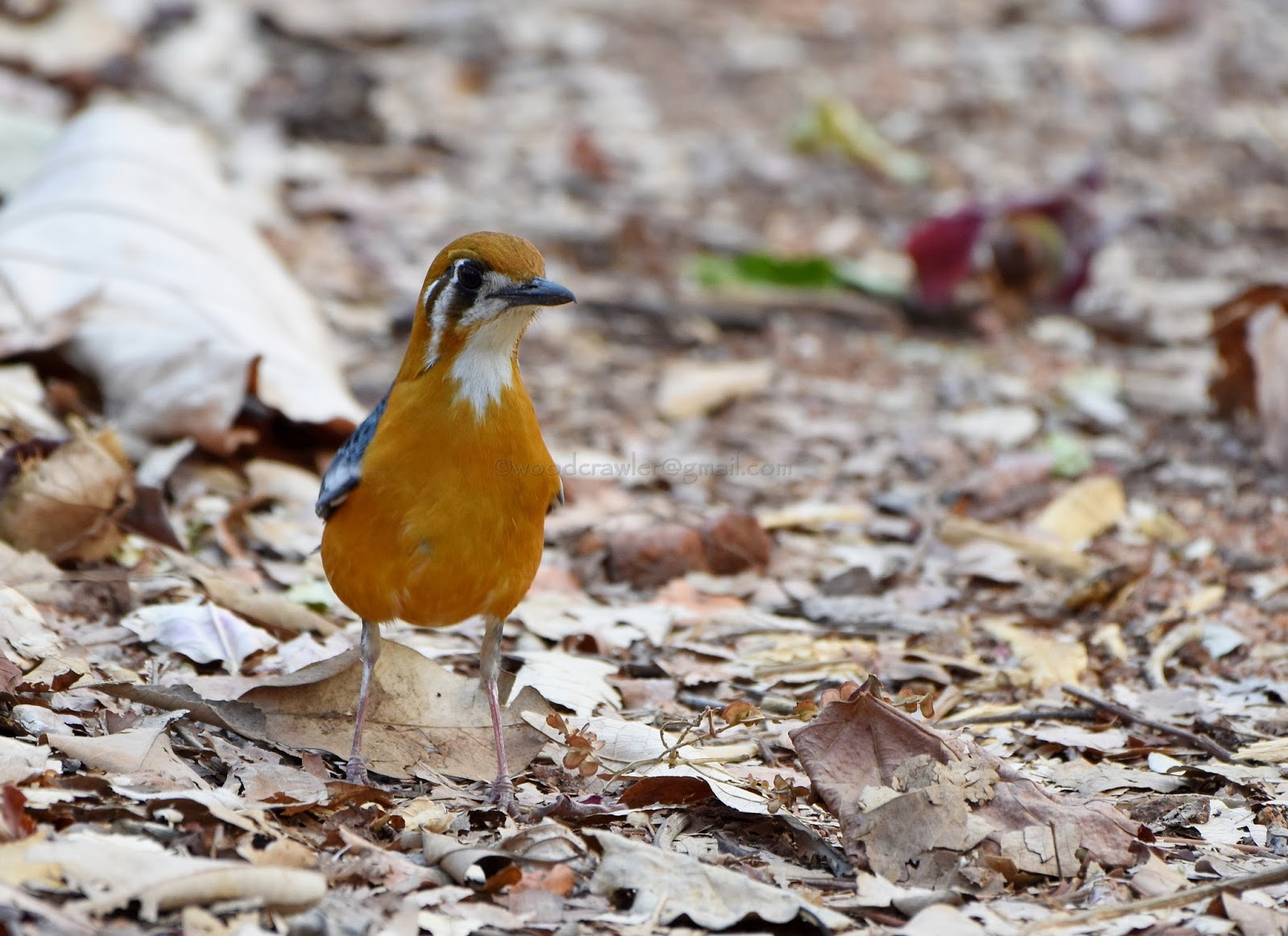

In fact, the orange headed thrush kept coming towards us, without any display of shyness, that it was in danger of being run over!. It was giving us a look that said, "Get out of my way you moron. You are driving over my dinner!"


Then it struck me that the third bird, further up the track, wasn't another thrush. The colours weren't matching!  As realization dawned, I was felt that familiar tingling that I get when I sight a tiger or a leopard because, to me, the Indian pitta is like a tiger or leopard of the bird world, rarely sighted and photographed. I had one in my sights but I was in an awkward position and in any case too jittery to shoot in failing light!


The bird was on my left and my car was facing the other way. I told my son to jump into the back of the car and grab the camera and fire away. After all it is not every day we run into a pitta willing to wait for us! The bird itself was unconcerned by our presence, throwing up the dried leaves and perhaps, searching for some succulent caterpillar or spider under them.


Meanwhile, the orange-headed thrush was almost under my car now and I hopped out to see if it was in danger of becoming a roadkill! It was within touching distance before it decided that I wasn't about to budge, and flew off to some other place grumbling about inconsiderate humans!


While the thrush had me engaged for a little while, the pitta seemed to have no interest in the proceedings. It was hopping about from one side of the track to the other, as it went forward, lifting up leaves and peering under them. It seemed it wasn't having a good day as we didn't see it catch anything. Since it wasn't appearing disturbed by our presence, I asked my son to walk ahead slowly with me rolling along behind him. The pitta had reached the end of the track and turned to fly back but realizing that there were some obstruction in its path, it chose to skirt us and land on a tree behind us, instead.


Now, the car and I were in the way of my son who had the camera. On the narrow track, he couldn't cross to the bird unless I reversed. I decided that reversing the car would spook the bird so I killed the engine and took the camera. As I stepped out from behind the car, the pitta decided to fly back onto the forest floor again!


The Indian Pitta is a ground bird, found foraging in leaf litter or in the under bush. They do roost on trees but make a nest on the ground or lower branches.Their call is a distinctive, two note whistle (whee - tiu) , that sounds like someone is choking the bird! They call at dawn or dusk, and the Tamil name, "aarumani kuruvi" (six o'clock bird) is apt for them. You can listen to the call here on the link from Xeno-Canto. They breed in the north-western Himalayan foothills and central India, but migrate south for winter. They are tiny birds and flying long distances exhausts them and sometimes they end up inside homes or offices!


In the meantime, our pitta decided that it was getting too crowded and uncomfortable for foraging, with two-legged creatures and four-wheeled contraptions running around in its territory. Passing motorists had also started stopping to see what I was up to, hopping around among the leaves on the forest floor! I had no sort of cover and was stepping from tree  to tree, trying to hide as much as possible, till I got sufficiently close. Unfortunately, the dried leaves crackling under my feet as I walked wasn't aiding my cause! The bird flew off again but this time, as if taking pity on us, it landed on a thick vine. The perfect perch!


I positioned myself as best as I could behind a thin tree, hoping it would hide my bulges! The bird was getting skittish with all the disturbance and I did not want to spoil its dinner any more than I already had. Cranking up the ISO, ( I had no time to dig out my monopod) I clicked as it posed for me, in all possible angles. Profile view, rear view and front view; I couldn't have asked for more.


I had finally got my pitta. An unexpected bonus, on my search for more nightjars, in Malampuzha. So tiny but packed with so many colours. In Sri Lanka, apparently, they interpret its call as a complaint by the bird of the theft of its clothes by a peacock! ("The Sinhalese interpretation of its call is that the bird is complaining about the theft of its dress by a peacock: “Evith giya, evith giya, ayith kiyannam, methe budun buduwana vita ayith kiyannam,” which translates as: “Came and went! Came and went! I’ll still be complaining when the next Buddha comes! I’ll still be complaining!” - Source  Wikipedia)

I wouldn't doubt that. It still is a beautiful bird, one of the prettiest around and perhaps any more colours would have made it too gaudy.

Sunday, January 31, 2016

Big Cat Magnet or a Lucky Talisman?

Pinks are Links

I have been doing the wildlife circuit for more than a decade and a half now and my first close encounter with a big cat in the wild came after 5 years of tiger tracking! Even after that, the few times I crossed paths with the big cats, were few and far in between. 

Then, in the January of 2015 I broke my 300mm f2.8, the best lens that I owned broke in two and my heart with it. I had mounted it on my E-M1 and it was the first trip with a new camera. It still rankles but then it seems there is a bright side to the debacle. It seems that this nightmare ordeal in the middle of a safari was the turning point in my woodcrawling life.

On that first trip with the E-M1 I met two leopards, not something I had experienced since April of 2010. The first one walked past when I was still recovering from the previous day's experience. I had an older 50-200 mm lens I carried as back up but forgot that all zoom lenses have a long ends to them! I got some pictures but it was too late by the time I realized that I was shooting at around 125 mm!! The very next morning, we had our second leopard of the trip and I, again, forgot that I had a tele-zoom and an in-body digital teleconvertor! So much for getting used to a prime.

Meanwhile, Olympus Japan sent me the Zuiko ED 90-250mm f2.8 as a replacement. I wasn't very keen on a medium telephoto zoom even if it was fast. I would have preferred my prime. This lens wasn't ideal for birds even with a 2x teleconverter attached. However, in combination with the E-M1 it was doing a much better job than with the E-M5. In addition, I started noticing, my big cat encounters suddenly was on the upswing! 

People carry many things on themselves that are purportedly, their lucky talismans. I never believed in such things personally and so never had one on myself. The next trip was to Kabini, in April of 2015. The E-M1 was now permanently mounted to the new lens and they seemed to make a fine pair. together. On that trip, we met the spotted one up close. This one was lapping up water from a puddle not 20 meters away, and then walked towards us before cutting across the track into the forest beyond.  


It was then that I started getting the feeling that something was happening. A big cat was always a bonus on any trip but this was becoming a habit. I didn't think much about it but then the feeling got reinforced on our next Bandipur safari. In August we did a combined Bandipur-Masinagudi trip with a friend and his family. Once again, late in the evening, we got a call about a tiger sighting. Predators don't wait for us; so we went, half expecting that the beast would have taken cover from prying human eyes. When we reached the spot he was still there, the Prince of Bandipur. 


He was one tiger I always wanted to meet but never succeeded in any of our trips. There he was lolling about in a mud puddle looking absolutely disinterested at all the excitement he was generating.  Once again, a very close encounter! I looked at my E-M1 and the new lens with a new found respect! They were a rocking combination! Four cats in three trips never happened to me before. More like one cat in five trips!

23rd October, 2015

The pull of the wilderness never goes away and if Skanda and I had half a chance, we'd be off. So the Pooja holidays of 2015 was just another excuse! We packed our gear and drove off to Bandipur. By now I had procured another adapter for my son and we were both using OM-Ds with four-third lenses. He had the Zuiko ED 50-200 mm f2.8 SWD on his E-M5.

Morning safaris are more for the birds but as we turned a corner on Wesley road, Bomma, our driver said. "Leopard." For a few seconds we were searching around us, and then we realized that the cat was in the grass ahead of us, marking territory as cats do!


We thought he'd slink away into the bush seeing us but it seemed he was out for a purpose. He got off the grass and onto the road.


Without hesitation he kept moving straight at us. Our presence was not going to dissuade him from advancing.


At one point he moved onto the grass in the middle of the track, sprayed on it, and kept coming forward.


He wasn't taking his eyes off us. Perhaps he was curious to know what we'd do.

Then, a few meters ahead of us he crossed to the other side and continued advancing.


Some 10 meters in front of our vehicle he veered of onto the grass, maybe realizing that we were not moving.


One withering look................


...............and a purposeful turn of the head before heading off away from us.

At touching distance he moved towards the lantana...........


...........and disappeared through a gap.

It was a great morning, and again I felt that the new combination of gear seemed to be having an effect on our opportunities for meeting the big cats, striped or spotted! With that overwhelming feeling we reversed to go onto a parallel track, hoping that this beautiful creature would appear again.

As we waited, he appeared from behind us and started stalking something in the bush.


I think the noise of the camera shutters furiously clicking annoyed him. He gave a single backward glance, as if to tell us, "Buzz off! I'm hungry!"


As we moved away leaving him to his hunt he resumed his stalking, of a chital herd, once again.


Whether he caught his breakfast, we never found out, but we sat for a very satisfying breakfast at the resort. That feeling about the E-M1 and the 90-250 mm lens working as a lucky charm was intensifying!  Ever since the E-M1 came, we had not had a trip without a big cat. Big Cat Magnet is seemed to be!!

Wednesday, November 04, 2015

Rendezvous with Royalty

Pinks are Links

The pull of Bandipur had become unbearable.

Our last trip there, was in January of this year and it was a disaster of sorts because my favourite lens, the 300mm f2.8, had broken at the mount. It was a devastating experience and I had just about recovered from it. I had been keeping off Bandipur because some painful memories would flood back if I reached the anti-poaching camp within the tiger reserve, the location of the breakage incident!

In the intervening months, I had been to Kabini, B.R Hills and Chinnar but Bandipur refused to relent and I finally gave in. Pooja holidays provided me an opportunity and with a friend's family for company, we went back our favourite corner in the world.

27th August, 2015
An encounter with a bull elephant in musth at the start of our first safari, seemed to be the highlight of the day and we were on the last half hour of the evening safari when the call came. There was a tiger at a waterhole! Without wasting valuable time we headed towards where the action was, Moolapura. Tigers would not be comfortable in the presence of humans so we were not really expecting it to wait for us. However, when we reached the spot, we were greeted by the sight of the big cat soaking itself in the muddy water.


It seemed that it had fed well and was cooling off its systems in the water. We weren't sure if it was a male or female but the tiger (or tigress) was not looking disturbed by our presence. Cameras were clicking away furiously on all sides but the rattle of the shutters didn't seem to annoy the beast. Then, suddenly, it came to life.


It lifted it's big head and folded its rear legs as if to get up. Perhaps all the noise from our vehicles and excited visitors had annoyed it.


Then after a moment's hesitation it laid its head on its paws and lay down again. It seemed it was too full to move.


 With a great deal of effort it lifted it's head and turned its gaze towards us. I gasped! It was instant recognition. 

I was in the presence of His Royal Highness, the Prince of Bandipur! He fixed us with a baleful glare, as if he was saying, "Why can't you leave me in peace?" I recognized him, Prince; the most photographed tiger in Bandipur and the King of all he surveyed. The unmistakable feature was the cleft in his upper lip on his right side. Possibly a legacy of some fight for territorial rights.


After a momentary exchange of glances, which literally left me with jellied knees, he dropped his head again.


Then for another brief moment he lifted his head, looked up, sweeping all the parked vehicles with heavy lidded gaze before slumping down again to catch up with a disturbed dream!


For a full 20 minutes we were all transfixed by the sight of the Prince. I forgot my gear, and kept clicking away without changing any setting. Occasionally he would lift up his head and look at us, as if asking, "Why are you still hanging around?"


Then finally, maybe in disgust, he turned away and put his head down on his massive paws and resumed his slumber. Only the occasional twitch of his tail betraying his irritation with us and the flies buzzing around him!


It was past 6.30, time for the park gates to close. When we left him, he was still facing away soaking in the brown water.

It was the best encounter I had with a tiger in the wild, and the longest. It seemed that the new Zuiko 90-250mm f2.8 was proving lucky for me!