19th July 2023. 6.30 AM to 2.00 PM
Terith - Agham - Durbuk - Tangtse - Chilam - Harong - Muglib - Spangmik
The next stop in a typical itinerary is the Pangong Tso lake. This high altitude lake, located at an altitude of around 14,000 feet (4250 metres), is a salt water lake that straddles the disputed territory between India and China. The lake is around 130 kilometres long, extending from Ladakh in the east to Tibet in the west. About a third of it is in India and the rest in Tibet. About 10% east of the LAC is the disputed territory.
To reach this lake there are two options. You can drive from Leh (about 160 kms) on a day trip which is what most people who go to Nubra valley and return to Leh, usually do on the next day. The downside of a day trip is that you'll be able to spend only a couple of hours at the lake, during the hottest part of the day. The best time at Pangong Tso is around sunrise and sunset, when the lake goes through various shifting colours. To enjoy that, a night's stay is an absolute must. (I credit this idea to my friend Lijo, who travelled through Ladakh on a scooter!) So, a better option, if you are driving from Leh, is to stay over and return the next day. In any case, a one way trip itself takes about 5 to 6 hours over the Chang La pass, so if you are doing a day trip, you will be on the road all day.
The other option, for people who travel to Nubra valley from Leh, is to drive directly from Diskit or Terith, to Pangong. It is about the same distance and will also take about 6 hours. When you drive directly from Nubra valley, you save on taxi fare as the extra distance traveling back to Leh and then going to Pangong Tso next day, is avoided. Also an additional night stay at Leh can be reserved for a stay in Pangong. The only problem was that the usual road from Diskit was undergoing up-gradation, so we had to drive over a non-existent road literally.
Since this was our option, Tsewangji had told us that we'd have to leave early. Other drivers had told him about the road going underwater as the heat melted the snow faster as the day progressed. We knew then, that we were in for an exciting drive so we got breakfast packed and left our resort at 6.30 AM. A few kilometres after our resort, we got onto a track than ran on the opposite bank, parallel to the river. Instead of crossing the Shyok towards Khalsar, we took the road that ran along the northern bank of the river, towards Rongdu.
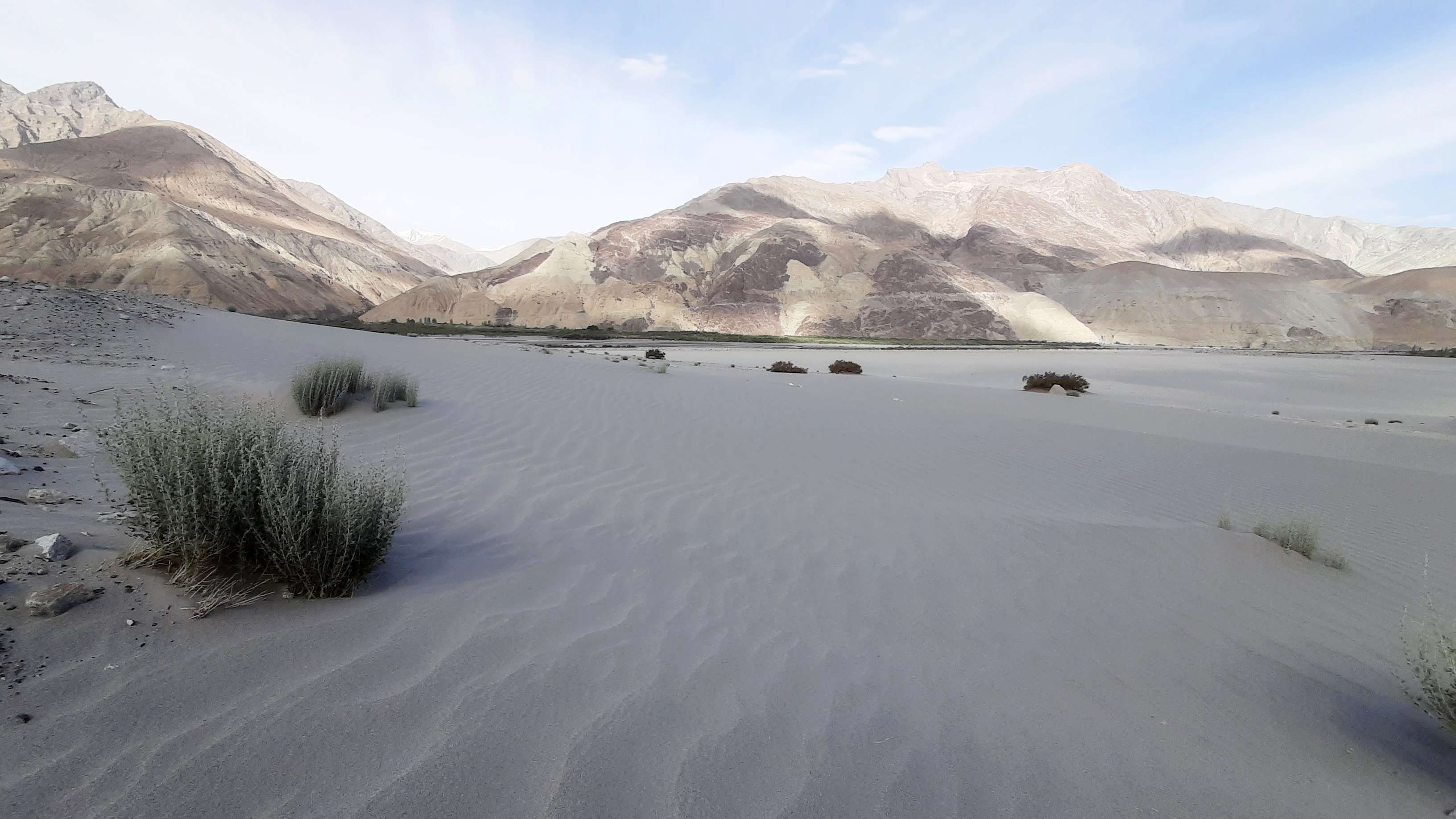
The day we were travelling, the rain seemed to be holding back. The only problem was that it would get really hot as we neared Pangong Tso. There were patches of exposed asphalt but in most places the road was covered in sand. We were in for a surprise though. Our experience at the Hunder dunes had been a tad disappointing. A little after, Tsati village, we found more dunes on the road edges! This time, they were totally undisturbed.
Progress, on the road that was playing hide-and-seek with us, was relatively slow. The clouds were still hovering above us but the absence of rain was a relief. For now, the fear of being held up by the rising waters of the river was dissipating.
The landscape was awesome, reminding me of the Wild West in Clint Eastwood movies but without the Stetson clad cowboys. It was a real contrast to the greenery that we were used to at home. No trees were visible for miles. The only greenery being the short thorny shrubs, herbs and grass. It was only along the river banks, around small villages and hamlets that trees were seen growing.
Eventually, just before Rongdu, the road split. The one going straight goes to Rongdu and the one going right, over the Shyok would reach Agham. Luckily there was a bridge across the Shyok so the crossing was easy. We had planned to stop near Agham for breakfast as a tea would be welcome after a long bumpy drive. The guys at the hotel were kind enough to let us use their furniture to eat breakfast. It was getting warm so we also got some cold drinks to carry on the rest of the journey.
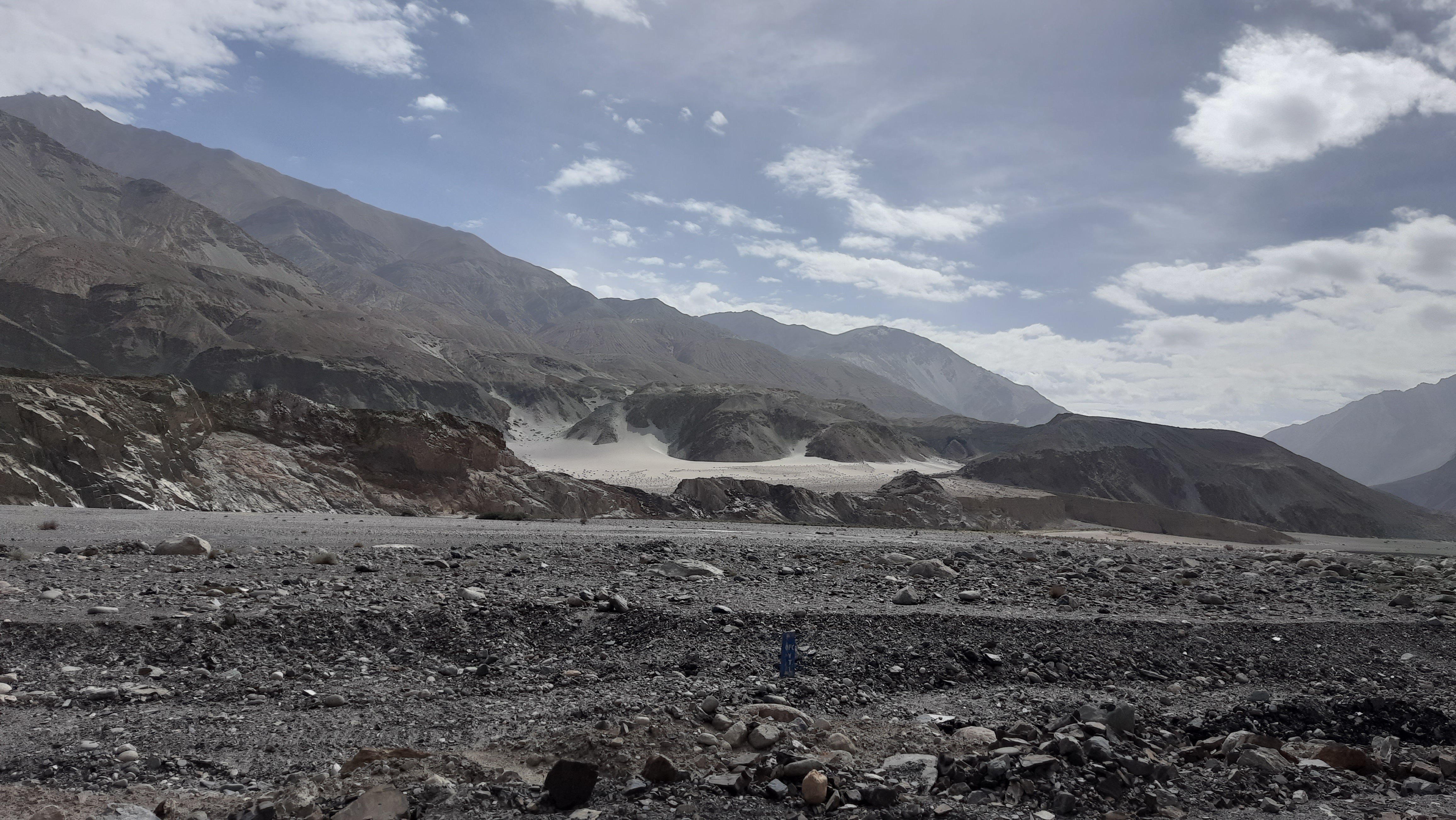
After Agham the road disappeared altogether. It was only rubble. The work on the new road didn't spare the old one. It was dug up and in the process of being freshly laid. Luckily traffic wasn't heavy so while we were raising dust behind us, we were not made to eat other's dust!
The muddy water's of the
Shyok was flowing alongside of us towards the Nubra Valley. It
was looking menacing and we didn't want to be stuck somewhere unable to cross it. As the sun warmed up the landscape, our imagination was also running wild. The waters of the Shyok seemed to be rising each passing minute!
The road was still winding along the river, matching its twists and turns till we reached an area where the two ranges of the mountains closed in around us. It was not the most comfortable experience with boulders strewn on either side. On our left, the walls of loose rock and sand threatened to come down any minute. This feeling was reinforced after we crossed the road gang of the Border Roads Organisation (BRO) clearing up recently fallen rocks!
Eventually, the road again crossed the river and moved to the opposite side. Here it was almost in the middle of the river so the threat of falling rock was not there anymore.
The joy, however, was short lived! The flowing water had done its worst. We had to make our own road because the asphalted road was nowhere to be seen. It was covered with tons of rock and flowing water!
It wasn't an easy drive but it certainly was one hell of an experience. We were glad that we had the fortune to hire Tsewangji's taxi. He was a really cool and unruffled character. He wouldn't go scrambling across the rocks hastily. He got off the car to inspect the track ahead before his tyres crossed that stretch. We realized the value of having a driver like him when we ran across a stranded car. It seemed that the driver, in an adventurous mood, decided to go over some submerged rocks without first checking if it was possible! His rear tyres were now floating without touching the ground as his car had dug its rear wheels among the slippery rocks, and had bottomed out.

Our car had a tow rope but we didn't have a 4 wheel drive so it was unlikely that we could get him out of his predicament. Unfortunately, the couple inside seemed to think it was a part of their package! While a few strangers were trying to help them in the blistering heat, they were cosily sitting inside. Only after they realized that their weight was adding to the problem, did they get out. Their stars, it seemed, were aligned perfectly. A group of motorcycle riders we crossed a little earlier, had a back up vehicle following them. It was a pick-up truck with 4 wheel drive. The stranded car was tied to the truck and it was happily dragged out. Tsewangji allowed him to hang on to the tow rope, just in case. He would collect it later.

We made it to Tangtse without further adventures, where we filled up on fuel for the car at what is claimed to be the highest petrol station in the world. Then, since we weren't hungry yet, we decided to take a short diversion to Harong through Chilam. I was hoping to land a few birds. It wasn't my day. The weather was not getting any better. It was too hot inside and outside the car and probably the birds agreed too. They weren't active even along the banks of the stream that was flowing towards the Shyok.
It was half past twelve so we decided to go towards Pangong Tso and lunch. We had to return to Tangtse and take the Pangong road that would pass through Muglib.The road on this final stretch to Pangong Tso is also undergoing widening.
The river here had much less water than the Shyok. Along the way, grazing on the patches of green grass on the edges of a tributary of the Shyok were herds of
Changthangi goats, the source of the wool used to make the highly prized
Pashmina (Cashmere) fabric.
We finally arrived at the western end of the lake around half past one and since our lunch wasn't arranged at our resort, decided to stop in Pangong for a meal. It appeared that our luck was running out. It was very hot by then but there were clouds that heralded rain. Our plans for a second round of Milky Way shooting seemed at risk.
As we drove towards Spangmik, where we were supposed to halt for the night, the first of the hundreds of tents and cabins on the lake's shores came into view. There are a few hundred (or maybe even thousands) of such tented accommodation all along the lake road. I was told that a little bit of bargaining would bring the room rates down significantly; especially in the beginning and towards the end of the tourist season. We had booked into a place that had wooden cottages because someone had told us that the nights would be freezing cold due to the sub-zero temperatures and the windy nature of Pangong's shores.
For a place located 14,000 feet above sea level, it was disappointingly warm. We hoped that Spangmik would be different. More of our Spangmik experience in the next post.