For those who came in late:
This is a tale of Mrs & Mr. Hornbill whom I had the chance of getting to know a couple of years ago. I had been just a casual acquaintance of theirs but things changed over the last six months. I have had the rare privilege of being witness to their courting, mating, confinement & birth of their two chicks. If you are not the impatient type, I suggest, you
go back to the last post here.
You'll find the links to all other posts in this series on the top of the page in that previous post. I have deliberately avoided putting the links here because this post is unique. I have, over the last six months, shared the joys & sorrows of parenting that these hornbills went through. I want people who have been following this post not to get distracted at this truly important point in time.
The events in this final post, on this pair's activity this season (2013-2014), happened over a period of five days, from the 13th to the 18th of May. This particular post is longer than the previous ones, and rightly so, though this covers only one tenth of the entire breeding season of the hornbills. Please bear with me.
13th May, 2014
It seemed to me that
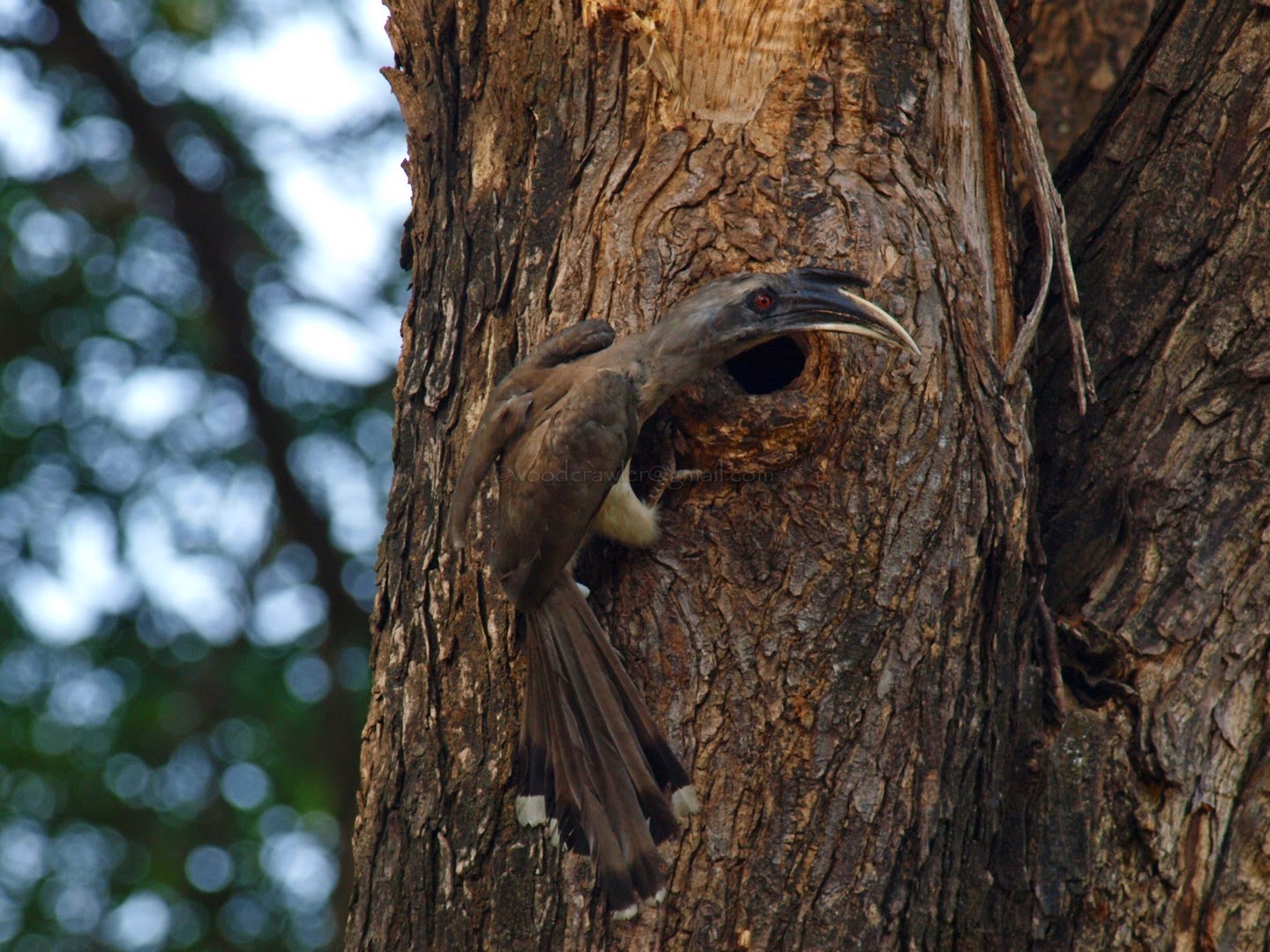
the parents had decided that it was time for the chicks to move into the real world. There was a drop in the frequency of feeding. Though the parents were always in the vicinity of the nest they rarely responded to the cries of the chicks. They were maintaining a certain aloofness that suggested they wanted the chicks to venture out of the protective walls of the nest if they wanted food.
The little ones would poke a beak out and keep looking out for their parents without knowing that they would be sitting on a branch somewhere above them!
14th May, 2014
Children can be stubborn and hornbill my chicks were no different. They
were not playing ball. Other than just craning their necks out of the
hole they refused to budge out of their cozy nest.
When the exasperated mother once tried prodding them out with a piece of bark, they only became more adamant.
Sometimes they seemed to realize that the parents were sitting above them and so every now and then they would make their pleading cry and look up expectantly.
The mother knew that her plan wasn't working so she tried another strategy. She would go and sit at the edge of the hole with a tempting fruit in her beak. She would make no attempt to give it to the chicks. After waiting for a few seconds she'd fly back to her perch on the overhanging branch and wait expectantly.
Even that ploy was a failure. It seemed that the more the parents tried to induce the chicks to get out, the more they refused. Occasionally, the parents would succumb to the pleading cries and give the chicks a small meal. This, however, happened only rarely. The parents seemed to realize that their only chance of success was keeping the chicks hungry!
Both the parent's and the chicks were playing a game. The question was,
who would blink first?!
So far the chicks seemed to have an upper hand. The adults went off to roost on a branch a little farther away and perhaps rethink their strategy to get the chicks out of the nest.
15th May, 2014
It was apprent that
the curtains were coming down on the hornbill breeding season. The other pair on the casuarina tree that I had seen earlier came for the last goodbye. I haven't seen them since.
The hornbill near my house too came to say farewell for the season!
For my pair, however, it was another day of relentless effort. They seemed to have run out of ideas. The mother hadn't given up the tempt-with-fruit strategy but I wasn't sure it was working.
The mother bird would put her head inside and try to coax her babies out but it seemed they were still acting stubborn, or so I thought.
She repeated this act a few times but the chicks didn't seem to show any interest in moving out of the nest. As a matter of fact, they did not peep out from their nest at all, that morning!
The pensive parents would just sit on their regular perch above the hole and keep calling. I started getting worried. Almost an hour of waiting the chicks hadn't peeked out or cried for food. Had they flown away? I would know tomorrow.
16th May, 2014
I unpacked my camera and trained the lens on the hole. It was my usual habit. The reach of the 600mm would let me know when the chicks were moving inside the darkened tree hole. Today I was in for a shock.
What popped out of the hole was not a hornbill chick's beak but a whole bird; a myna!
Papa hornbill was sitting on the end of a broken branch and after the myna took off he bent down as though to see if he really saw a myna!
It certainly was a myna. It went and perched itself above the hole as if to assert itself.
The female hornbill was on another tree, looking despondent but the male was still hoping that his chicks would come out of the nest.
Just to be sure, he went down to inspect the nest while the mynas cackled angrily from above.
The female kept a safe distance since the mynas were especially rude to her, chasing her away every time she came near the nest. It was the male who was now trying to make the little ones come out.
The
attitude of the mynas had changed. They were acting like they had achieved something. Though they were wary of approaching the male hornbill
they'd ruffle their feathers and act like Tarzan of the Apes after he succeeded in subduing an animal in a fight...............
.................. complete with the scream and waving of their wings, like Tarzan beat his chest and let out his famous victory yell!
The mynas were now entering and exiting the nest with impunity and I realized that the chicks were not in the nest anymore.
My manager, who has by now become an expert in hornbills, told me that he had seen the mynas chase the two chicks away in the morning. They had also thwarted an attempt by one of them to get back inside. According to him the chicks had flow to another tree some 100 meters away.
I was not sure if the parents were waiting for the chicks to return or whether they still thought that the little ones were in the nest.
After a while it became evident that they too realized that the mynas were occupying their nest because their children had been driven out. They were going down to the hole on the broken branch where the mynas had been nesting temporarily and inspecting it.
I couldn't tell if they were searching for their chicks or simply seeking to avenge their loss by destroying whatever was in that nest.
Perhaps it was already too late. The mynas were doing their own cleaning up. They would pop in, pick up something and come up and throw it out.
17th May, 2014
Suddenly there seemed to be a whole horde of bullies. Mynas were gathering together and heckling the hornbills.
The hornbills, on their part, bore everything in dignified silence. The were flying between the trees in the immediate vicinity calling out and searching for their little ones.
There was no sign of the little ones still. I could only pity the parents.
After three months of patient vigil I was left wondering who felt the chick's absence harder, the father, mother or I!
I am sure, dear reader, that you too are left a little shaken & shocked by the turn of events like me. I am praying that the chicks are fine somewhere and the parents will be united with them eventually.
I have packed my gear and carried my tripod back home. I've not given up just yet. It is that
a long awaited trip to Bandipur is around the corner and I have to get my gear in shape. I'm hoping that during the intervening period my hornbill family will be reunited.
EPILOGUE
Nothing happened on the 19th of May. Literally nothing. I was not greeted by the raucous calls of the hornbills outside my window when I woke up. It was like the hornbills had switched off till the next season. At my post near my hornbill's treehole it was only mynas, drongos and crows now. There were no hornbills to be seen or heard.
On 20th May I carried my camera again hoping something would have turned. Turn it did but not in favour of the big birds but for the little resilient mynas. The hornbills were still there; the male flitting from tree to tree restlessly. I watched the mother sit and wait, hoping her little ones would come back. She made no attempt to go near her former nest.
It was the mynas who were going about their jobs as if nothing had happened. It had come full circle. They had been driven out of their nest in November and for six months they had to make do with a temporary home. Summer is bidding good bye and the monsoon is gathering. It rained today.
To the mynas it is a signal to get their house in order.
I watched as one dipped inside and came out with an orange thing in its beak. A remnant perhaps, of the succulent looking fruit papa hornbill had got a few days ago. The myna flew out with it, knowing well that its house would belong to her for the monsoon.
The hornbills would return in late October. That was a very long time away, especially when measured in terms of a bird's life. Turf wars were over for the season. It would start all over again when the rain tree started shedding its leaves. Till then peace would reign on the tree in the old depot.
I'm only hoping the would still be there next season. The track replacement work has pick up speed again and this tree looks like it is standing in the way of the grand plans of the railways!

DISCLAIMER:
- The entire series of blogs from late October 2013 till mid-May 2014 have been shot with an Olympus E3 DSLR with a 300mm f2.8 + EC20 2x tele-convertor attached & OM-D E-M5 with a M.Zuiko 70-300mm lens.
- The shooting was done from the rooftop of a building about 60 meters away. The nest was never accessed or disturbed in anyway.
- No flash photography was done.
- The birds, both adult & chicks were never disturbed or handled at any time during this period.
- No intervention happened to disturb the natural course of events.
- All events have been presented in chronological order.
- I don't claim to be an authority on the nesting or breeding habits of the Indian grey hornbill.
- This is only a record of my observations over a single breeding season of a single pair of hornbills as they unfolded before me.