Monday, June 13, 2016

OF BIRDS, BIRDERS & The PALGHAT GAP - Part 2

My obsession with birds are reaching a new level that I've taken to carrying a bird book or field guide wherever I go. In fact, my collection has swelled recently (more about it later, but you can read about the early days here) that I can keep a book in each of my cars and backpacks and still have a few lying around!

Sometime in the late 90s the wilderness bug bit me and the effect has not left me since. I was a 'tigertracker' initially but in 2001 I started a Yahoo group; the Woodcrawler's Den, which was taken over by a hack, and I never managed to recover it. My first linking with serious birders was through this group, and one of them has become a good friend and comrade in arms on our trips into Malamapuzha's forest fringes. The irrepressible Namassivayan Lakshmanan!

Malampuzha Dam, in Palakkad District of Kerala was commissioned in 1955 and is the largest irrigation reservoir in the state. The dam, almost 2 kilometers long has a catchment area of close to 150 square kilometers. Situated on the Palghat Gap, the reservoir is hemmed in by the low hills forming the northern edge of the Palghat Gap. It is fringed by the moist tropical forests of the deciduous and semi-evergreen types and has a rich biodiversity. 

When I say I have been wandering around Malampuzha almost every week, it is in these fringes and NOT in the famous Malampuzha Gardens. As a matter of fact In the last twenty years I have been inside the gardens about 5 times, but I have stopped counting the visits to the forests!

Sometime in early 2008 I laid hands on my first DSLR, the Olympus E3. It was a shift from the prosumer Fuji Finepix to the next level, as the wilderness bug had bitten me well and truly hard. The yearning to run off to the wild become a full blown disorder! As is natural with all wannabe nature photographers, in their early days, the tendency to shoot anything that moved afflicted me too.

With a digital camera, the worry about cost of film, developing negatives and printing some unprintable photos was gone. Earlier, the worry about film was a restriction on shooting but with the dawn of the digital age, that was gone. With a DSLR that could shoot at a respectable 8FPS, worries evaporated. Kabini and Bandipur were too far away for a day trip and also a little heavy on the pockets. That is when I discovered the forests around Malampuzha.

Most of the initial forays were in the Kava area. In summer, as the reservoir dried we'd drive inside it, otherwise we drove around the road along the edge of the reservoir. It was most often raptors and water birds that I 'noticed'. Perhaps their larger size and visibility in the open spaces ensured that I noticed them.


Then as we drove around we started noticing that there were smaller ground birds that had hitherto not been noticed because we were novices and small birds were less interesting perhaps.


Once out of the reservoir our eyes were now scouring the trees, bushes and electric lines. That was an even bigger treasure trove of birds.


That was then my birding eyes really opened. It suddenly dawned on me that I had been missing so much. My jungle trips were much too tilted in favour of the mammals, that birds were considered incidental. Everything changed from then on. Malampuzha transformed me. I realized, unlike mammals, I did not have to look for birds. One or two were always around. It was hard to avoid them,in fact. It was just that we took them so much for granted.

My birding eyes then realized that there were little patches of forests on the side of the road around the reservoir. It was time to explore a little further, but that is for the next post!

Saturday, April 30, 2016

Of Birds, Birders & the Palghat Gap - Part 1

It's been a while since I tread the blogging trial, and with good reason. I've been afflicted!
I think I have a type of Obsessive Compulsive Disorder (OCD) that centers around creatures with feathers. OCD is defined as a common, chronic and long-lasting disorder in which a person has uncontrollable, recurring thoughts (obsessions) and behaviours (compulsions) that he or she feels the urge to repeat over and over.

For a while now, my thoughts have been centered around birds. Earlier, woodcrawling always included everything in the woods but now I brake suddenly on my drives when a feathered creature whizzes past. So much so, that the risk of getting rear-ended by someone driving behind me is going to become a reality sooner than later. I'm only hoping that the unfortunate soul, who might slam the butt of my car, will think that I'm just a crazy guy with a crazy obsession!

Ever since I spoke on bird-watching to our local ophthalmic association's members and family, I have suddenly found people recognising me in restaurants and other places as 'that bird chap'. They don't even remember my name! For God's sake! I have a name, a nick name and I also like to watch tigers, leopards, elephants and other myriad creatures of the jungle!

Of course, it is undeniable that, what once was an occasional pass time has now become an obsession. I'm overcome by jealousy when my brothers in arms are able to run off after the feathered kind any time they choose, while I'm stuck in my consulting room wrangling with patients. 
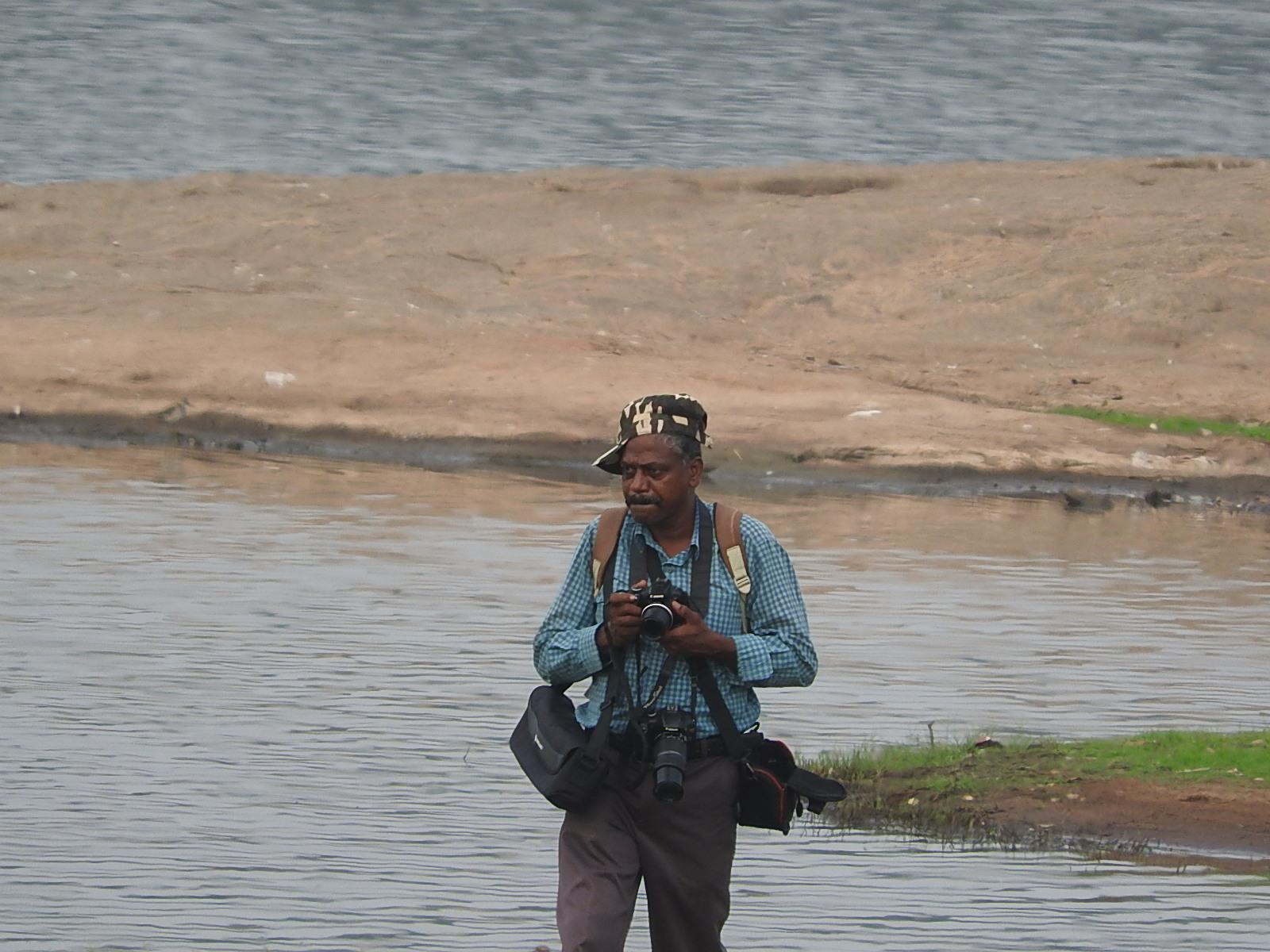
Adv. Namassivayan Lakshmanan (Pic courtesy: Namassi in the pic)

Venugopalan Raghunathan

The two gentlemen above feel that best way to watch birds is to let them come to you. Choose a strategic spot, park yourself in a portable chair and tune up the binoculars. They will come fluttering around as long as you don't make sudden moves!
Sometimes, the legs have to be given a bit of exercise while in pursuit!
Venugopalan Raghunathan & Gopal Prasad 
Occasionally you have to pick your way over rocks or wade through a stream to catch up with the certain species, but it is truly well worth the effort. Sometimes, the summer sun beats down mercilessly; especially when you are searching for water birds in the middle of a reservoir that has little water after a long hot summer. A little bit of sun burn or heat exhaustion is nothing compared to seeing and recording the presence of a bird that makes its rare or seasonal appearance at the spot you have been haunting!
Gopal Prasad

Krishna Moorthy, the teacher with a willing pupil


I had been wandering around the fringes of the Malampuzha reservoir for the last few years documenting the birdlife around and within it. Then, after linking up with the gentlemen above, I realize, I have only taken baby steps into the fascinating world of birds. Compared with the others of my birding group, I'm a novice. While they identify birds by calls and look only for confirmation; I have to look, listen and often refer the manual to be sure. Sure, I'm learning, but it is slow progress!  
 
 THE PALGHAT GAP
If you try Googling for birding sites in Kerala, the first one that always pops up is Thattekad & Salim Ali bird sanctuary. Arippa, Kadalundy & the Kole lands of Thrissur will also figure somewhere in the list. Palakkad or Palghat as it was called, rarely figures in any birder's radar except for Silent Valley NP and Parambikulam tiger reserve.

 The Palghat gap is a 30 kilometer break in the Western Ghats, flanked on the north by the Nilgiri Biosphere Reserve and on the south by the Anaimalai hills. The northern part of the gap is a natural boundary between Kerala and Tamilnadu. At the edge of these slopes is the Malmapuzha reservoir, surrounded by forests that teem with wildlife that includes large and small mammals, and a vast variety of birds. 

While I was happy to be looking for the birds on the forests bordering the reservoir and lying on either side of the roads, there was one gentleman; who, more than any other, opened up the possibility of exploring beyond the borders, Mr. Green Dinesh.


Green Dinesh (Pic courtesy: Namassivayan Lakshmanan)


Green Dinesh with Gopal Prasad

 Once we discovered that there were small unexplored pockets just beyond the ends & edges of the road our birding legs took us further afield, opening up a hitherto undiscovered treasure house of birds in our own backyard, the Palghat Gap


The rest of this series will attempt to give you a glimpse into this journey of discovery for a small team of ardent birders. Perhaps a day will come when this small area will see its name on the birding maps of the world, and wouldn't it be nice to be credited with the discovery!

Sunday, January 31, 2016

Big Cat Magnet or a Lucky Talisman?

Pinks are Links

I have been doing the wildlife circuit for more than a decade and a half now and my first close encounter with a big cat in the wild came after 5 years of tiger tracking! Even after that, the few times I crossed paths with the big cats, were few and far in between. 

Then, in the January of 2015 I broke my 300mm f2.8, the best lens that I owned broke in two and my heart with it. I had mounted it on my E-M1 and it was the first trip with a new camera. It still rankles but then it seems there is a bright side to the debacle. It seems that this nightmare ordeal in the middle of a safari was the turning point in my woodcrawling life.

On that first trip with the E-M1 I met two leopards, not something I had experienced since April of 2010. The first one walked past when I was still recovering from the previous day's experience. I had an older 50-200 mm lens I carried as back up but forgot that all zoom lenses have a long ends to them! I got some pictures but it was too late by the time I realized that I was shooting at around 125 mm!! The very next morning, we had our second leopard of the trip and I, again, forgot that I had a tele-zoom and an in-body digital teleconvertor! So much for getting used to a prime.

Meanwhile, Olympus Japan sent me the Zuiko ED 90-250mm f2.8 as a replacement. I wasn't very keen on a medium telephoto zoom even if it was fast. I would have preferred my prime. This lens wasn't ideal for birds even with a 2x teleconverter attached. However, in combination with the E-M1 it was doing a much better job than with the E-M5. In addition, I started noticing, my big cat encounters suddenly was on the upswing! 

People carry many things on themselves that are purportedly, their lucky talismans. I never believed in such things personally and so never had one on myself. The next trip was to Kabini, in April of 2015. The E-M1 was now permanently mounted to the new lens and they seemed to make a fine pair. together. On that trip, we met the spotted one up close. This one was lapping up water from a puddle not 20 meters away, and then walked towards us before cutting across the track into the forest beyond.  


It was then that I started getting the feeling that something was happening. A big cat was always a bonus on any trip but this was becoming a habit. I didn't think much about it but then the feeling got reinforced on our next Bandipur safari. In August we did a combined Bandipur-Masinagudi trip with a friend and his family. Once again, late in the evening, we got a call about a tiger sighting. Predators don't wait for us; so we went, half expecting that the beast would have taken cover from prying human eyes. When we reached the spot he was still there, the Prince of Bandipur


He was one tiger I always wanted to meet but never succeeded in any of our trips. There he was lolling about in a mud puddle looking absolutely disinterested at all the excitement he was generating.  Once again, a very close encounter! I looked at my E-M1 and the new lens with a new found respect! They were a rocking combination! Four cats in three trips never happened to me before. More like one cat in five trips!

23rd October, 2015

The pull of the wilderness never goes away and if Skanda and I had half a chance, we'd be off. So the Pooja holidays of 2015 was just another excuse! We packed our gear and drove off to Bandipur. By now I had procured another adapter for my son and we were both using OM-Ds with four-third lenses. He had the Zuiko ED 50-200 mm f2.8 SWD on his E-M5.

Morning safaris are more for the birds but as we turned a corner on Wesley road, Bomma, our driver said. "Leopard." For a few seconds we were searching around us, and then we realized that the cat was in the grass ahead of us, marking territory as cats do!


We thought he'd slink away into the bush seeing us but it seemed he was out for a purpose. He got off the grass and onto the road.


Without hesitation he kept moving straight at us. Our presence was not going to dissuade him from advancing.


At one point he moved onto the grass in the middle of the track, sprayed on it, and kept coming forward.


He wasn't taking his eyes off us. Perhaps he was curious to know what we'd do.

Then, a few meters ahead of us he crossed to the other side and continued advancing.


Some 10 meters in front of our vehicle he veered of onto the grass, maybe realizing that we were not moving.


One withering look................


...............and a purposeful turn of the head before heading off away from us.

At touching distance he moved towards the lantana...........


...........and disappeared through a gap.

It was a great morning, and again I felt that the new combination of gear seemed to be having an effect on our opportunities for meeting the big cats, striped or spotted! With that overwhelming feeling we reversed to go onto a parallel track, hoping that this beautiful creature would appear again.

As we waited, he appeared from behind us and started stalking something in the bush.


I think the noise of the camera shutters furiously clicking annoyed him. He gave a single backward glance, as if to tell us, "Buzz off! I'm hungry!"


As we moved away leaving him to his hunt he resumed his stalking, of a chital herd, once again.


Whether he caught his breakfast, we never found out, but we sat for a very satisfying breakfast at the resort. That feeling about the E-M1 and the 90-250 mm lens working as a lucky charm was intensifying!  Ever since the E-M1 came, we had not had a trip without a big cat. Big Cat Magnet is seemed to be!!