The elephant is a pet obsession of every Malayali. It would be difficult to imagine a temple festival without an array of caparisoned elephants. From a single tusker to as many as thirty, depending on the size of the temple's coffers, these decked up pachyderms are one of the attractions of God's own Country!
(As usual Pinks are Links!)
Unfortunately for most, if not all, of these elephants the period of musth, is a torture. During musth these normally gentle creatures become masses of seething anger and viciousness. The captive elephants are chained, isolated, and starved or tranquillized with the idea that it will curb their killer instincts. Nothing can be farther than the truth. I read
an interesting chapter from the book 'Practical Elephant Management; A handbook for Mahouts, which mentions the ways to handle a captive elephant in musth! For a true elephant lover it reads like a horror story!
Sometime in March this year,
Gajendra, a tusker belonging to the Karnataka Forest Department, killed its mahout and fatally injured another tusker Sri Rama. Both these elephants were stationed in K Gudi, B R Hills and were regulars during the Dasara festivities in Mysuru. Like all tuskers, Gajendra too went through cycles of musth but had never attacked anyone so far. When I went to B R Hills this year,
I saw a forlorn Gajendra, perhaps filled with remorse at his action that resulted in the death of two of his closest associates; his mahout and fellow pachyderm. It was two months after the tragedy but it seems,
the elephant's emotional upheavals had not subsided yet.
 |
| A remorseful Gajendra |
I know I must be right because
this has been mentioned in an article by A.Rajaram, published in
Resonance, a journal of the Indian Academy of Science, Bengluru.
 |
| Looking like he lost his best chums |
27th September, 2015
Turning the clock forward to Onam vacation 2015. We were in Bandipur for three days and on the first trip out into the forest, going down the Mysuru-Ooty highway, we ran into a
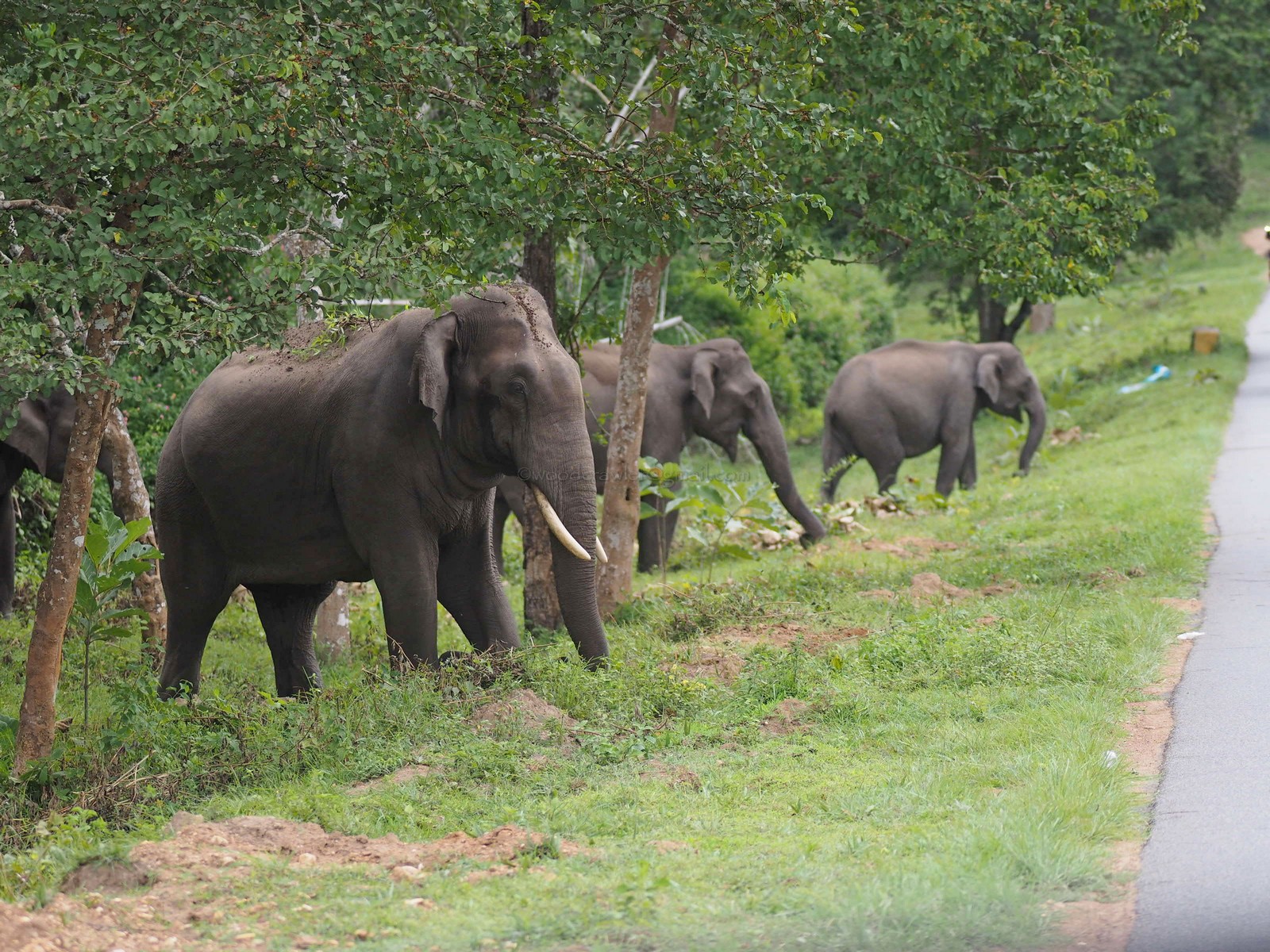
herd of elephants. There were seven of them, grazing on either side of the road. Two tuskers with females, sub adults and a calf were feeding in the succulent grass growing on roadside after the rains.
One
young tusker was on the right side of the road walking parallel to our vehicle. He broke into a hurried run to overtake us.
 |
| This male was separated by the road from the highway |
Once past us he turned towards a gap in the impenetrable wall of lantana, perhaps going towards the large pond a little further off inside the forest. It was quite a warm afternoon and a leisurely soak was in order.
We had halted just before reaching the main herd of
six elephants, including the other magnificent male who appeared to be in musth.
 |
| The rest of the herd |
 |
| The tusker in musth. |
All
the elephants looked in prime health unlike the ones we saw in Nagarahole in May.
The only aberration was this big male, who had the obvious patch of wetness between his eyes and ears, the secretion from his musth gland. The sight of a tusker in musth is sufficient to sent an average human being into a tizzy. That is because of the disrepute captive tuskers have earned with their behaviour during periods of musth.
I hope the brief description that follows, at the end of this post, about the mating behaviour in elephants, will help dispel a few myths about elephants in musth.
Meanwhile, we were watching the younger male on the right of the road. He abruptly turned back, strode purposefully onto the road and proceeded to cross it. Obviously,
the females had communicated with him, either by means of infrasonic rumbles which the human ears cannot hear, or by seismic vibrations.
 |
| The young tusker crossing to rejoin the herd |
 |
| He seemed to be reassuring them to remain calm |
 |
| He walked unhurriedly to where the herd was gathered.... |
 |
| ....and joined them. |
As we were watching this peaceful scene one chap on a motorcycle decided that it was safe to go, but the matriarch wasn't to pleased. She
gave a mock charge to hurry the rider on his way
 |
| "Get away you moron!" |
 |
| Then she started to cross the road. |
All
this action, meanwhile, had made us lose attention of the bull in musth that had actually been nearest to us earlier. When we looked for him he wasn't there! Then suddenly the lantana parted a few meters from us and the bull emerged silently!
 |
| The bull emerging from the lantana |
He wasn't interested in testing out the sharpness of his tusks on us.
He was probably observing us from the cover of the lantana to assess whether we were a threat to himself or the herd! He walked towards the road in front of us in a very dignified manner.
Without wasting a glance at us he followed the matriarch, obviously his mate for the season, across the road. The
tell tale wetness on his hind legs, from the trickle of urine, which is another sign, confirmed that he was in musth.
For a bull in musth he showed
no sign of ill temper or aggression. He was only concerned about rejoining his mate on the other side of the road. Why many of us have such a fear complex about bull elephants, especially the ones in musth, is something I cannot fathom!
The young male who had, meanwhile, joined the rest of the herd then proceeded to escort the youngsters and sub adults across the road.
 |
| Responsible big brother escorting cousins and others across |
 |
| The little one was still nervous |
 |
| Big sister urges her sibling to cross with her |
Eventually the entire herd was on the right side of the highway.
No drama, except when the matriarch mock charged the motorcyclist. As the big bull went to join the others the younger bull disappeared into the lantana. He wasn't ready for a showdown. His turn would eventually come, a few years from now.
 |
| A purposeful walk towards the herd |
 |
| He dispatched the young bull with a wave of his trunk and perhaps a rumble! |
 |
| On really big & happy family! |
During this entire episode,
I did not feel threatened; not even for a moment. As long as our vehicle was parked, with engine running, and we were not getting off it; we were safe. The elephants were looking to cross, and maybe go for a relaxing swim at the pond inside the park. Once the two safari vehicles parked on either side of the herd, blocking the rest of the traffic,
the crossing was accomplished without undue stress.
What I'm trying to highlight here is that
elephants in the wild are not as aggressive as their captive cousins! It is a misconception that wild elephants are looking to wreak havoc on passing humans.
Even a lone tusker, unless it is in musth, rarely attack. They only make threatening gestures but never proceed with a fatal intention. I have encountered, on many occasions, an elephant that came at our vehicle. They will stop short once they know you mean no harm.
Understanding the Musth Mystery
To understand the phenomenon of musth and the sudden change in the behaviour of, what was till then, a placid pachyderm, we have to delve into the details of mating in elephants.
Most of us have major misconceptions of a bull elephant in musth. I hope to dispel at least some of that misconceptions and with that, the inherent fear such misconceptions incite in us, by the end of this post.
Elephant Family Structure
Elephants have a
highly ordered family structure. Herds in the forests of South India number from 5 to 12 individuals but can swell to upto two dozen or more sometimes. The herds are usually
led by a matriarch, the oldest and most experienced female. The rest of the herd mainly consists of the matriarch's sisters and off spring, mostly females and few younger males.
Females remain with the herd all their life and help during birth and in bringing up the calves.
If the herd becomes large and food and water sources dwindle in the traditional grazing areas few females may leave to form new herds. These herds will mingle again for short periods, especially during migration to greener pasteurs. Large congregation of elephants are a regular feature around the Kabini reservoir in summer.
Males leave the herd when they are 12-14 years and are usually solitary, or form loose groups of two or three.
Breeding in elephants
The
female elephants come into 'heat' once every three or four months. She will be able to conceive only in a brief window of 3-5 days. During this period she is receptive to mating.
A female in oestrus attracts males by their behaviour. They raise their head, make rumbling vocalizations and often spend time with the male they have selected, even leaving the herd for short periods.
The bull, that the female accepts as her mate, stays with the herd for about two weeks. After mating, he then heads off back to his solitary life till the next season. He plays no role during his mate's pregnancy, calving or in the bringing up his off spring! The gestation period of elephants is the longest of all mammals; some 20-22 months. The birth of the calf usually coincides with the end of summer or beginning of the wet season when food and water will not be scarce.
A Bull in Musth
The musth period in an elephant is a physiological phenomenon that occurs once a year in all mature bulls. True, that there is a production excess of testosterone, sometimes in the region of 60 times more than normal, but that is because the bull is ready for procreation. It has been interpreted as
"the honest advertising of the male's sexual availability and condition". The smell of the musth secretion and the constant dribbling of urine scent marks their trail and attracts receptive females.
It has been noted that during musth other males, especially younger ones, avoid contact with the bull in musth.
Younger males don't go into musth at the same time as older and bigger males. The males in musth are aggressive and pick fights on a whim so it helps when there is only one male in musth at at time. In the right company, a bull in musth is like any other elephant. It's honest intention is to mate but the condition itself being very uncomfortable makes them behave extraordinarily.
In the wild, these bulls have an outlet, in the form of a very coquettish female. Otherwise they usually keep to themselves away from the herds and other elephants, perhaps unsure of themselves. Considering that
elephants are emotional animals, it is safe to assume that somewhere in the recesses of their mind bent on violence, there is a part telling them to avoid confrontation. So
when a bull in musth rejoins a herd his only intention is to mate. As I mentioned earlier, he will stay with the herd for a short duration of few weeks and moves back to his solitary existence once he has achieved his purpose.
Captive elephants are, sadly, not so fortunate. Their life is a torture, though elephant owners will disagree! Chained for life, restricted from moving freely and forced to stand in their own excreta, their lives are a nighmare of sorts. To compound the fact, the management policies suggested in the
Mahout's Handbook, makes life living hell for an elephant in musth. No wonder most captive elephants show a destructive streak, taking out their suppressed ire on animate and inanimate objects, when they are in musth. Such elephants become unmanageable and turn on their handlers, sometimes resulting in fatalities.
It is alleged that the increasing fatalities are directly related to the cruelty these gentle creatures are put through in the festival season. They are paraded in temples, transported on trucks and made to stand for hours in energy sapping heat. On top of that, drunken mahouts and greedy owners add to the elephant's woes. It is no wonder that the number of human deaths is growing over the years;
a staggering 500 plus mahout deaths in 15 years!
While temple elephants of Kerala in musth are chained, starved of food and water to suppress them the
Karnataka Forest Department has a more humane approach. If they are not able to control the animal,
it is let loose in the forest, but with chains on. The mahouts and the forest staff constantly follow and monitor the elephant so it does not get into trouble or cause any trouble for others. Wild tuskers in musth have rarely been implicated in such fatalities recently. The tales of rogue elephants from shikar stories probably have something to do with the tusker being in a period of musth.
To those who still are skeptical, let me assure you that
in over a decade and a half of woodcrawling I have never been charged by a tusker. All charges that I have been faced with are mock charges by the females with small calves. More of a display of false aggression than with any real intent to hurt. Having said let me also highlight a few points again that should be remembered in the presence of wild elephants.
- Elephants don't attack unless provoked.
- Stay in the vehicle if you are faced with a herd or even a lone tusker.
- Keep the engine running all the time and don't get off. Elephants have poor eyesight your presence is not easily detected when you are in a closed vehicle.
- If you are on foot, back off slowly if your presence has not been detected.
- When inside a vehicle don't make noise or sudden moves. If you pop up like a jack-in-the-box you may annoy the elephant.
- Avoid flash photography. It irritates elephants, both male and female.
- Don't make noise to attract the animals, it only serves to provoke them.
- In the presence of a herd with very small calves, don't try to get too close. Female elephants tend to charge if they feel that you are a threat to the little one.
- Lone tuskers are also not always dangerous and show less tendency to charge unlike females.
- If you run into a lone tusker in musth, avoid it at all costs. They behave unpredictably
Wild tuskers, rarely look for an encounter with humans. The prefer disappearing from our presence as quickly as they can. Only females with calves actually give you the charge!
I hope I have given you something to think about and get rid of some misconceptions about wild elephants. They have always been portrayed as villains though the truth is otherwise. It is our attitude and behaviour that makes these gentle creatures act as they sometimes do. Remember, they are herbivores so they don't kill to eat. Unless provoked, they will continue to feed contentedly or go about doing whatever elephants do when they are at peace with the world!
I love our elephants, I hope you start loving them too.
Happy Woodcrawling!