Showing posts with label musth. Show all posts

Wednesday, January 10, 2018

A Messenger from the Wilderness


Ever since the birding bug bit me I have been obsessively pursuing the feathered bipeds with undisguised glee. Suddenly, I found my species count had touched 300 plus! Then I splurged on audio equipment and even abandoned a not-so-bad Chinese made shotgun microphone for a Sennheiser! (More about that later)

On Fridays, messages flow in our birding gang's Whatsapp group about plans for the Sunday to follow. I found that I started missing my mother's yummy masala dosas and appam with stew! Moreover, I realized that Sunday, which was a day for relaxation found me out of the bed earlier than usual, loading up the car for a three or four hour birding session in Palakkad's hot weather! I had completely flipped for the birds!

Not only that, I had become specifically obsessed with two groups of birds, the nightjars and the warblers. One would only wake up at dusk and fly around in the dark and the other would skulk in the bushes rarely showing itself to be photographed decently! The nightjars have become like an obsessive disorder that despite any other program on Sunday mornings, I'd return in the evenings,  to a hillside in Malampuzha, that we had started calling 'Nightjar Valley', to await their arrival at dusk!

I am in love with the nightjar orchestra. The quartet, consisting of Indian, Jerdon's, Jungle and Savanna nightjars, start their performance at sunset and play till darkness falls. After that, they each go their individual ways, pursuing invisible insects in the air. I can't seem to get enough of them though I've recorded all four species many times over and this obsession culminated in a totally unexpected encounter this last Sunday (7th January, 2018).

Recording their calls is relatively easy, especially with my new possession, the Sennheiser ME67 long shotgun mic, but getting a decent photograph of these elusive birds is a challenge in the failing light of dusk. I have a powerful headlight and torch but even then it is very difficult to get a good picture especially since they are always on the wing. Then, it so happened, that on a previous Sunday evening I saw a nightjar in daylight; sitting, of all the places, on an electric wire! While that was unusual, it got me thinking about looking for them during the daytime. That is how I happened to be in a place to meet my Messenger!


The place we call 'Nightjar Valley' is essentially a hillside in the Malampuzha reservoir's edge, the slopes of which descend into the waterbody. These hillsides are the route mammalian denizens use to reach their water source, especially in summer. I have run into sambar deer while exploring the slopes.


Sometime last year we had seen the pugmarks of a leopard but except for the presence of their dried dung, never elephants.


Below the slope here, are small farms with human settlements and 'Nightjar Valley' itself is on the edge of these settlements so the animals have to traverse the length of the protruding hillocks to access the reservoir.

So, on Sunday the 7th January, 2018, I drove out to the place with a plan to look for sleeping nightjars. We had noticed that at dusk the calls started from a small patch of forest lying on the northern side of the slope and the birds flew into the 'Nightjar Valley' from somewhere beyond that. I had been on that slope many times and had once flushed a nightjar from almost underfoot. So with the fond hope of meeting my favourite bird in daylight I parked my car in Nightjar Valley and crossed the small patch of forest to the slope on the other side.

Once I reached the slope, I scanned the rock face for potential places. The edges of the boulders, among the leaf litter at bottom of the trees or roosting along a branch would be the most likely places for finding the nightjar. I started climbing the slope slowly in a crisscross pattern looking carefully at all the possible hiding places this master-of-camouflage could blend into. Then I heard it, a sharp crack of a breaking branch or bamboo from the next patch of forest to the right of the slope I was on. I saw the violent shaking of the top of a tree below me. Elephants!

I could feel the blood rushing into my head, and my ears felt blocked as the adrenaline rush started. Here I was, on a slope, all alone and below me was either a herd (the person I met a few days earlier, looking for his cows, had told me that there were three) or a lone elephant. I couldn't see anything at first. The canopy was too dense and the forest floor below was completely obscured. As long as the feeding was going on I knew where the elephants would be. I debated with myself if I should keep going up the slope on my quest or wait and watch for a while.Then, it occurred to me that if I reached the top and then the herd decided stop feeding and came onto the place I had been earlier, I would be stuck with no escape route!

I had to be sure of the number of elephants and their mood. I stayed on the edge of the slope peering carefully through the gaps in the branches under the tree that continued to shake under the herd's onslaught. Then I saw it, a small movement like a pendulum, through the leaves; an elephant's tail! From the position of the tail I knew it was facing away from me. I was downwind of the elephants where I stood. If I moved uphill I would give the elephants the opportunity to scent my presence and if they were annoyed by my intrusion, would be in deep trouble. Beside, I was already encumbered by my camera and bird call recording gear, hanging from various parts of my anatomy and in the event the elephants decide to show their ire on me, I would be hard put to make a fast exit.

Discretion being the better part of valour, I decided to abort my nightjar expedition and withdraw to safety. If there was a mother with a young calf, I could be assured of an angry charge! Then, in my haste to turn around and make a safe exit I stepped on a pile of dry leaves. The sound of cracking leaves never sounded this loud to me before. Almost like jumping into a basket of crisply fried 'papadums'! I stopped in mid-step and also realized instantly that the sounds of feeding had stopped too! The herd realized that someone was spying on them!

I couldn't possibly outrun an angry elephant but I had to be sure in which direction they were headed. There was no way for them to circle around and pounce on me. I had the advantage of being on a higher level and could see them if they moved. They could either move to the right towards the road or up over the rocks towards me. The other two directions wasn't an option with almost vertical slopes on one side and steep forested slope towards the top of the hillock. Then, I heard the noise; dried leaves on the forest floor getting crushed under the moving pachyderms. The sounds were  moving to the left and towards the slope I was on. That would slow the herd, especially if there was a small calf. There was a relatively open part in the canopy just below and left of where I was standing and as I stared through the branches, following the sound of the crackling leaves, I saw what I had disturbed.


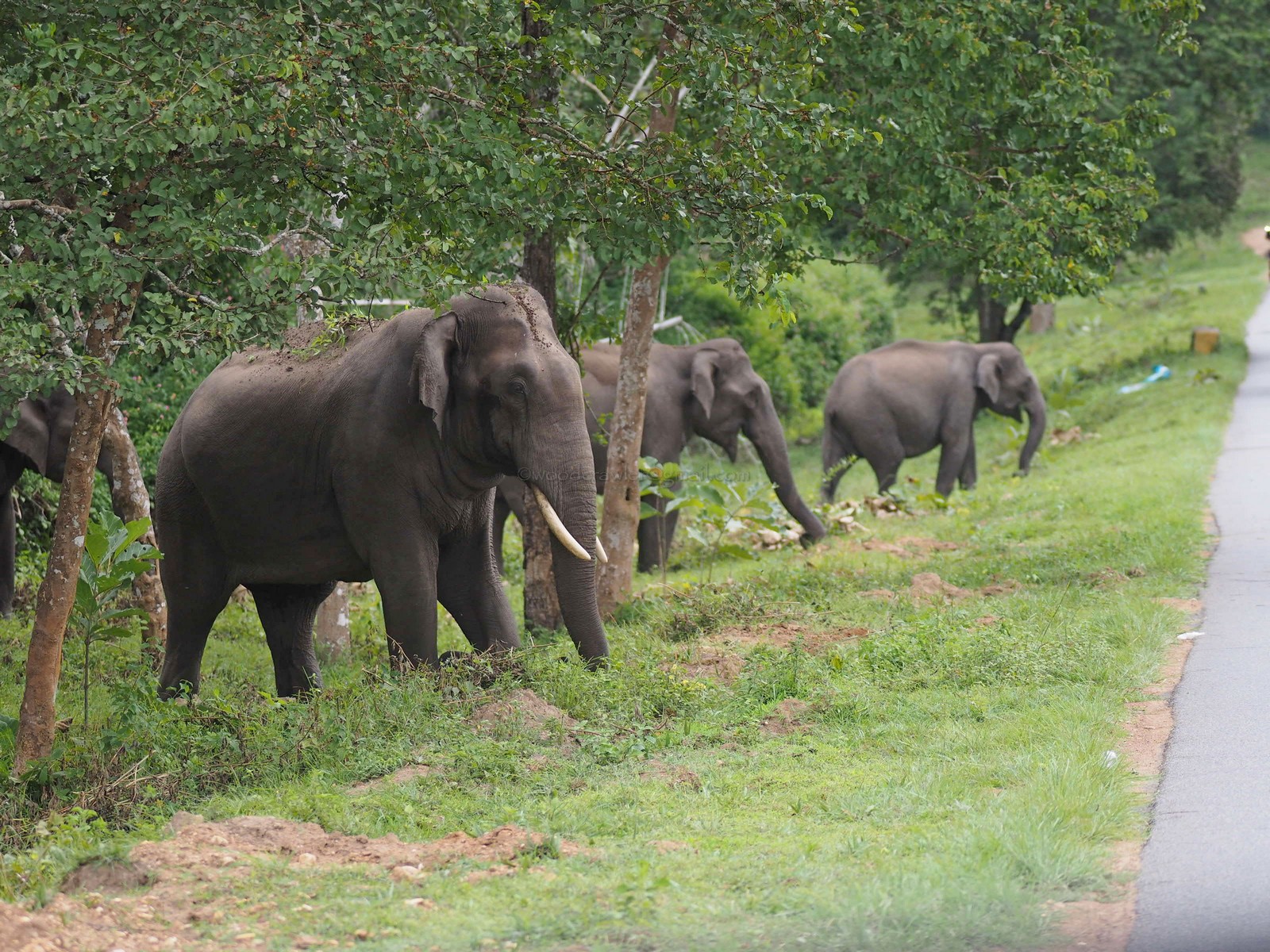
The first thing I saw was a pair of menacingly sharp white tusks. Then I saw the trunk, curling in different directions trying to pick up the scent of the intruder. It was a bull elephant! Fortunately I was still downwind and the elephant was moving very slowly, probably trying to be as noiseless as possible! I could see his grey hide and part of his ear through the branches and it seemed he was facing in my direction, perhaps even looking up and trying to locate the source of the sound which had disturbed him.


I knew it was time to move. The elephant could clamber up the slope without much effort, so it would be foolhardy of me to hang around longer. I carefully moved back towards the little forested patch below which my car was parked. This time I was careful to step only on bare rock so that the elephant would not guess in which direction I had gone.

After I reached the forest patch, I halted to listen for the sound of the elephant's movements. It was still coming up, but very slowly. I waited behind a tree about 75 meters from where I had been standing earlier. I knew all elephants were not dangerous and in case he was in a temperamental mood I had my escape route clear behind me. As the sound came closer, I saw something grey emerge over the edge of the slope a few feet below where I had been standing a little while earlier. Then the forehead and tusks came into view.


What a magnificent specimen? I have seen elephants at close range in Bandipur and Nagarahole but that was from the relative safety of a safari vehicle. I have never had an experience of a malicious charge. Mostly, it was mothers with little calves in tow that showed a tendency to get irritated and the mock charges were to scare you off. All the bull elephants only gave long hard looks before they went on their way. Some of them completely ignored us!

As this handsome bull emerged from below, I could see he was a young adult in his prime. My first concern was to see if he was in musth. My gaze went to the line between his ear hole and the eye. If he was in musth a wet patch can been seen starting from midway on this line, where the opening of the musth gland is, and flowing towards the mouth. It was a perfectly dry space on this tusker.


Then, as he reached the edge of the slope he looked in my direction, with ears forward. Perhaps he heard my camera clicking or he saw me standing there.


It was only once he reached the top that I realized how fortunate I had been. Here was a superb specimen of elephantine handsomeness and I had the privilege of setting my eyes on him at eye level, and on foot. It was my first face-off with a wild tusker on foot and all alone. I wasn't therefore very keen to provoke him into charging me. I stayed in the safety of the forest, partly hidden by some trees.


He had the most dignified look about him and I couldn't resist squeezing off a few more shots. He looked at me calmly and I could feel him telling me something. Almost as if he was a Messenger from the Wilderness. It seems, I had forgotten recently that there was more to nature than birds.  

Just on top of this slope is a flat rock with a small tree beside it, our Bodhi Tree. That was the rock on which my son and I had come and sat many a time just enjoying the feel of the winds blowing over us while we soaked ourselves in the the sights and sounds of the forest around us.Perhaps it was a wake up call; just a reminder that we forgot about Bandipur and our other regular haunts. Time has come for a revisit and also a revival of the Woodcrawler's Journal that has suffered a breakdown for nearly a year.

It seems the Messenger knew that I heard him. He turned, and walked off up the slope away from me. I too returned to my car, humbled by the experience. It is a rare privilege to encounter a handsome bull, all alone and on foot in a favourite patch of forest.


To those who think elephants are dangerous, I'll tell you that you are wrong. They are far more sensible than us humans and prefer to melt silently into the forest in the presence of humans but when we encroach into their territory and disturb them, they WILL retaliate. Don't forget, these gentle creatures, when provoked can be extremely angry and then it will be too late to regret.


My experience in Malampuzha was unexpected, though not entirely. I don't claim to be an expert in jungle craft but I've acquired some knowledge and minor skills that could get me out of many tricky situations. Remember, don't try anything foolhardy. Keep a safe distance if you know you are in the vicinity of elephants, especially herds with very small calves.

The latest idiotic trend is to try and take a selfie everywhere, including in the presence of wild elephants. That is outright stupid. Not only that, the flash in a camera, mobile or otherwise is very irritating to elephants and all wildlife in general. You can get yourself into trouble if you 'flash' at a pachyderm.

Next time you run into an elephant herd in the wild, remember that if you give them their space, they will almost surely ignore you and continue with their business of feeding. It is only when you deliberately provoke them that they react violently.

My instinct tells me that 2018 promises to be a great year for the Woodcrawlers of the world.

Happy Woodcrawling!

Wednesday, September 16, 2015

Wild Elephants - Myths of the Musth

The elephant is a pet obsession of every Malayali. It would be difficult to imagine a temple festival without an array of caparisoned elephants. From a single tusker to as many as thirty, depending on the size of the temple's coffers, these decked up pachyderms are one of the attractions of God's own Country!

(As usual Pinks are Links!)

Unfortunately for most, if not all, of these elephants the period of musth, is a torture. During musth these normally gentle creatures become masses of seething anger and viciousness. The captive elephants are chained, isolated, and starved or tranquillized with the idea that it will curb their killer instincts. Nothing can be farther than the truth. I read an interesting chapter from the book 'Practical Elephant Management; A handbook for Mahouts, which mentions the ways to handle a captive elephant in musth! For a true elephant lover it reads like a horror story!

Sometime in March this year, Gajendra, a tusker belonging to the Karnataka Forest Department, killed its mahout and fatally injured another tusker Sri Rama. Both these elephants were stationed in K Gudi, B R Hills and were regulars during the Dasara festivities in Mysuru. Like all tuskers, Gajendra too went through cycles of musth but had never attacked anyone so far. When I went to B R Hills this year, I saw a forlorn Gajendra, perhaps filled with remorse at his action that resulted in the death of two of his closest associates; his mahout and fellow pachyderm. It was two months after the tragedy but it seems, the elephant's emotional upheavals had not subsided yet.
A remorseful Gajendra
I know I must be right because this has been mentioned in an article by A.Rajaram, published in Resonance, a journal of the Indian Academy of Science, Bengluru.
Looking like he lost his best chums
27th September, 2015

Turning the clock forward to Onam vacation 2015. We were in Bandipur for three days and on the first trip out into the forest, going down the Mysuru-Ooty highway, we ran into a herd of elephants. There were seven of them, grazing on either side of the road. Two tuskers with females, sub adults and a calf were feeding in the succulent grass growing on roadside after the rains.

One young tusker was on the right side of the road walking parallel to our vehicle. He broke into a hurried run to overtake us.

This male was separated by the road from the highway
 Once past us he turned towards a gap in the impenetrable wall of lantana, perhaps going towards the large pond a little further off inside the forest. It was quite a warm afternoon and a leisurely soak was in order.

We had halted just before reaching the main herd of six elephants, including the other magnificent male who appeared to be in musth.

The rest of the herd

The tusker in musth.
 All the elephants looked in prime health unlike the ones we saw in Nagarahole in May. The only aberration was this big male, who had the obvious patch of wetness between his eyes and ears, the secretion from his musth gland. The sight of a tusker in musth is sufficient to sent an average human being into a tizzy. That is because of the disrepute captive tuskers have earned with their behaviour during periods of musth. I hope the brief description that follows, at the end of this post, about the mating behaviour in elephants, will help dispel a few myths about elephants in musth. 

Meanwhile, we were watching the younger male on the right of the road. He abruptly turned back, strode purposefully onto the road and proceeded to cross it. Obviously, the females had communicated with him, either by means of infrasonic rumbles which the human ears cannot hear, or by seismic vibrations. 
The young tusker crossing to rejoin the herd

He seemed to be reassuring them to remain calm


He walked unhurriedly to where the herd was gathered....

....and joined them.

As we were watching this peaceful scene one chap on a motorcycle decided that it was safe to go, but the matriarch wasn't to pleased. She gave a mock charge to hurry the rider on his way
"Get away you moron!"


Then she started to cross the road.
All this action, meanwhile, had made us lose attention of the bull in musth that had actually been nearest to us earlier. When we looked for him he wasn't there! Then suddenly the lantana parted a few meters from us and the bull emerged silently!
The bull emerging from the lantana
 He wasn't interested in testing out the sharpness of his tusks on us. He was probably observing us from the cover of the lantana to assess whether we were a threat to himself or the herd! He walked towards the road in front of us in a very dignified manner.

Without wasting a glance at us he followed the matriarch, obviously his mate for the season, across the road. The tell tale wetness on his hind legs, from the trickle of urine, which is another sign, confirmed that he was in musth.

For a bull in musth he showed no sign of ill temper or aggression. He was only concerned about rejoining his mate on the other side of the road. Why many of us have such a fear complex about bull elephants, especially the ones in musth, is something I cannot fathom!

The young male who had, meanwhile, joined the rest of the herd then proceeded to escort the youngsters and sub adults across the road.

Responsible big brother escorting cousins and others across


The little one was still nervous

Big sister urges her sibling to cross with her
Eventually the entire herd was on the right side of the highway. No drama, except when the matriarch mock charged the motorcyclist. As the big bull went to join the others the younger bull disappeared into the lantana. He wasn't ready for a showdown. His turn would eventually come, a few years from now.

A purposeful walk towards the herd

He dispatched the young bull with a wave of his trunk and perhaps a rumble!

On really big & happy family!
During this entire episode, I did not feel threatened; not even for a moment. As long as our vehicle was parked, with engine running, and we were not getting off it; we were safe. The elephants were looking to cross, and maybe go for a relaxing swim at the pond inside the park. Once the two safari vehicles parked on either side of the herd, blocking the rest of the traffic, the crossing was accomplished without undue stress.

What I'm trying to highlight here is that elephants in the wild are not as aggressive as their captive cousins! It is a misconception that wild elephants are looking to wreak havoc on passing humans. Even a lone tusker, unless it is in musth, rarely attack. They only make threatening gestures but never proceed with a fatal intention. I have encountered, on many occasions, an elephant that came at our vehicle. They will stop short once they know you mean no harm.

Understanding the Musth Mystery
To understand the phenomenon of musth and the sudden change in the behaviour of, what was till then, a placid pachyderm, we have to delve into the details of mating in elephants. Most of us have major misconceptions of a bull elephant in musth. I hope to dispel at least some of that misconceptions and with that, the inherent fear such misconceptions incite in us, by the end of this post.

Elephant Family Structure
Elephants have a highly ordered family structure. Herds in the forests of South India number from 5 to 12 individuals but can swell to upto two dozen or more sometimes. The herds are usually led by a matriarch, the oldest and most experienced female. The rest of the herd mainly consists of the matriarch's sisters and off spring, mostly females and few younger males. Females remain with the herd all their life and help during birth and in bringing up the calves.

If the herd becomes large and food and water sources dwindle in the traditional grazing areas few females may leave to form new herds. These herds will mingle again for  short periods, especially during migration to greener pasteurs. Large congregation of elephants are a regular feature around the Kabini reservoir in summer. Males leave the herd when they are 12-14 years and are usually solitary, or form loose groups of two or three.

Breeding in elephants
The female elephants come into 'heat' once every three or four months. She will be able to conceive only in a brief window of 3-5 days. During this period she is receptive to mating. A female in oestrus attracts males by their behaviour. They raise their head, make rumbling vocalizations and often spend time with the male they have selected, even leaving the herd for short periods.  

The bull, that the female accepts as her mate, stays with the herd for about two weeks. After mating, he then heads off back to his solitary life till the next season. He plays no role during his mate's pregnancy, calving or in the bringing up his off spring! The gestation period of elephants is the longest of all mammals; some 20-22 months. The birth of the calf usually coincides with the end of summer or beginning of the wet season when food and water will not be scarce.

A Bull in Musth
The musth period in an elephant is a physiological phenomenon that occurs once a year in all mature bulls. True, that there is a production excess of testosterone, sometimes in the region of 60 times more than normal, but that is because the bull is ready for procreation. It has been interpreted as "the honest advertising of the male's sexual availability and condition". The smell of the musth secretion and the constant dribbling of urine scent marks their trail and attracts receptive females.  

It has been noted that during musth other males, especially younger ones, avoid contact with the bull in musth. Younger males don't go into musth at the same time as older and bigger males. The males in musth are aggressive and pick fights on a whim so it helps when there is only one male in musth at at time. In the right company, a bull in musth is like any other elephant. It's honest intention is to mate but the condition itself being very uncomfortable makes them behave extraordinarily.

In the wild, these bulls have an outlet, in the form of a very coquettish female. Otherwise they usually keep to themselves away from the herds and other elephants, perhaps unsure of themselves. Considering that elephants are emotional animals, it is safe to assume that somewhere in the recesses of their mind bent on violence, there is a part telling them to avoid confrontation. So when a bull in musth rejoins a herd his only intention is to mate. As I mentioned earlier, he will stay with the herd for a short duration of few weeks and moves back to his solitary existence once he has achieved his purpose.

Captive elephants are, sadly, not so fortunate. Their life is a torture, though elephant owners will disagree! Chained for life, restricted from moving freely and forced to stand in their own excreta, their lives are a nighmare of sorts. To compound the fact, the management policies suggested in the Mahout's Handbook, makes life living hell for an elephant in musth. No wonder most captive elephants show a destructive streak, taking out their suppressed ire on animate and inanimate objects, when they are in musth. Such elephants become unmanageable and turn on their handlers, sometimes resulting in fatalities.

It is alleged that the increasing fatalities are directly related to the cruelty these gentle creatures are put through in the festival season. They are paraded in temples, transported on trucks and made to stand for hours in energy sapping heat. On top of that, drunken mahouts and greedy owners add to the elephant's woes. It is no wonder that the number of human deaths is growing over the years; a staggering 500 plus mahout deaths in 15 years! 

While temple elephants of Kerala in musth are chained, starved of food and water to suppress them the Karnataka Forest Department has a more humane approach. If they are not able to control the animal, it is let loose in the forest, but with chains on. The mahouts and the forest staff constantly follow and monitor the elephant so it does not get into trouble or cause any trouble for others. Wild tuskers in musth have rarely been implicated in such fatalities recently. The tales of rogue elephants from shikar stories probably have something to do with the tusker being in a period of musth.

To those who still are skeptical, let me assure you that in over a decade and a half of woodcrawling I have never been charged by a tusker. All charges that I have been faced with are mock charges by the females with small calves. More of a display of false aggression than with any real intent to hurt. Having said let me also highlight a few points again that should be remembered in the presence of wild elephants.

  1. Elephants don't attack unless provoked.
  2. Stay in the vehicle if you are faced with a herd or even a lone tusker.
  3. Keep the engine running all the time and don't get off. Elephants have poor eyesight your presence is not easily detected when you are in a closed vehicle.
  4. If you are on foot, back off slowly if your presence has not been detected.
  5. When inside a vehicle don't make noise or sudden moves. If you pop up like a jack-in-the-box you may annoy the elephant.
  6. Avoid flash photography. It irritates elephants, both male and female.
  7. Don't make noise to attract the animals, it only serves to provoke them.
  8. In the presence of a herd with very small calves, don't try to get too close. Female elephants tend to charge if they feel that you are a threat to the little one. 
  9. Lone tuskers are also not always dangerous and show less tendency to charge unlike females.
  10. If you run into a lone tusker in musth, avoid it at all costs. They behave unpredictably

Wild tuskers, rarely look for an encounter with humans. The prefer disappearing from our presence as quickly as they can. Only females with calves actually give you the charge!


I hope I have given you something to think about and get rid of some misconceptions about wild elephants. They have always been portrayed as villains though the truth is otherwise. It is our attitude and behaviour that makes these gentle creatures act as they sometimes do. Remember, they are herbivores so they don't kill to eat. Unless provoked, they will continue to feed contentedly or go about doing whatever elephants do when they are at peace with the world!

I love our elephants, I hope you start loving them too. 

Happy Woodcrawling!


Sunday, March 01, 2015

The Aftermath of an Elephant Attack - Post Script

Almost a month has passed since the Gavi incident and the elephant has suddenly become my current fixation. 25th February was an important day in the Palakkadan calender. It was Manapully Vela, the annual event that falls in late February or early March. The Malayali has an elephantine fixation. Every temple festival is inevitably linked to a parade of decked up elephants, and all of them tuskers of various sizes and hues. The most famous is undoubtedly the Thrissur Pooram, so famous it has a website of its own!

Central Kerala has a tradition of temple festivals that culminate with a display of these decked up tuskers. Even small roadside shrines have nowadays started ostentatiously imitating the big temples. They use is this as an excuse to collect donations for the upkeep and development of the temple but in realty, is shared by the members committees that plan and execute such events. Palakkad has a few such events that involve a large assemblage of tuskers; Nemmara-Vallangi vela in Nemmara, Chinakathoor Pooram near Ottapalam and the Manapully Vela in Palakkad town. All of them involve participation of, on an average, 30 tuskers.

A large assembly of tuskers is a sure recipe for trouble. With smaller temples also vying for a share of the 'grandeur' of an elephant parade the domestic elephants in Kerala are a harried lot. Once the season sets in, typically at the beginning of summer, they are always on the road being take from temple to temple. Hiring out elephants is good money so the owners try to squeeze in the maximum number of rental in every season.

The temple festival season starts in late January and goes on till April, some of the hottest months in Kerala. The elephants used to be walked from temple to temple earlier but now they are carried in trucks with modifications to transport a large pachyderm. By the middle of the season the elephants are stressed out and, at the slightest provocation, misbehave. One prime example of a stressed elephant going on rampage is there in this incredible video(It contains some graphic scenes so viewer discretion is advised.)


Just a day before the Manapully vela this elephant, Guruvayur Sankaranarayanan, decided to throw a tantrum on the way to Palakkad from another Vela where he was paraded. Eventually, he was not used for the procession and was sent back to Guruvayur.

Guruvayur Sankaranarayanan tethered to a tree for misbehaving!

He was obviously not in a state of  musth


Chains & ropes that is a part the anatomy of Kerala's temple elephants

No water and food, except a few coconut palm leaves
A few years ago the normal number for Manapully Vela was 30 elephants. 15 of the Manapully kavu and 5 each from the other temples. The elephants literally wade through a sea of humanity towards the entrance to the fort where they are lined up.

The elephants from Manapully kavu heading to the Kota maidanam


At the top of the slope they line up facing downwards, towards the east. This time, instead of the usual 15, Manapully Kavu fielded only 9 elephants. Perhaps the fear of another going berserk influenced the decision or the cost of hiring so many elephants. Whatever it was the Vela seemed to have lost its sheen this time. What was instantly obvious was the the reduction in the number of elephants had given the beasts a lot of gap between themselves.

I am happy it happened that way. I always used to wonder how they managed to squeeze fifteen very large tuskers in a 30 meters wide gap between the entrance to the fort and the Kota maidanam. Even if one of the elephants decided to get angry it would also effect the others. There is nowhere to go but forward and the panchavadyam artistes and the crowd form a human wall some 50 layers thick towards the bottom of the slope.


If there is an unfortunate incident where any of the elephants were to run amok it would be a disaster. The crowd would panic and try to run to safety. Children and old people would become victims of the stampede and a few would fall prey to the elephant's temper.

In such a situation the blame has to be placed on the greedy owners and the heartless mahouts. Maintaining an elephant is an expensive proposition. On an average Rs.3000 to 3500 is required for the daily upkeep of the elephants and its mahouts. It roughly translates into an annual expense of Rs.12,50,000/- for an elephant. This has to be recovered in the three months between mid January and mid April. Cost of hiring an elephant ranges from Rs. 50,000 to Rs 4 lakhs daily, depending on the status of the elephant!

There is an excellent article on the state of the temple elephants of Kerala here.

Elephants are wild animals. We tend to forget that they are used to freedom in the forests they are born in. The spend almost two-thirds of a day wandering around feeding on things they fancy. An animal of this size has to migrate from one feeding ground to another. Typically they are always on the move especially in the summer, congregating around areas with water.

Captive elephants, on the other hand spend all their lives tied to some tree or post.  The temple elephants, despite all the tall claims otherwise, spend their lifetime in chains feeding on stuff we humans think they should be eating! During the few weeks in summer where the temple festival
 season is at its peak, they are driven nonstop from one venue to the other without rest. They are denied food and water and the drunken mahouts take out their frustrations on the poor beasts.

During such festivals they are paraded through the street in the heat of the daytime, because the pomp and glory of the festival will be lost in the nights! Now stricter authorities have shifted the time to the evenings and as a preparation the roads are doused with water to cool the hot asphalt before the elephants reach the place.


What most people tend to forget is that there is no such thing as domestic elephant. All elephants are wild but we keep them captive for our own selfish interests. If someone objects, the blame is conveniently placed on the deity of the temple! The fact is, no God will want to torture a gentle creature like an elephant. Therefore will not be surprising if a misbehaving elephant is God's way of telling us, "Enough is enough!"

Guruvayur Sankaranarayanan went back to Punathoor Kota in a truck. Whether his life will change is debatable. This time he was only behaving like a stubborn child but the next time he may not be so forgiving. The sooner we realize that the elephant belongs to the forest the better, for both us and these gentle creatures. I'm praying that the number of elephants paraded next year should be five!

For those who came in late:
This is the final part of the series 'The Aftermath of an Elephant Attack', a three part series on how we should behave in wilderness areas. The third part has a direct connection with this. In case you missed it go back and read that post on how the elephant will behave in the presence of humans. The LINK is the sentence in PINK, as always!

Sunday, February 08, 2015

The Aftermath of an Elephant Attack - Part 3 : Thinking like an Elephant

Note: This is a really long post, please have patience for the pictures to load. If you have not read the first two parts please click here. 

The Gavi incidence is rare but not unusual. I have run into these gentle giants on my woodcrawling and on more then one occasion, been charged. 


(Pinks are Links, Click to open a related page)

All these charges have been only an assertion of who is the authority in the jungle, never with any intention to hurt or kill. Just take a look at this video recorded just under a month ago. It gives you an idea how much damage an elephant can do even if the intention was not to kill!

Know the Elephant
Elephants, as a rule, are placid creatures. If a day had 48 hours they'd love nothing more than just crunching on some juicy bark or tearing off tender grass and stuffing them inside their cavernous mouths. They spend 80% of their life feeding. They consume about 150 kilograms of vegetation and drink upto 100 liters of water everyday. Not very surprising, considering that a full grown elephant can weigh as much as 3000 - 5000 kgs! Their shrinking habitats have now ensured that large herds have to be on the move constantly looking for fresh feeding grounds. This brings them into direct conflict with man.

We humans are unreasonable creatures. After encroaching and destroying the elephant's territory we block their movements by building roads and settlements, after which we go about converting vast tracts of forest into agricultural lands! Then, we expect these gentle creatures to understand our superiority and avoid the areas we have usurped from them!

Why, then, do these gentle giants turn killers sometimes? I quote from Vivek Menon's book 'Tusker'. "A large number of elephants captured in Kodagu district and near Bandipur had multiple bullet wounds on them, caused by .12 bore and .22 bore shots sprayed on them by resisting farmers. In adjoining Kerala, two elephants of the Guruvayoor temple had bullet wounds with small lead pellets when the temple acquired them". Further, he also writes, "In Wayanad, Kerala, a large tusker was captured in 1995 because of crop raiding problems. It had over 25 bullet wounds on various parts of its body". No wonder some elephants, especially those that live near human habitations or come into contact with humans, behave aggressively. They are simply being defensive.

This is not meant to be a treatise on elephant behaviour but I though a small introduction will give you an idea why we should not take these creatures lightly.


Elephant senses
Elephants have small eyes and their range is limited, approximately 25 meters. They see better in low light and are slightly handicapped in very bright light. Due to their location on the sides of the head they afford a better peripheral vision than binocular vision. To compensate for this anomaly, nature has provided the elephant with very powerful hearing and the best sense of smell in the animal kingdom. Their large ears help to gather sounds well beyond the range of our small ones.            (More about elephant senses here.)

The versatile trunk of an elephant is the best smelling organ of all animals. It is five times more sensitive than the humans. It is so powerful that the African elephant can smell water 12 kilometers away! (More about the fascinating trunk here.) The elephant keeps feeling the air every now and then with the trunk. 


When you are in the forest especially on foot you can smell the elephant's presence easily. It also means that the elephant can know you have arrived much before you. For an animal that weighs a few tonnes it moves very silently so the human ear or nose is incapable of detecting it before it has detected you. The strategy is to always be downwind of the elephant. It means that the wind should blow from the elephant towards you and not the other way around.

Elephant behaviour
Most often elephants go about their business of eating and caring for the young very quietly. On occasions they show an aggression that is expected from an animal of that size. If you know a little bit about how elephants display their aggression you can judge if the animal you encountered is really a threat to you.

Elephants, as I mentioned before are generally peaceful animals. Females show aggressive intent when the herd has very young calves. Bulls are solitary and become extraordinarily aggressive when in musth. All elephants are aggressive when they are harassed, injured or sick.

Reaction to threats by the elephants differ. Most often they put on a dominance display to scare of the intruders by raising their heads and tusks with the ears pushed forward to appear larger than they are. This maybe accompanied by much shaking of the head swishing of the trunk.


This young bull was about to cross the track when we surprised it.

Beginning of the dominance display, the head raising

Tusks thrust forward and the ears spread out

It took a couple of steps out of the lantana....


... but realized that, though we were not a serious threat, we were not budging.....

...... and so, retreated into the lantana again!
The other reaction is the charge. They are most often they are mock charges and are broken off before any actual contact is made. The intention is to drive of the threat with a display of aggression. Female elephants are more prone to give you the charge.


In the presence of a herd with small calves you are better off keeping a safe distance. The matriarch is very protective and will charge without any provocation.  Once the threat has been dealt with the herd forms a protective ring of adults and sub-adults around the calves.

Very small calves are under the care of the entire herd

If they perceive a threat they close rank around the little ones

If the matriarch decides that the intruders are harmless they break off to feed again....

... but the smallest calves are led away from danger by the mothers with gentle nudges and pushes!
Sometimes the herd itself moves away if they are not comfortable in the situation.


Occasionally the mock charge can become converted to a real life threatening charge. This video was recorded in Kruger National Park on 15th January, 2015. It was being streamed LIVE!


You can see how incredibly strong even the small tusks of the female African elephant is. Imagine how much damage a full grown bull can do if it decides to really handle the threat!

When you happen to encounter a solitary bull in the wild leave him alone. They are much maligned because they are solitary (termed 'ottyaan' or single one in Malayalam) and very unpredictable when they are in musth. Every solitary bull is viewed as a trouble maker though in actual fact, they are not. Solitary males in musth are best avoided at all cost.

The opening of the musth gland can be seen inside the green circle. 
 It is not difficult to identify a bull in musth. Look for the opening of the gland located about halfway between the eye and the ear hole.

A cropped version of the above picture. The red arrow shows the opening of the gland.

If an elephant is in musth there is a trickle of fluid from this hole towards the mouth. It leaves a very distinct wet patch of skin between the mouth and ears.

You can see the wet track of the secretion, temporin, as a darker patch. (blue arrow)


Temple elephants of Guruvayur are chained up and isolated during the cycle as they pose a danger to their handlers, other elephants and anything that they take a fancy to including vehicles and electric or telephone posts!


 Asian elephants can attain sexual maturity by 15 years but the musth period is not intense till they are 20-25 years old. (More about musth here.)  The African counterparts go into cycles about 5 years later.

This old bull was estimated to be over 70 years and is one of the oldest in Punnathoor Kota, Guruvayur. It was in musth but wasn't behaving as aggressively as the younger males.


There is no clarity on the upper age for musth or if the intensity reduces over time but it lasts throughout life as observed in captive elephants.

In the wild it might not be always easy to identify an elephant in musth because they tend to be hidden by the vegetation and suddenly pop out on you without warning! It has happened more than once especially after a good monsoon. The vegetation is rich and dense. Even a very large tusker will be invisible till you almost knock into it!

As we rounded a turn this large bull was feeding on the foliage on the side of the track.

Mature bulls are generally calm and just want to be left alone with their feeding

They will move slowly feeding as they go along............

.......... before going off into the bush eventually. 

Younger and inexperienced bulls are more demonstrative and put up the dominance display more often and accompanied sometimes, by a half charge. This young bull was about to cross the Campanmutti Circle in Bandipur National Park. It appeared that it had just crossed the highway from the eastern part of the park into the western part. The bull and our vehicle reached the junction almost simultaneously.


The young bull ambling along peacefully

It realizes that there are others waiting to cross its path.

Walks forward with the trunk casually wrapped on its magnificent tusk.

Continues to walk towards the track nonchalantly, trying to ignore our presence 

Decides to show its superiority; ears forward, trunk swishing and tail up!


For good measure it threw some mud and grass onto its back.

After all that belligerent display............

....... it decided, enough was enough.......

............ and ran away squealing in protest!!


Occasionally turning to see if we were following.........


......before eventually disappearing into the lantana on the opposite side of the track!

Recognizing a dangerous charge
As I mentioned earlier an occasional charge can be genuinely dangerous. You have to learn to differentiate a mock charge from a real killer charge. When an elephant charges there are a few signs that can forewarn you if it is going to end unhappily for you. Each elephant is a distinct individual with its own distinct behaviour therefore all of them may not behave predictably but in most instances they do. Although it may not be perfect it is useful to know these signs as they can be the difference between life and death.

When it is a mock charge the elephant is more demonstrative. It trumpets, opens the ears and flap them, lifts its head and twists it from side to side. It may pluck grass or mud and throw it in your direction. If it is a mock charge you can hold your ground, that is if you really have the nerve to face up to a few tons of solid bone and muscles bearing down at you at trumpeting loudly! It might just halt as abruptly, wheel around and retreat.

On the contrary if the charge is truly with malicious intent the animal curls up its trunk, lowers its head and charges with the ears laid back. Then it is time to take flight. The only intention the elephant has is to catch you, trample you, impale you with its tusk and probably dismember you! A very painful death is the only possible result if it gets to you.

Running from an elephant is a challenging affair especially if your fitness levels are suspect and the terrain and forest favours a bigger animal. We can run at about 15-20 kmph on level ground. Usain Bolt is clocked at 37 kmph over 100 meters! The elephant has been known to run at about 25 kmph but has been clocked at 40 kmph on one occasion! The idea is not to outrun a genuinely angry animal. Try to find something to climb onto or keep between you and the elephant. If there is a deep trench or ditch, jump in.

Click here for the link on 'How to Survive a Charging Elephant'

Mature bulls, unless in musth, are rarely very demonstrative. The observe you with quite dignity and once they have assessed your threat potential the simply ignore you and walk off unhurriedly.

A slight lifting of the ears and a careful sniff with the trunk.....

..... and he knows we are no threat. A few seconds of eye balling to let us know he is not alarmed.....

......he crosses the track with no care in the world. "Wait till I'm gone" is the message!

Without a backward glance the majestic tusker disappears into the jungle.

Some bulls will just ignore you and get about their business. While waiting at the Subbarayankatte waterhole in Bandipur, late in the evening on a safari, this bull came down to the water, drank its fill, had a shower, then went and scratched itself on a low tree. All the while it seemed oblivious to our presence!


Pleasurable itch!
More often than not, an elephant in the wild would prefer to avoid a confrontation. Most killing happen in areas where we humans have encroached into its territories or and places where domesticated elephants have been ill treated by drunk mahouts. There is no need to panic in the presence of these gentle pachyderms if you adhere to the guidelines mentioned in my previous blog.

The same rules apply to the gaur, the largest wild cattle in the world. They are found in large herds and in the morning come out onto the safari track to warm up in the morning sun. They will move off at their own time and remember gaurs don't charge like elephants. When a herd stampedes, just keep out of the way.

Road block

Even large bulls are very benign

They would rather herd the calves off rather than charge at a human

More road blocks!


I have, on one trek in Chinnar, crossed the path of a gaur. The guide and me had smelt elephant and were scouring the forest on either side of the tracks for the herd. Suddenly, out of the trees the head of a young gaur pops up!

If the gaur was not right in the middle of the frame it would have been difficult to spot it in the dense vegetation! 

 That was the first time I had taken Skanda on a real trek in the wild because he was growing up into a real Woodcrawler! I wasn't sure who was more surprised, the gaur or us!

So if you are out in the wilderness, either on a vehicle or on foot, if you adhere to some simple rules you can ensure that you won't have any unhappy encounters.


  1. Stay in your vehicle at all times. Getting out makes you an isolated target and even with poor eye sight an elephant can pick you out for showing its irritation.
  2. Start your trip after at dawn and finish it off before sunset.
  3. Don't switch off the engine and light of the vehicle. The vehicle is seen as a larger 'creature' and the people sitting inside are not perceived as separate from the vehicle.  
  4. Don't drive too fast. Animals crossing suddenly maybe knocked down and killed unintentionally. Keep to the speed limits; usually 30-40 kmph. 
  5. Animal crossing areas are marked with boards. Slow down and drive carefully.
  6. Don't make noise or speak excitedly. Some people have the annoying habit of trying to attract the attention of wild animals by making loud noises. Loud noises can alarm the herd. What happened in Gavi was a result of an alarmed sambar running out of forest into the herd's presence.
  7. Don't attempt to get too close to an elephant. They will misread your intention as a threat and react accordingly.
  8. Photography is encouraged but keep your flash switched off. Elephants hate the sudden flashes of light. Remember, the see poorly in very bright light. 
  9. If you are trekking on foot ensure that you are fit for the trip. 
  10. Follow the guide's instructions and don't wander off the track. Stick to the route designated by the forest department.
  11. Ensure that the guide has instruments or avoiding attacks by wild animals. They usually carry fire  crackers, a large bush knife and sticks. Some places have guides with firearms.
  12. Carry maps or handheld GPS especially while on foot.
  13. Carry water and food sufficient for the trip. Ensure you carry your litter back with you. 
  14. Wear clothing and footwear suited to the place you are trekking in. Avoid loud colours and flimsy street footwear.
  15. Consider getting travel insurance!
This is one of my longest posts and is a direct result of the Gavi elephant attack. I call myself a Woodcrawler and encourage others to try woodcrawling. I felt it is my responsibility to also share with you some tips for safe woodcrawling. 


If you found this series useful please share the link to this blog with others who might also like to travel or trek in wilderness areas. 

Happy Woodcrawling!