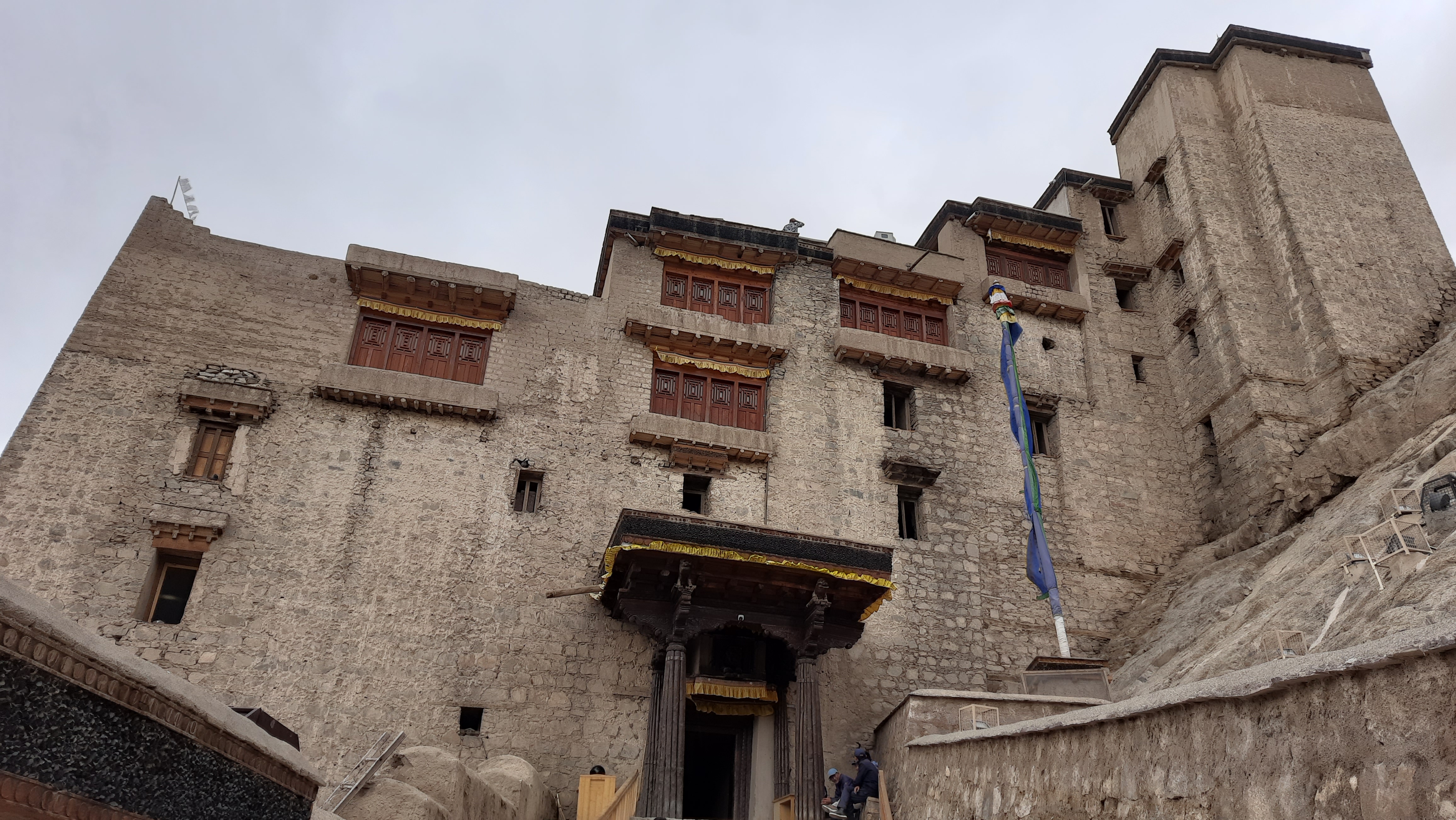
From here on, the posts that follow will take you through our travel through Ladakh. During your travel with us, I will try to give you some information about places we went to, routes taken and lessons we learnt about travel in such a remote place.
July 16th 2023, 8.45 AM - Forenoon in Leh
We touched down in Kushok Bakula Rinpoche Airport at half past eight in the morning. For an airport with such a grand name, it is rather nondescript, In fact, one of the smallest I've seen. The terminal had seen better days and seemed to be desperate need of repair. I decided against using the toilets after seeing the expressions of people coming out after using the facility.
The airport sits in a valley flanked by mountains on all sides and the Indus river on the south-western end, and is the highest commercial airport in India at an elevation of 3250 metres above MSL. It is in the midst of defence establishments and served as an exclusive defence airport before being opened for civilian use. The single runway, lying east-west makes the view from an approaching aircraft nothing short of spectacular. This is one airport that is bereft of greenery, as most of Ladakh is, which we discovered very soon.

The old terminal is pretty ramshackle with a very small area for arriving passengers. The sole baggage conveyor belt looks like it would break down any minute. The airport has wooden pillars much like the ones in the monasteries. I wasn't keen on fishing out my phone to take a few photos after the experience with airport security in Delhi. The new terminal is coming up next to the old one and once finished should be a world class facility considering that Ladakh is now a hot tourist destination.
We picked up our bags from the creaking conveyor belt which seemed to sigh in relief as each heavy bag came off, and moved to the exit gate. Travel in Ladakh is entirely dependent of taxis, but more about that in a subsequent post. We were to rendezvous with a Mr. Tsewang Gurmet, our taxi driver cum guide for the rest of our stay. Tsewangji was at the gate with my wife's name on a pink chart paper. The taxi's are not allowed to come to the entry or exit gates so they either drop you off or pick you up at the parking lot. If you don't want to damage your bag's wheels, load them onto an airport luggage trolley. Even if you leave it at the parking lot it will come back to the airport with passengers flying out of Leh!

Tsewangji dropped us off a to our hotel, the Padma Ladakh, driving through some very narrow roads. Leh town is essentially a large village that has grown with time. Haphazard construction with no planning ensured that buildings jostled for space on either side of the narrow roads. There was hardly room for a car to pass another if it came from the opposite side. It is boom time in Ladakh after it was split from the state of Jammu & Kashmir. As a place dependent on tourist economy, every narrow gully seemed to have three or four hotels. Very few had their own parking spaces. In fact, even houses seemed to lack space for parking and many vehicles were just parked on the road. The only roads that were wide enough was the Srinagar -Leh highway and the Manali - Leh highway, both of which skirted the town.
His Holiness, the Dalai Lama was in town and had prayer meetings every day from around 8.00 am to 10.00 AM. So the day started in earnest only after the meeting had concluded. Our room wasn't ready as we had arrived early, so I went for my breakfast in the restaurant. I was truly famished as I hadn't had anything on the flights. The hotel serves a very nice breakfast and I tucked into it.
Once our room was ready and we were checked in the manager gave us 'strict instructions' to go to sleep. He told us that we were to move slowly, even going to the bathroom or getting off the bed. Since the oxygen levels were low at this altitude, it would leave us gasping for breathe and in the worst case scenario, would end up with Acute Mountain Sickness (AMS). In any case all of us were exhausted after a sleepless night, we promptly settled down to rest. We had instructed Tsewangji to bring his car at half past four for a brief trip into town.
Acclimatization
This would be a good place to introduce the word, 'acclimatization'. It is a word you will hear used very frequently when you travel to high altitude places, especially in the Himalayas and any place where the elevation is more than 2000 - 2500 metres. It is the process by which your body adjusts to the environmental conditions of the place you are in. In the Himalayas, you are at an elevation where the atmospheric is far lower than at sea level. The air is thinner, which means that the molecules of gases that make up the atmosphere is 'spread out' and so less oxygen is available for use by your body's organs. You will also have a tendency to get dehydrated faster.
Your body compensates by increasing the heart and respiratory rate. You find that you breathe more rapidly that it appears you are gasping. Even little exertion can make you feel fatigued easily. This is the immediate effect of low oxygen air. Changes start happening in your blood too. Hemoglobin levels start going up slowly as your body starts producing more red blood cells to increase the oxygen carrying capacity of your blood. This change in your body doesn't happen overnight so you have to give it time to adjust itself. If you don't give your body time to get attuned to the new situation you will be inviting trouble.
At the lower end of the scale is Acute Mountain Sickness (AMS), characterized by any or all of the following symptoms.
- Nausea and giddiness
- Headache
- Breathlessness
- Fatigue
- Loss of appetite
- Sleep disturbances
If you feel any of these symptoms, it is better not to exert yourself more and worsen your condition. Not everyone are built the same and each person's body reacts differently. Therefore, just because you run 5 kilometres or workout in the gym for an hour daily, you needn't be healthy enough to escape the effect of altitude. Conversely, persons who are sub-par when it comes to fitness (like me) needn't always be affected by AMS if you take some precautions. I am not going into the details of severe mountain sickness as those type of problems affect people who do high altitude treks or mountaineering. This is for the regular traveller who spends only a few days in such areas and don't exert too much.
1. Ascend slowly or stay put to acclimatise
Many travellers are now preferring to drive or ride to Ladakh either through Srinagar or Manali. If you can halt overnight for every 400 - 500 metres you climb, it will help you get used to the altitude better. This may not always be feasible if you don't have many days available. For those who fly in from the plains, this is not an option. In our case we flew in from an elevation of about 150 metres to 3250 metres above MSL in under 12 hours. We are landing directly into a high altitude area so the only option is to stay at that elevation for a couple of days to get our bodies used to the low oxygen levels.
2. Avoid exertion
In the first few hours at high altitude, especially if you just flew in, even normal activity can make you breathless. Going to the bathroom, getting off the bed, walking especially up a staircase or anything that needs a little physical effort can leave you gasping. In the first 24 hours make sure your movements are as if you are acting in a slow motion film.
3. Hydrate yourself by drinking lots of water
There is a tendency for many of us to avoid drinking lots of water when travelling. Unfortunately, there is a risk of getting dehydrated at high altitudes. It is suggested that you consume at least 3-4 litres of water a day to keep yourself rehydrated but personally it is a tough ask; 2 litres seems more reasonable. It can be in the form of fresh juice, soup or plain water. Avoid too much of coffee or tea in the first few days as excess caffeine can cause increased heart rate and palpitations.
4. Avoid cigarettes and alcohol
A smoker's lungs are already compromised and in a location with low oxygen levels it will only add to your problems. Alcohol will worsen your dehydration. It is also suggested to avoid sleeping pills.
5. Sleep well
Your body recovers when it is given rest. In Ladakh you are going to be spending a lot of time on the road. So once you are finished with the day's itinerary, eat an early dinner and turn in. Days are long in that part of the world so you might think it is still not time to hit the bed. If you have nothing else to do, sleep. That is the best medicine.
6. Pay attention to symptoms of AMS
Don't try to play a hero. If you feel, even lightly; any of the symptoms mentioned in the paragraph on AMS, inform your travel partner or guide. Stop exerting yourself and stay put at that location or descend to a lower altitude. Most travel operators ensure that oxygen is made available in your taxi or in the back up vehicle in case of motorcycling groups.
7. Preventive measures before setting off
For those having to ascend rapidly you can take some precautions before leaving your comfort zone. One of the remedies suggested is to start taking acetazolamide tablets two or three days before your trip. Acetazolamide in small doses helps prevent or reduce the severity of AMS. While the mechanism of how it helps is not clear, acetazolamide increases oxygen saturation level of blood. Since I'm a doctor myself, I think it is inappropriate to mention the dosages without assessing a patient. Please consult your doctor before embarking on your journey for better advise that is tailored to your individual needs.
8. Expose your ears
Yes, you read right. While it makes sense to cover up your ears from the biting cold, it is advised to expose your ears to the air once in a while. It is said to help your body to better gauge the environmental condition and allow it to acclimatize naturally.
The above points will give you a broad idea about how to get adapted to the new environment you are exposed to. While is doesn't tell you everything, it gives you an outline before planning a trip to Ladakh or similar places. Ladakh is not a place for the regular tourist. Remember it is a high altitude desert and outside of the capital Leh, the facilities are bare minimum. So if these posts pique your interest and makes you want to travel to Ladakh, remember; it takes a lot of planning.
All the posts that follow this will have some information regarding travelling in Ladakh, with points that I gathered on my short trip there.
Meanwhile let us sleep a while and get ready to go visit the local market in the evening.....
Click this link for the previous post