Ever since the birding bug bit me I have been obsessively pursuing the feathered bipeds with undisguised glee. Suddenly, I found my species count had touched 300 plus! Then I splurged on audio equipment and even abandoned a not-so-bad Chinese made shotgun microphone for a Sennheiser! (More about that later)
On Fridays, messages flow in our birding gang's Whatsapp group about plans for the Sunday to follow. I found that I started missing my mother's yummy masala dosas and appam with stew! Moreover, I realized that Sunday, which was a day for relaxation found me out of the bed earlier than usual, loading up the car for a three or four hour birding session in Palakkad's hot weather! I had completely flipped for the birds!
Not only that, I had become specifically obsessed with two groups of birds, the nightjars and the warblers. One would only wake up at dusk and fly around in the dark and the other would skulk in the bushes rarely showing itself to be photographed decently! The nightjars have become like an obsessive disorder that despite any other program on Sunday mornings, I'd return in the evenings, to a hillside in Malampuzha, that we had started calling 'Nightjar Valley', to await their arrival at dusk!
I am in love with the nightjar orchestra. The quartet, consisting of Indian, Jerdon's, Jungle and Savanna nightjars, start their performance at sunset and play till darkness falls. After that, they each go their individual ways, pursuing invisible insects in the air. I can't seem to get enough of them though I've recorded all four species many times over and this obsession culminated in a totally unexpected encounter this last Sunday (7th January, 2018).
Recording their calls is relatively easy, especially with my new possession, the Sennheiser ME67 long shotgun mic, but getting a decent photograph of these elusive birds is a challenge in the failing light of dusk. I have a powerful headlight and torch but even then it is very difficult to get a good picture especially since they are always on the wing. Then, it so happened, that on a previous Sunday evening I saw a nightjar in daylight; sitting, of all the places, on an electric wire! While that was unusual, it got me thinking about looking for them during the daytime. That is how I happened to be in a place to meet my Messenger!

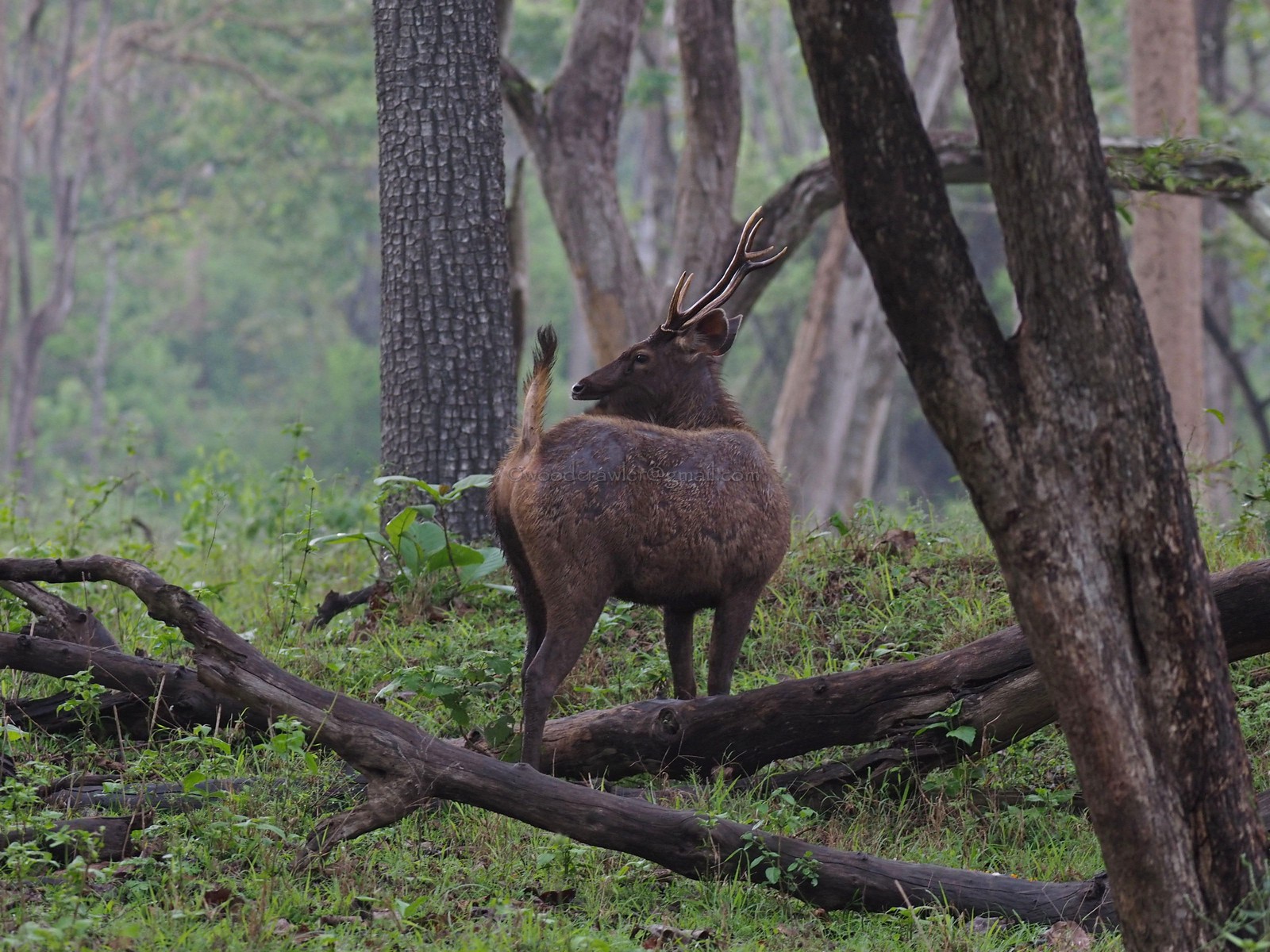
The place we call 'Nightjar Valley' is essentially a hillside in the Malampuzha reservoir's edge, the slopes of which descend into the waterbody. These hillsides are the route mammalian denizens use to reach their water source, especially in summer. I have run into sambar deer while exploring the slopes.


Sometime last year we had seen the pugmarks of a leopard but except for the presence of their dried dung, never elephants.

Below the slope here, are small farms with human settlements and 'Nightjar Valley' itself is on the edge of these settlements so the animals have to traverse the length of the protruding hillocks to access the reservoir.
So, on Sunday the 7th January, 2018, I drove out to the place with a plan to look for sleeping nightjars. We had noticed that at dusk the calls started from a small patch of forest lying on the northern side of the slope and the birds flew into the 'Nightjar Valley' from somewhere beyond that. I had been on that slope many times and had once flushed a nightjar from almost underfoot. So with the fond hope of meeting my favourite bird in daylight I parked my car in Nightjar Valley and crossed the small patch of forest to the slope on the other side.
Once I reached the slope, I scanned the rock face for potential places. The edges of the boulders, among the leaf litter at bottom of the trees or roosting along a branch would be the most likely places for finding the nightjar. I started climbing the slope slowly in a crisscross pattern looking carefully at all the possible hiding places this master-of-camouflage could blend into. Then I heard it, a sharp crack of a breaking branch or bamboo from the next patch of forest to the right of the slope I was on. I saw the violent shaking of the top of a tree below me. Elephants!
I could feel the blood rushing into my head, and my ears felt blocked as the adrenaline rush started. Here I was, on a slope, all alone and below me was either a herd (the person I met a few days earlier, looking for his cows, had told me that there were three) or a lone elephant. I couldn't see anything at first. The canopy was too dense and the forest floor below was completely obscured. As long as the feeding was going on I knew where the elephants would be. I debated with myself if I should keep going up the slope on my quest or wait and watch for a while.Then, it occurred to me that if I reached the top and then the herd decided stop feeding and came onto the place I had been earlier, I would be stuck with no escape route!
I had to be sure of the number of elephants and their mood. I stayed on the edge of the slope peering carefully through the gaps in the branches under the tree that continued to shake under the herd's onslaught. Then I saw it, a small movement like a pendulum, through the leaves; an elephant's tail! From the position of the tail I knew it was facing away from me. I was downwind of the elephants where I stood. If I moved uphill I would
give the elephants the opportunity to scent my presence and if they
were annoyed by my intrusion, would be in deep trouble. Beside, I was already encumbered by my camera and bird call recording gear, hanging from various parts of my anatomy and in the event the elephants decide to show their ire on me, I would be hard put to make a fast exit.
Discretion being the better part of valour, I decided to abort my nightjar expedition and withdraw to safety. If there was a mother with a young calf, I could be assured of an angry charge! Then, in my haste to turn around and make a safe exit I stepped on a pile of dry leaves. The sound of cracking leaves never sounded this loud to me before. Almost like jumping into a basket of crisply fried 'papadums'! I stopped in mid-step and also realized instantly that the sounds of feeding had stopped too! The herd realized that someone was spying on them!
I couldn't possibly outrun an angry elephant but I had to be sure in which direction they were headed. There was no way for them to circle around and pounce on me. I had the advantage of being on a higher level and could see them if they moved. They could either move to the right towards the road or up over the rocks towards me. The other two directions wasn't an option with almost vertical slopes on one side and steep forested slope towards the top of the hillock. Then, I heard the noise; dried leaves on the forest floor getting crushed under the moving pachyderms. The sounds were moving to the left and towards the slope I was on. That would slow the herd, especially if there was a small calf. There was a relatively open part in the canopy just below and left of where I was standing and as I stared through the branches, following the sound of the crackling leaves, I saw what I had disturbed.

The first thing I saw was a pair of menacingly sharp white tusks. Then I saw the trunk, curling in different directions trying to pick up the scent of the intruder. It was a bull elephant! Fortunately I was still downwind and the elephant was moving very slowly, probably trying to be as noiseless as possible! I could see his grey hide and part of his ear through the branches and it seemed he was facing in my direction, perhaps even looking up and trying to locate the source of the sound which had disturbed him.

I knew it was time to move. The elephant could clamber up the slope without much effort, so it would be foolhardy of me to hang around longer. I carefully moved back towards the little forested patch below which my car was parked. This time I was careful to step only on bare rock so that the elephant would not guess in which direction I had gone.
After I reached the forest patch, I halted to listen for the sound of the elephant's movements. It was still coming up, but very slowly. I waited behind a tree about 75 meters from where I had been standing earlier. I knew all elephants were not dangerous and in case he was in a temperamental mood I had my escape route clear behind me. As the sound came closer, I saw something grey emerge over the edge of the slope a few feet below where I had been standing a little while earlier. Then the forehead and tusks came into view.

What a magnificent specimen? I have seen elephants at close range in Bandipur and Nagarahole but that was from the relative safety of a safari vehicle. I have never had an experience of a malicious charge. Mostly, it was mothers with little calves in tow that showed a tendency to get irritated and the mock charges were to scare you off. All the bull elephants only gave long hard looks before they went on their way. Some of them completely ignored us!
As this handsome bull emerged from below, I could see he was a young adult in his prime. My first concern was to see if he was in musth. My gaze went to the line between his ear hole and the eye. If he was in musth a wet patch can been seen starting from midway on this line, where the opening of the musth gland is, and flowing towards the mouth. It was a perfectly dry space on this tusker.

Then, as he reached the edge of the slope he looked in my direction, with ears forward. Perhaps he heard my camera clicking or he saw me standing there.

It was only once he reached the top that I realized how fortunate I had been. Here was a superb specimen of elephantine handsomeness and I had the privilege of setting my eyes on him at eye level, and on foot. It was my first face-off with a wild tusker on foot and all alone. I wasn't therefore very keen to provoke him into charging me. I stayed in the safety of the forest, partly hidden by some trees.

He had the most dignified look about him and I couldn't resist squeezing off a few more shots. He looked at me calmly and I could feel him telling me something. Almost as if he was a Messenger from the Wilderness. It seems, I had forgotten recently that there was more to nature than birds.
Just on top of this slope is a flat rock with a small tree beside it, our Bodhi Tree. That was the rock on which my son and I had come and sat many a time just enjoying the feel of the winds blowing over us while we soaked ourselves in the the sights and sounds of the forest around us.Perhaps it was a wake up call; just a reminder that we forgot about Bandipur and our other regular haunts. Time has come for a revisit and also a revival of the Woodcrawler's Journal that has suffered a breakdown for nearly a year.
It seems the Messenger knew that I heard him. He turned, and walked off up the slope away from me. I too returned to my car, humbled by the experience. It is a rare privilege to encounter a handsome bull, all alone and on foot in a favourite patch of forest.

To those who think elephants are dangerous, I'll tell you that you are wrong. They are far more sensible than us humans and prefer to melt silently into the forest in the presence of humans but when we encroach into their territory and disturb them, they WILL retaliate. Don't forget, these gentle creatures, when provoked can be extremely angry and then it will be too late to regret.
My experience in Malampuzha was unexpected, though not entirely. I don't claim to be an expert in jungle craft but I've acquired some knowledge and minor skills that could get me out of many tricky situations. Remember, don't try anything foolhardy. Keep a safe distance if you know you are in the vicinity of elephants, especially herds with very small calves.
The latest idiotic trend is to try and take a selfie everywhere, including in the presence of wild elephants. That is outright stupid. Not only that, the flash in a camera, mobile or otherwise is very irritating to elephants and all wildlife in general. You can get yourself into trouble if you 'flash' at a pachyderm.
Next time you run into an elephant herd in the wild, remember that if you give them their space, they will almost surely ignore you and continue with their business of feeding. It is only when you deliberately provoke them that they react violently.
My instinct tells me that 2018 promises to be a great year for the Woodcrawlers of the world.
Happy Woodcrawling!
Next time you run into an elephant herd in the wild, remember that if you give them their space, they will almost surely ignore you and continue with their business of feeding. It is only when you deliberately provoke them that they react violently.
My instinct tells me that 2018 promises to be a great year for the Woodcrawlers of the world.
Happy Woodcrawling!