Showing posts with label Nagarahole. Show all posts

Wednesday, January 10, 2018

A Messenger from the Wilderness


Ever since the birding bug bit me I have been obsessively pursuing the feathered bipeds with undisguised glee. Suddenly, I found my species count had touched 300 plus! Then I splurged on audio equipment and even abandoned a not-so-bad Chinese made shotgun microphone for a Sennheiser! (More about that later)

On Fridays, messages flow in our birding gang's Whatsapp group about plans for the Sunday to follow. I found that I started missing my mother's yummy masala dosas and appam with stew! Moreover, I realized that Sunday, which was a day for relaxation found me out of the bed earlier than usual, loading up the car for a three or four hour birding session in Palakkad's hot weather! I had completely flipped for the birds!

Not only that, I had become specifically obsessed with two groups of birds, the nightjars and the warblers. One would only wake up at dusk and fly around in the dark and the other would skulk in the bushes rarely showing itself to be photographed decently! The nightjars have become like an obsessive disorder that despite any other program on Sunday mornings, I'd return in the evenings,  to a hillside in Malampuzha, that we had started calling 'Nightjar Valley', to await their arrival at dusk!

I am in love with the nightjar orchestra. The quartet, consisting of Indian, Jerdon's, Jungle and Savanna nightjars, start their performance at sunset and play till darkness falls. After that, they each go their individual ways, pursuing invisible insects in the air. I can't seem to get enough of them though I've recorded all four species many times over and this obsession culminated in a totally unexpected encounter this last Sunday (7th January, 2018).

Recording their calls is relatively easy, especially with my new possession, the Sennheiser ME67 long shotgun mic, but getting a decent photograph of these elusive birds is a challenge in the failing light of dusk. I have a powerful headlight and torch but even then it is very difficult to get a good picture especially since they are always on the wing. Then, it so happened, that on a previous Sunday evening I saw a nightjar in daylight; sitting, of all the places, on an electric wire! While that was unusual, it got me thinking about looking for them during the daytime. That is how I happened to be in a place to meet my Messenger!


The place we call 'Nightjar Valley' is essentially a hillside in the Malampuzha reservoir's edge, the slopes of which descend into the waterbody. These hillsides are the route mammalian denizens use to reach their water source, especially in summer. I have run into sambar deer while exploring the slopes.


Sometime last year we had seen the pugmarks of a leopard but except for the presence of their dried dung, never elephants.


Below the slope here, are small farms with human settlements and 'Nightjar Valley' itself is on the edge of these settlements so the animals have to traverse the length of the protruding hillocks to access the reservoir.

So, on Sunday the 7th January, 2018, I drove out to the place with a plan to look for sleeping nightjars. We had noticed that at dusk the calls started from a small patch of forest lying on the northern side of the slope and the birds flew into the 'Nightjar Valley' from somewhere beyond that. I had been on that slope many times and had once flushed a nightjar from almost underfoot. So with the fond hope of meeting my favourite bird in daylight I parked my car in Nightjar Valley and crossed the small patch of forest to the slope on the other side.

Once I reached the slope, I scanned the rock face for potential places. The edges of the boulders, among the leaf litter at bottom of the trees or roosting along a branch would be the most likely places for finding the nightjar. I started climbing the slope slowly in a crisscross pattern looking carefully at all the possible hiding places this master-of-camouflage could blend into. Then I heard it, a sharp crack of a breaking branch or bamboo from the next patch of forest to the right of the slope I was on. I saw the violent shaking of the top of a tree below me. Elephants!

I could feel the blood rushing into my head, and my ears felt blocked as the adrenaline rush started. Here I was, on a slope, all alone and below me was either a herd (the person I met a few days earlier, looking for his cows, had told me that there were three) or a lone elephant. I couldn't see anything at first. The canopy was too dense and the forest floor below was completely obscured. As long as the feeding was going on I knew where the elephants would be. I debated with myself if I should keep going up the slope on my quest or wait and watch for a while.Then, it occurred to me that if I reached the top and then the herd decided stop feeding and came onto the place I had been earlier, I would be stuck with no escape route!

I had to be sure of the number of elephants and their mood. I stayed on the edge of the slope peering carefully through the gaps in the branches under the tree that continued to shake under the herd's onslaught. Then I saw it, a small movement like a pendulum, through the leaves; an elephant's tail! From the position of the tail I knew it was facing away from me. I was downwind of the elephants where I stood. If I moved uphill I would give the elephants the opportunity to scent my presence and if they were annoyed by my intrusion, would be in deep trouble. Beside, I was already encumbered by my camera and bird call recording gear, hanging from various parts of my anatomy and in the event the elephants decide to show their ire on me, I would be hard put to make a fast exit.

Discretion being the better part of valour, I decided to abort my nightjar expedition and withdraw to safety. If there was a mother with a young calf, I could be assured of an angry charge! Then, in my haste to turn around and make a safe exit I stepped on a pile of dry leaves. The sound of cracking leaves never sounded this loud to me before. Almost like jumping into a basket of crisply fried 'papadums'! I stopped in mid-step and also realized instantly that the sounds of feeding had stopped too! The herd realized that someone was spying on them!

I couldn't possibly outrun an angry elephant but I had to be sure in which direction they were headed. There was no way for them to circle around and pounce on me. I had the advantage of being on a higher level and could see them if they moved. They could either move to the right towards the road or up over the rocks towards me. The other two directions wasn't an option with almost vertical slopes on one side and steep forested slope towards the top of the hillock. Then, I heard the noise; dried leaves on the forest floor getting crushed under the moving pachyderms. The sounds were  moving to the left and towards the slope I was on. That would slow the herd, especially if there was a small calf. There was a relatively open part in the canopy just below and left of where I was standing and as I stared through the branches, following the sound of the crackling leaves, I saw what I had disturbed.


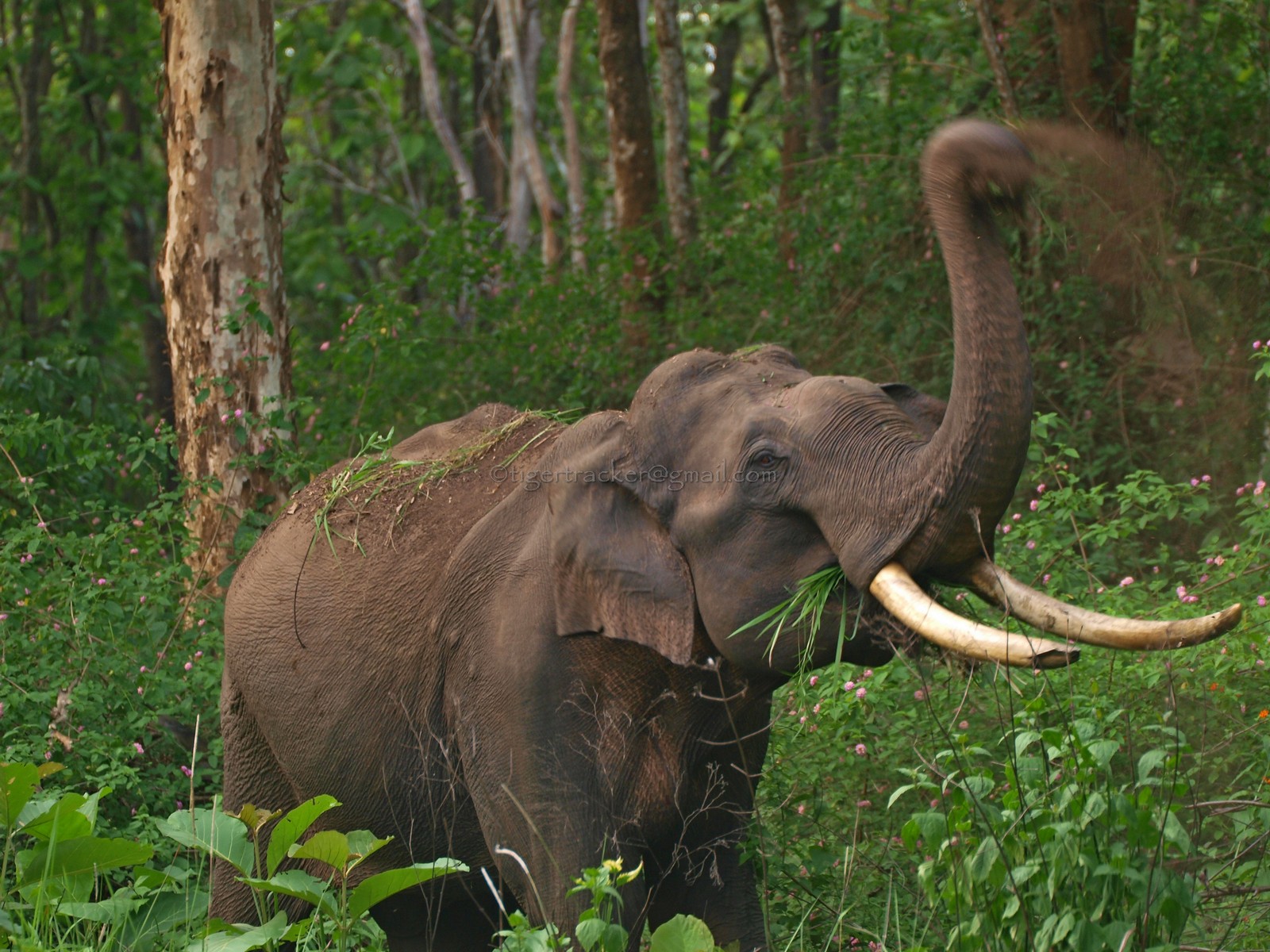
The first thing I saw was a pair of menacingly sharp white tusks. Then I saw the trunk, curling in different directions trying to pick up the scent of the intruder. It was a bull elephant! Fortunately I was still downwind and the elephant was moving very slowly, probably trying to be as noiseless as possible! I could see his grey hide and part of his ear through the branches and it seemed he was facing in my direction, perhaps even looking up and trying to locate the source of the sound which had disturbed him.


I knew it was time to move. The elephant could clamber up the slope without much effort, so it would be foolhardy of me to hang around longer. I carefully moved back towards the little forested patch below which my car was parked. This time I was careful to step only on bare rock so that the elephant would not guess in which direction I had gone.

After I reached the forest patch, I halted to listen for the sound of the elephant's movements. It was still coming up, but very slowly. I waited behind a tree about 75 meters from where I had been standing earlier. I knew all elephants were not dangerous and in case he was in a temperamental mood I had my escape route clear behind me. As the sound came closer, I saw something grey emerge over the edge of the slope a few feet below where I had been standing a little while earlier. Then the forehead and tusks came into view.


What a magnificent specimen? I have seen elephants at close range in Bandipur and Nagarahole but that was from the relative safety of a safari vehicle. I have never had an experience of a malicious charge. Mostly, it was mothers with little calves in tow that showed a tendency to get irritated and the mock charges were to scare you off. All the bull elephants only gave long hard looks before they went on their way. Some of them completely ignored us!

As this handsome bull emerged from below, I could see he was a young adult in his prime. My first concern was to see if he was in musth. My gaze went to the line between his ear hole and the eye. If he was in musth a wet patch can been seen starting from midway on this line, where the opening of the musth gland is, and flowing towards the mouth. It was a perfectly dry space on this tusker.


Then, as he reached the edge of the slope he looked in my direction, with ears forward. Perhaps he heard my camera clicking or he saw me standing there.


It was only once he reached the top that I realized how fortunate I had been. Here was a superb specimen of elephantine handsomeness and I had the privilege of setting my eyes on him at eye level, and on foot. It was my first face-off with a wild tusker on foot and all alone. I wasn't therefore very keen to provoke him into charging me. I stayed in the safety of the forest, partly hidden by some trees.


He had the most dignified look about him and I couldn't resist squeezing off a few more shots. He looked at me calmly and I could feel him telling me something. Almost as if he was a Messenger from the Wilderness. It seems, I had forgotten recently that there was more to nature than birds.  

Just on top of this slope is a flat rock with a small tree beside it, our Bodhi Tree. That was the rock on which my son and I had come and sat many a time just enjoying the feel of the winds blowing over us while we soaked ourselves in the the sights and sounds of the forest around us.Perhaps it was a wake up call; just a reminder that we forgot about Bandipur and our other regular haunts. Time has come for a revisit and also a revival of the Woodcrawler's Journal that has suffered a breakdown for nearly a year.

It seems the Messenger knew that I heard him. He turned, and walked off up the slope away from me. I too returned to my car, humbled by the experience. It is a rare privilege to encounter a handsome bull, all alone and on foot in a favourite patch of forest.


To those who think elephants are dangerous, I'll tell you that you are wrong. They are far more sensible than us humans and prefer to melt silently into the forest in the presence of humans but when we encroach into their territory and disturb them, they WILL retaliate. Don't forget, these gentle creatures, when provoked can be extremely angry and then it will be too late to regret.


My experience in Malampuzha was unexpected, though not entirely. I don't claim to be an expert in jungle craft but I've acquired some knowledge and minor skills that could get me out of many tricky situations. Remember, don't try anything foolhardy. Keep a safe distance if you know you are in the vicinity of elephants, especially herds with very small calves.

The latest idiotic trend is to try and take a selfie everywhere, including in the presence of wild elephants. That is outright stupid. Not only that, the flash in a camera, mobile or otherwise is very irritating to elephants and all wildlife in general. You can get yourself into trouble if you 'flash' at a pachyderm.

Next time you run into an elephant herd in the wild, remember that if you give them their space, they will almost surely ignore you and continue with their business of feeding. It is only when you deliberately provoke them that they react violently.

My instinct tells me that 2018 promises to be a great year for the Woodcrawlers of the world.

Happy Woodcrawling!

Sunday, August 16, 2015

Summer in Kabini - Part 1: Routes

April 2015,

(Pinks are links)

Kabini River Lodge of JLR, on the banks of Kabini reservoir, is reputedly their best resort. A jewel in the crown of Jungle Lodges & Resorts and a favourite of many of my photographer friends because the forests of the Rajiv Gandhi National Park ( or Nagarahole NP) was prime leopard country. The resort is located on the southern fringes of the park and my first visit was in 1999. An unforgettable trip because, throughout that visit, I shared a vehicle with Robert Plant of Led Zeppelin!


Routes
Kabini was a temptation that I resisted primarily due to one reason, the route and distance.

The first time I took a route that went almost up to Mysore through Sathyamangalam, Chamarajanagar, Najangud then got onto the Mysore-Manathavady road to reach Kharapur. A distance of more than 310 kilometers and a drive of 7- 8 hours.


Later, after Bandipur Safari Lodge came into existence (from what was the erstwhile KSTDC Mayura) I would drive up through Nilambur, Gudalur, Mudumalai, Bandipur, Gundlupet, Begur, Nugu and H.D Kote. This route was shorter by almost 30 kilometers compared to the previous one. From the last mentioned place I'd get on the Mysore Manathavady road again to reach my destination. This route also needed a 7 hour drive to cover the 280 kilometers.


Those were the days when the Mysore-Manathavady road was a nightmare to drive on. The 20 odd kilometers after the national park gates, would take, not less than a couple of hours; that is, if you did not stop to count the potholes and shoot pictures of the wildlife that would be wandering close to the road. On my last trip to Bandipur in January, whenI happened to break my Zuiko 300 mm f2.8, my friend Mohan Thomas told me that this nightmare road was now a pleasure to drive on. That decided me. I had to give in to my long-standing temptation!


Not only was this a better road but it also cuts some 40 kilometers from the Bandipur route! This road goes through Mannarkad, Pandikad, Manjeri, Mukkom, Thamrassery, Kalpetta and Manathavady. That is the route I followed to reach Nagarhole a few years ago. If you want the distances from Palakkad to Manathavady just check the first post of the Nights in Nagarahole series. The Kalpetta bypass mentioned as unmotorable has since been completed and it takes you onto the Manathavady road quickly. If you take the road through the aforementioned places, it is 205 kilometers from Palakkad to Manathavady.

About 10 kilometers after Manathavady, is Kattikulam (215 kms) where the road divides into two. The left goes to Tholpetty, Kutta and thence to Nagarahole. If Kabini River Lodge is your destination, take the right turn to Bavalli (223 kms), the Kerala-Karnataka border. 15 kilometers from Bavalli you reach the Balle check post. About 4 kilometers after that you have to turn right to Kharapur and Kabini River Lodge (249 kms).


To be continued.....................

Sunday, May 31, 2015

Dummies Guide to Creating a Man-eating Tiger!

Sometimes we see glaring evidences of the imperfections in God's creative skills. The most imperfect creature he created is Man and I'm sure he regrets not going through the blue-prints sufficiently before plunging into his task!


We are perhaps the only one in his countless creations that have an surfeit of evil over goodness, and of all the evils that God planted in us, ego is one of the worst. Ego is like cancer, the more you have the more it grows and eventually it overpowers the person that sometimes they think they are Gods themselves.

I am posting a video here that left many of my sensible friends and me shell shocked. This was uploaded on YouTube by a certain M**u R******t recently and has since been taken off after the uproar it caused. I am re-posting it here not to show how great the gentleman, M R, was but to tell you how not to behave in the jungle. This gent has a Facebook page that says he is a writer and a teacher who does not want to set a bad example for his students by writing on alcohol but for some strange reason has a website that has Rum Road and Ravings in its name! The link to the website, however, is not working but I got to his blog! Perhaps too much of rum and the he forgot to renew the domain!


Anyway, this video is his singular contribution on how to convert an innocent tiger into an alleged man eater, and get the poor creature get lynched by some frenzied mob. I want you to watch the video, look closely at the tiger's expressions before it bounds away into the jungle and also the reaction of the gent in question. While he is setting an bad example for many DSLR swinging wannabe photographers, there is a lesson to be learnt on how not to do things also.


Many of the tiger reserves in Kerala offer trekking packages, sometimes overnight, with armed guides. While, I admit, all guides cannot be viewed alike, there are certainly some bad apples like our guide in the video who will take you for are tiger show, shoot the video and pocket some money for massaging your already inflated ego! This video according to his Facebook album was shot in Parambikulam with the assistance of his guide.


Before the video was taken off there was a lengthy treatise in Malayalam, (wonder who has the patience to go through all that gibberish) on his success story but that is also gone missing now. The hero of this story is very proud of his achievement and rightfully so. After all, how many of us ordinary mortals have the influence in the right places to make an adventurous trip like that! I take pride in the fact that I am a nature photographer but have been very reluctant to use influence to get access to areas that are restricted to us 'ordinary mortals'. A very famous wildlife photographer is credited with saying that wildlife photography is not wildlife photography, unless done on foot! I agree, and I'd love the chance to be close to the ground, but how many wildlife sanctuaries or national parks permit access on foot?

Most, if not all, national parks in Karnataka have safaris on forest department or government vehicles. They are strict about numbers and that tourists should confine themselves to the vehicles at all times. It serves the purpose of protecting the person from unexpected attacks from disturbed wildlife. Most importantly, it works the other way too. I have had many opportunities to photograph wildlife at close quarters from such vehicles and never felt that I was disturbing them because we were always on the designated track.


When you are on foot, you are going off the beaten track, into the territory of the wildlife. However good your forest guide maybe, wildlife should be treated with respect. They are wild animals. Period. Rules and regulations apply on to humans. When we encroach on their rightful territory, they feel threatened and react instinctively. The Gavi incident, 21st January, where a couple of tourists were trampled is a prime example.


In the video above our hero M R, creeps as close a s possible to a resting tiger. He was lucky perhaps that it had eaten and was sleeping off the stupor! It was certainly surprised to see a two legged man thing so close to what it thought, was a safe place to sleep. It growls threateningly but notices that there is another person in the vicinity, so understanding that discretion is the better part of valour, turns and bounds off into the forest.

Let us assume for a moment that it was a tiger feeding or a tigress with very young cubs. The reaction in such a situation would have been very different. The animal would have probably taken the threat head on, in this case a quick leap and a ferocious attack. Our hero would have been badly mauled and perhaps been killed, not as food, but as a perceived threat. The guides can do nothing but stand and watch because things will need only a few seconds to go out of hand!

Then Mr. M R, would be real hero for the media, and the poor animal would be branded a man-eater! Public opinion would influence the forest department decision and in all likelihood the tiger would be trapped or killed.

A few selfish, egoistic folks like Mr. M R here don't realize that more than the risk they undertake on themselves, it is worse for the tiger. Already threatened and confined to increasingly restricted spaces, they sometimes stray into human settlements in the borders of forest areas. Tigers need large areas; 20 square kilometers for a tigress and 60-100 square kilometers for a male tiger.  Increasing tiger population, mind you, not in millions like us humans but hundreds, mean less space for them in their already shrinking habitats. If we invade their privacy, we are forcing them to change their behavior. A man-eater is created in our minds even if it is only a mauling. We would still blame the tiger and not the stimulus that created a man killer.

For God's sake let them live peacefully in their little pockets of peace. Refrain from such acts of foolishness Mr. M R, or anyone else. This is an appeal for the tiger and all other creatures that live in India's forests. Let them be. We humans are over-populating the planet so quickly that the day is not far off when we'll either have to colonize neighbouring planets or kill each other for space! Let these beautiful creatures, untainted by human traits or vices live peacefully in their little confines. I hope there will be some responsible people from the Forest Departments who will read this and ensure that such incidents do not happen in future.

UPDATE: 31st, May 2015, 6.30 PM
It seems that this issue is more murkier that what I thought! Apparently, as is evident from many of the Facebook, entries on Mr. M R's wall, this was part of a grandiose plan. He keeps referring to a 'project' that would keep him busy for a few weeks. It seems he was part of a group of photographers sub-contracted to scour the forests of Kerala on foot to gather photographic footage for a COFFEE TABLE BOOK to be released by a rather famous, or should I say infamous now, self-proclaimed 'Independent Conservation & Travel Photographer' who is Kerala Forest Department's current favourite. More details will follow as I gather them. Watch this space..........

Sunday, July 08, 2012

Nights in Nagarahole - The Final Chapter

I have delayed the last part of this series deliberately for many reasons but it got delayed a little longer than I expected with my BSNL broadband dying on me. It is still not up so I'm relying on my rather unrelaible Reliance USB stick, which claims on its surface to be a broadband but behaves like one of those old modems from the Sancharnet days!

27th May, 2012. A long weekend in the wilderness drew to a close. The previous night's excitement was fresh in the mind and a herd of chitals rushing down the road as if their tails were on fire promised an action packed departure. The herd halted their mad rush in front of the rest house and were looking back the way they came.

I was ready with my camera pointing in the general direction of where I expected a predator would most likely make its grand entry. That never happened because  a minute later a taxi appeared. It was the one from Mysore to pick my sister and family. It had reached very early. Not surprising, since the day starts early in Nagarahole


Mahadeva had readied khara bath to go with the bread and omlettes. All of us had long journeys back so we tucked into breakfast. As always leaving from a place teeming with wildlife is a heart wrenching experience for me and breakfast tasted like ash in my mouth. I cannot smile for a photograph. Period!


Rather than driving straight off towards Wayanad, I followed the taxi upto Murkal camp. We had taken a trip in the night to meet the gaur and we wanted to see how it looked in daylight. Besides, it gave us an excuse to hang around a little longer!


Now, largely abandoned, our plans to explore the camp had to be shelved. The minute our car halted we were promptly shooed off by the enthusiastic guard. Not wanting to break rules we co-operated and turned back. 


There were a row of buildings that looked like disused cottages. What an experience it would be to sit outside one of them and watch the nightlife of Nagarahole pass by? I guess that will remain a dream forever.


As we drove back wistfully the greenery gave way to dried up bamboo. Forest fires had happened earlier this year. We hoped it would not happen. A lone crested serpent eagle kept vigil on the bamboo, perhaps ensuring that we got out without damaging its habitat.


Just as we reach the park gates there is a banyan tree that my son calls the gate of Jurrassic Park. We drove through it with a promise to come back to this paradise very soon.

After the Karnataka-Kerala border the road passed through the Tholpetty range. The Tholpetty WLS allows private vehicles to go into the forest. The rate for a jeep is Rs.400/-. The forest department allots a guide and a vehicle for the 90 minute drive in the forest. They allow 30 vehicles in the morning and 20 in the evening. I can surmise what we will see in those 90 minutes especially if you are the last to get in!


Of course, if you missed the wildlife inside the WLS there are always a few wild creatures outside to keep you interested. It is always better to fertilize the trees rather than waste it in a King's toilet! A Malayalee is always concerned about the environment. After all, what is a little stench when a teak tree will benefit!

The roads in Wayanad are beautiful. All the way from Tholpetty to Thamaraserry it's an enjoyable winding drive if you can ignore the traffic.


Along the way we bumped into Mr. Bean but that is another story...........check Mango musings after a few days!


Sunday, June 10, 2012

Nights in Nagarahole - Part 5: The Day After


26th May, 2012. When I'm ensconed in the comforting embrace of the wilderness my whole being undergoes a change. A body that struggles to crawl out from under the sheets at 6.30 AM is up and about, all senses alert, by 5.00 AM in the wild. Nagarahole was no exception.

Ablutions over, I went over to window to welcome the morning. The sky was just brightening in the East and the last few stragglers of the chital herd that came in for the night were still under the gulmohar tree.

The morning begins quietly in Nagarahole. The park gates open at 6.00 AM but there were no speeding vehicles with blaring horns trying to outrun each other. This was Nagarahole, not Bandipur.

A hot cup of tea and we were out on the road by 7 AM because we had been told that a jeep had been arranged at the Nagarahole reception center for a morning trip into the jungle. We watched the last of the chital move off into the forest. It seemed to be a good day for the herbivores.

Kushalappa, the driver, was waiting at the office. "You should have been here at 6 AM", he told us. Unfortunately, the range officer had informed us that the vehicle would be ready only by 7.30 AM. Unlike many drivers I know Kushalappa was very well informed about the forest he was driving in and for his age he had a rather keen eye for spotting wildlife.

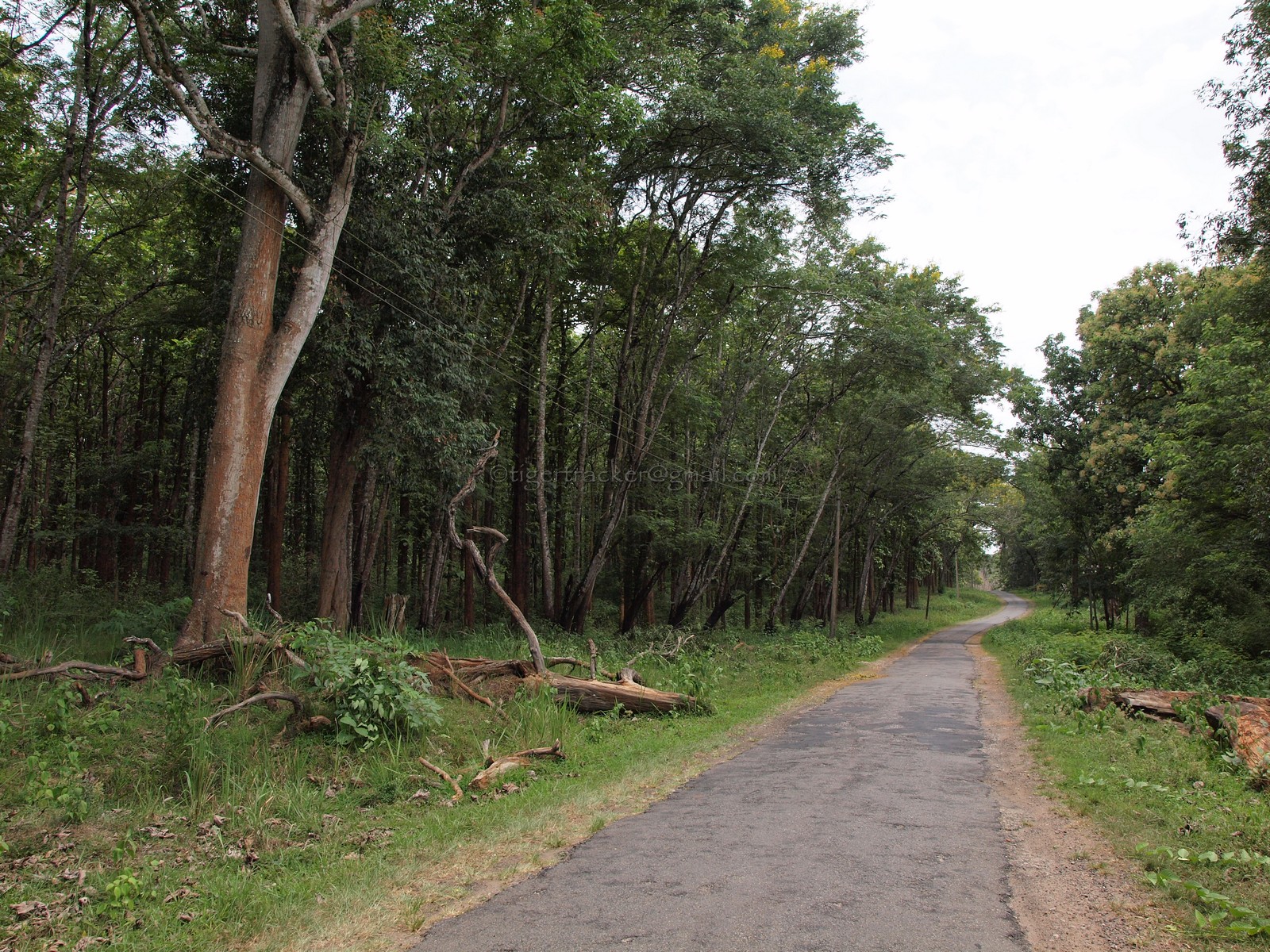
Not much could be expected at half past seven but the forest had it's own beauty. Large swathes of teak forests with trees that were between 30 - 60 years old arched over the track.

Placid waterholes at every turn but with nary a movement. Even the morning mist that floats over the water was gone. Summer showing its colours.

The lonely egret walked forward in slow motion, watching for breakfast to swim by in the murky water around its legs.....

 ..... the terrapins decorated the tips of the submerged tree trunks. Basking in the early morning sun, they looked like sculptures in the midst of the brown water.


The only activity in the morning were the chitals near a watch tower. Some grazing, some sparring and some just soaking the morning sun. Life was Beautiful in Nagarahole. The elephant census had just concluded and it would be a little unreasonable to expect a predator to just rush out of the bushes!


Just as we were about to conclude our morning round we heard the unmistakable clicking call of the Malabar Giant Squirrel. Sure enough, up in the canopy an eye appeared from behind a trunk.

After a minute of assessing us it decided that we were not competing for breakfast and came out in the open to pick its choice of fruit & nut.

There was a whole day ahead of us as we sat down to a leisurely breakfast of home made idlis. It didn't take much effort for us to polish off the entire container!


We were the only souls in the reception area that morning. Even the car looked lonely in the parking lot.

We had to find something to do for the morning and as we mulled over it as we collect some plastic litter and disposed it safely.

As we got into the car we saw why Kushalappa had chided us. Timings in Nagarahole were a little different. Here, the priority was for the wildlife, not humans. I remember once, in Bandipur, a loud mouthed 'wildlife photographer' from the North making more noise than a trumpeting elephant and complaining about the insufficient opportunities for his camera because of the time restrictions. Of course, his only interest was getting a tiger in his sights. The rest of the jungle could have well been invisible. I stopped short of telling him to go to the zoo! I hope our forest remains unchanged forever.

The lunch menu had been entrusted with Mahadeva so we had to kill time till he could place it on the table. Thirunelly wasn't too far away and we could get back in time. Besides, we had to pick up another feathered creature for our dinner table!

As we drove out of the park we discovered the reason for our powerless night. A snapped electric line with branch over it.

Mahadeva had assured us the the power would be restored when we got back but chances seemed remote. We were worried about the butter in the fridge! Our worries were unfounded. On our way back from Thirunelly the line had been repaired. The chicken in the back of the car would be alright after all!

(The Thirunelly leg of the trip is another story. Please watch for a link that I'll place here shortly. The full story will come in Mango Musings & other Seasonal stories)

Mahadeva had readied a sumptuous lunch. We were rolling like hippos after lunch and a siesta was in order. In any case, there were no definite plans for the evening.  The siesta was never destined to be completed, as we had a visitor. Mr Vijay Ranjan Singh, Conservator of Forests & Director of the Rajiv Gandhi National Park. We spent a good hour in conversation, of which I'll relate in a separate blog.

We did go on another round in the evening but Mr.F who doubled up as the driver was all at sea in Nagarahole. He was in charge of the Kallahalla range and was totally lost in Nagarahole. Even the tourism zone tracks were unfamiliar to him so we called it a day and returned to the rest house.

Mr. V.R Singh had told us about a tiger who had made the Karmadu junction his favourite evening resting spot so we got into the car and went for a drive. There was no tiger but the elephants were making their presence felt as the sun went down.

Hollow tusk, as I chose to call him was there with his wife.


His right tusk was broken, perhaps in a fight, or maybe just rotted off, but he was still a handsome bull. The pair seemed inseparable. It was something I wasn't familiar with. An elephant couple without the rest of the herd anywhere in sight! I had seen them together earlier in the morning on the way to the reception center. Since the cow was in a belligerent mood we rushed past without slowing for a good picture.


Hollow tusk was probably older than King Elephant, and so more wily when it came to getting the attention of the ladies!  He was more keen on looking good and applying what is suspect is the equivalent of the fairness creams our Bollywood heroes promote. Slowing down near him had no effect on his composure.


 Even his lady love seemed calmer than she was in the morning. Despite four cars full of gawking humans on the road beside her, she ambled off without paying any attention.

A few hundred meters further down the road I spied something lying in the middle of the road. I slowed down to see what it was and before I could get a hand to my camera it skimmed across into the grass. I was a spectacled cobra. 

Karmadu junction did not have the tiger waiting. There was this guy in his car having a leisurely conversation on his cell phone. I was wondering about parking vehicles within the national park. Driving down the road was like going through a bamboo thicket. Dried and broken bamboo were lying on the road and on either side of it. It was an after effect of bamboo flowering after a few decades.

 
They were a potential fire hazard as it had been proven in March- April. Nagarahole has its share of horror stories. Forest fires that have been deliberate more than accidental. The conservator of forests had told us his story (which I will record separately). We were just wondering about the consequences


... and the TV news link is here.

While the Forest Department and NGO's point fingers at each other, the fact remains that it is the wildlife & forest that suffers.


As darkness settled a hesitant little animal came onto the road. "Camera", I hissed but I needn't have asked. Barking deer are too shy to wait and pose like the chital or gaur. We returned to the rest house to wash off the days dust and grime.

Power did not fail and Mahadeva's prediction of power being available for the night seemed true.The heaters in the bathrooms and fridge were working. A nice hot bath washed away the weariness from the body. We were ready for Mahadeva's dinner.


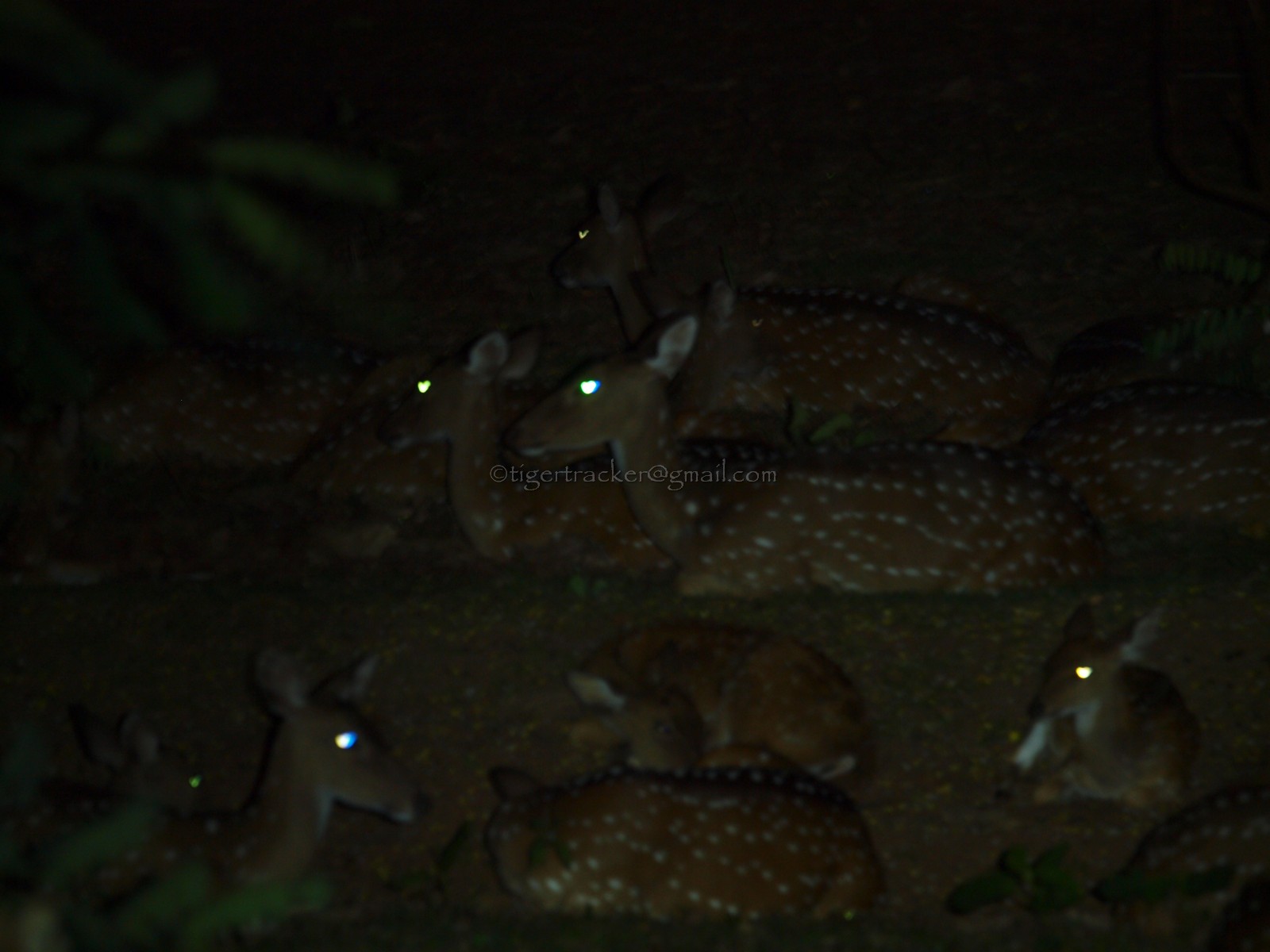
Kallahalla was settling for the night and so were we. Sitting in the the darkness in the lounge we awaited the arrival of the 'resident' leopard. According to Mr.F, it would appear around 8 PM most evenings to pick out a well fed chital from the herd that gathers in front of the lodge.


Not wanting to disturb the creatures we shone our flash light to take these pictures. Flash would spook them and in any case the on board flash was grossly inadequate. The herd were peaceful. No signs of alarm till well past 10 PM. Our eyelids were drooping to and we decided that the leopard had already fed and probably was not going to hunt again this night.


An hour after we hit the bed I heard, through the darkness and haze in my head, the sound of a chital's alarm call. Something was happening. We scrambled out of bed and peered out of our windows. The chitals had disappeared. A couple of them were standing under the gulmohar tree looking in the direction of the road. Perhaps the leopard had come after all. 

It was not our night but the experience was unparalleled. Nagarahole is a memory that won't fade away too quickly.

Watch this space.......