Sunday, August 16, 2015

Summer in Kabini - Part 1: Routes

April 2015,

(Pinks are links)

Kabini River Lodge of JLR, on the banks of Kabini reservoir, is reputedly their best resort. A jewel in the crown of Jungle Lodges & Resorts and a favourite of many of my photographer friends because the forests of the Rajiv Gandhi National Park ( or Nagarahole NP) was prime leopard country. The resort is located on the southern fringes of the park and my first visit was in 1999. An unforgettable trip because, throughout that visit, I shared a vehicle with Robert Plant of Led Zeppelin!


Routes
Kabini was a temptation that I resisted primarily due to one reason, the route and distance.

The first time I took a route that went almost up to Mysore through Sathyamangalam, Chamarajanagar, Najangud then got onto the Mysore-Manathavady road to reach Kharapur. A distance of more than 310 kilometers and a drive of 7- 8 hours.


Later, after Bandipur Safari Lodge came into existence (from what was the erstwhile KSTDC Mayura) I would drive up through Nilambur, Gudalur, Mudumalai, Bandipur, Gundlupet, Begur, Nugu and H.D Kote. This route was shorter by almost 30 kilometers compared to the previous one. From the last mentioned place I'd get on the Mysore Manathavady road again to reach my destination. This route also needed a 7 hour drive to cover the 280 kilometers.


Those were the days when the Mysore-Manathavady road was a nightmare to drive on. The 20 odd kilometers after the national park gates, would take, not less than a couple of hours; that is, if you did not stop to count the potholes and shoot pictures of the wildlife that would be wandering close to the road. On my last trip to Bandipur in January, whenI happened to break my Zuiko 300 mm f2.8, my friend Mohan Thomas told me that this nightmare road was now a pleasure to drive on. That decided me. I had to give in to my long-standing temptation!


Not only was this a better road but it also cuts some 40 kilometers from the Bandipur route! This road goes through Mannarkad, Pandikad, Manjeri, Mukkom, Thamrassery, Kalpetta and Manathavady. That is the route I followed to reach Nagarhole a few years ago. If you want the distances from Palakkad to Manathavady just check the first post of the Nights in Nagarahole series. The Kalpetta bypass mentioned as unmotorable has since been completed and it takes you onto the Manathavady road quickly. If you take the road through the aforementioned places, it is 205 kilometers from Palakkad to Manathavady.

About 10 kilometers after Manathavady, is Kattikulam (215 kms) where the road divides into two. The left goes to Tholpetty, Kutta and thence to Nagarahole. If Kabini River Lodge is your destination, take the right turn to Bavalli (223 kms), the Kerala-Karnataka border. 15 kilometers from Bavalli you reach the Balle check post. About 4 kilometers after that you have to turn right to Kharapur and Kabini River Lodge (249 kms).


To be continued.....................

Sunday, August 09, 2015

Nightmare in Bandipur - Part 3 : Leopards on the prowl

26th January, 2015

Link to previous post here

The reason I was in Bandipur this trip was Republic Day. Sometimes there is a suspicion about who is more excited about a school holiday that falls outside of the usual vacation seasons. Since my son insists on 100% attendance at school, I make use of every little opportunity to run off into the jungles.

Pic Courtesy: Skandapoorvaja
Handicapped as I was, the morning of 26th January held little interest for me. The damaged 300mm still weighed on me and I was in two minds whether to go on the morning safari. The previous evening's leopard notwithstanding, I was loathe to go with without my favourite lens.

Finally, not wanting to waste an opportunity to just bump around my favourite tiger reserve, I clambered into the vehicle. Morning safaris were usually quiet affairs as the larger mammals and the predators would become active only as the sun came up. It was winter and there was a nip in the air, we pulled our headgears down to cover our ears and hunkered down for what we though would be a cold and uncomfortable drive.

An hour into the drive we saw another vehicle pulled up ahead of us. There was, apparently, a leopard in the bushes and it would probably cross the track! Our driver thought he was a clever bloke and said it would come out on the track that branched off, a little behind where we had stopped. So he backed up to the previous junction to cover both tracks.

Suddenly the folks in the vehicle ahead of us jumped up and started clicking furiously. By the time our driver got us back to the original point the leopard had decided to go deeper into the forest rather than cross the track in front of two vehicle load of crazy humans!

Skanda managed to get a few face on shots, like the one above, but me? I never got anything as nice!


If I had stayed back brooding over my loss I would have missed this. It seems Bandipur was compensating!

I was still not used to the fact that I was holding a zoom instead of a prime. Using the zoom ring and in-body tele-converter was taking a little bit of effort and some jiggling of my memory. I'd have to get used to it unless something totally unexpected happened!


Juvenile crested serpent eagle

White eyed buzzard

White eyed buzzard


The Kabini trip report is pending and hopefully it will be up next weekend. Between this trip and the one to Kabini I was lying low. The damage to my Zuiko 300mm f 2.8 was still not off my mind. Apparently it had to go to the Tatsuno facility in Japan for repairs and the service center in India was having problems sending it. Then something unexpected happened!

My Kabini trip with my new 'girfriend will be up shortly! Watch this space. I will update it before my upcoming trip to Bandipur and Masinagudi later this month.

Happy Woodcrawling.............

Nightmare in Bandipur - Part 2 : E-M1 finds a Leopard!

25th January, 2015

Link to the previous post here

How I passed the night of the 24th January I will never know, but it was a really long, restless one. A photographic catastrophe is something that cannot be put in a few words. Your best lens is like your girlfriend! You are so smitten by her that you take her for granted and when she leaves you in the lurch rather unexpectedly, it is a truly deflating experience! I'm sure no one will disagree on that count!

My Photographic Journey has been an interesting one and the the high point was the day I got my 'girlfriend', the Zuiko 300mm f2.8. That was sometime in December of 2011. It was the best 300mm f2.8 anywhere by any manufacturer and  Olympus' Zuiko lenses are legendary for their rendition of colours. So when my lens broke, I was shell shocked.

Luckily, I had carried my Zuiko 50-200mm f2.8-3.5 SWD another rugged lens that was doing duty before the 300mm  came. It had itself suffered a breakage on a trip to Nagarahole in the summer of 2012. From that experience I had learned that getting these fine lenses repaired, meant shipping them to Singapore or Japan, because Tatsuno did not trust them in anyone else's hands!

I had somehow managed to remove the broken mount ring of the 300mm from the E-M1 and with a prayer I mounted the Zuiko 50-200mm SWD. It worked! So I was not totally handicapped after all. With the digital 2x teleconvertor in the E-M1 I had a 100-400 f 2.8-3.5 now. It would never replace my favourite 'girlfriend' but at least I had a new mate for the E-M1. My previous trip was in December, just before Christmas and for just a day. That was because I had got my E-M1 and wanted to test it out in the field. There were not many photo opportunities because it was raining and I was on a one day trip.

I never knew God's were kind to sad people! The morning safari was all about birds and a lone tusker. The Zuiko 50-200mm SWD was doing a reasonably good job but it would never replace a 300mm f.2.8.


A hoopoe looking for snacks in burnt grass

Streak throated woodpecker (female)

Brahminy starling

Langur with her little one

Tusker


The evening drive was monotonously uninteresting. Forests have never ceased to amaze me in any season but this was an unusual trip. I had lost my 'girlfriend' and I was in depression. It was around 5.00 PM, half way through the safari and we were waiting outside the anti-poaching camp because someone wanted to answer the call of nature!

Suddenly, behind us, appeared a Duster! We backed up to stop them and ask how they got in and our driver realized that one of then was some forest official.


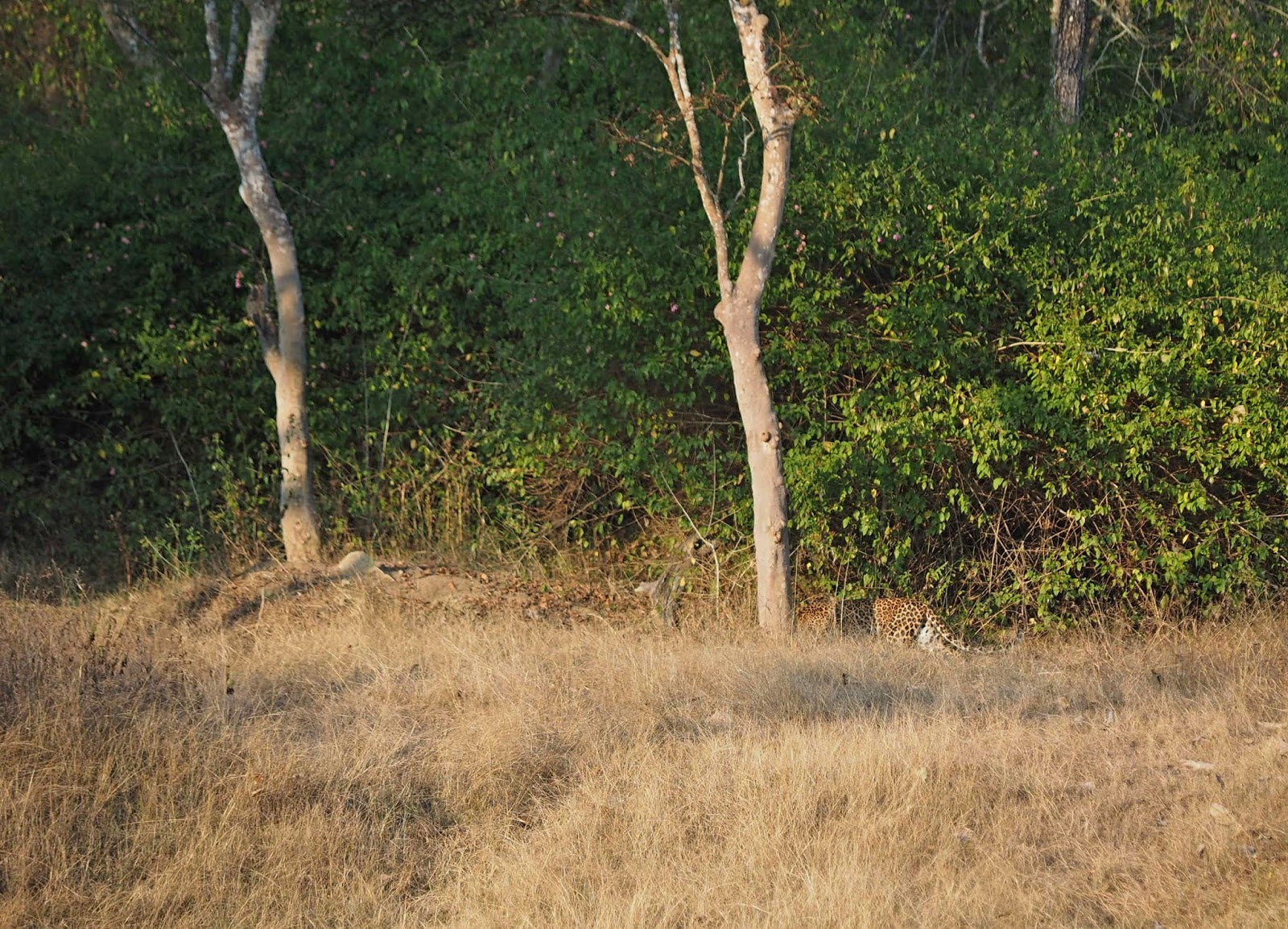
They seemed to be looking at something to their right and when we looked in that direction this is what we saw! A leopard slinking across the track!


It all happened so fast and in a moving vehicle, I did not have time to react. The leopard disappeared into the lantana.


We raced back to our position in front of the anti-poaching camp. There was a waterhole in front of it and the leopard was obviously making a beeline for it! The adrenaline rush that accompanies the sight of a predator is something that defies description. My fiasco of the previous day was forgotten and I only had eyes for a magnificent creature that would make its appearance any moment now!

A few minutes of anxious waiting and a head popped out of the undergrowth.


 It looked around, up into a tree, at us and at the waterhole.


Then decided that this was not a place to be in and walked off into a nullah and disappeared.


For an evening without even a gaur or elephant, this was a bonus. As the excitement settled and we started on our drive back I was reviewing the photos. I suddenly realized that the leopard appeared too small!

I had completely forgotten that I had a different lens attached to my camera and I had not zoomed in! I had shot at around 125 mm and also failed to use the 2x digital converter! A slight disappointment but something I'd have to get used to till my 300mm was repaired.

That was not the last of the leopards on this trip. Watch this space.....


Friday, August 07, 2015

Nightmare in Bandipur - Part 1 : Death of the Zuiko 300mm f 2.8

January 2015

Some times we take many things for granted. Our family, our colleagues, our cars, our gadgets and many more things we use or own.

My photography gear is one such thing that I've gotten used to taking for granted. As the collection of camera bodies and lenses grew, my travels reached a stage where there would be one bag of clothes and three of gear! One of these bags with gear had my E3 body mated to the Zuiko 300mm f 2.8 with a 2x TC. I rarely split the three because my E-M5 would take care of all other requirements. It was about then that I had got my E-M1 and this trip was supposed to be a shoot out between the two Micro Four-third bodies. I had sort of retired the E3 and mounted the  300mm f2.8 on the E-M1.

In January of 2015, we went back to Bandipur for the umpteenth time. After checking in I walked around looking for birds in the resort's trees. I got this one, and never knew that it was the last few pictures I would shoot with my beloved Zuiko 300mm f 2.8.


The evening safari wasn't very eventful in terms of sighting but it was just as well that it happened to be that way. I never knew it would turn out to be safari I wanted to forget, (and so the delay in this post). A family of sambar deer passed us by.


A grey jungle fowl was scratching in the dust just ahead of us. He looked majestic in the evening sun.


The E-M1 was sitting on my lap under a shemagh. It was a dusty day and I wasn't keen on getting my gear more dirtier than necessary. The forest department had been working the fire lines and the track sides were charred. Chital were moving as the sun sank low on the horizon.


I was thinking that everything was brown or black. It wasn't summer yet but it looked like summer. Then I felt something give. The camera on my lap fell off from the lens. For a moment I was shocked. How could I have been so stupid to not have mounted the lens properly? I lifted the shemagh off to see what had happened, and then I froze in horror.

For a few moments, I was too shocked for words and then realization dawned. My best lens was in two pieces on my lap. The mounting ring had split in two. The main part of the lens had fallen off on one side and the mounting ring was still attached to the camera body!


The rest of that safari is a very vague memory. I wasn't interested any more. It was a photographer's nightmare! The Zuiko 300mm f 2.8 was my best lens and it was dead for all practical purposes. None of the lens elements were broken but the AF wiring was torn off. No communication was possible between the camera body and the lens; not even manual focussing was possible.

I returned to the resort a broken man. I was too numb and dinner went down like a lump of tasteless clay! What you see here are the last few pictures I clicked with my favourite lens.

I was not sure if I would find a solution or even a new lens. Olympus has discontinued the Four-thirds series so new lenses they were releasing were only for the Micro Four-third bodies. The rest of my Bandipur trip was something I want to forget!

Oh! Before I forget, the leopards saved my trip! That is in the next post of this series.......!


Sunday, July 26, 2015

Parambikulam - Forest of Teaks & Tigers

The Western Ghats or Sahyadris, is a stretch of mountains running south along the western edge of the Indian peninsula. Starting somewhere on the border between Gujarat and Maharashtra it runs south through Maharashra, Goa, Karnataka, Kerala and ends at Kanyakumari in Tamilnadu. 

It is now an UNESCO World Heritage Site and in its 1600 kilometers of nearly unbroken terrain, encompasses within its 160,000 square kilometers, one of the world's 10 most hottest 'biodiversity hotspots'! Along its length it includes 39 major national parks, wildlife sanctuaries and reserve forests; 20 in Kerala, 10 in Karnataka, 5 in Tamilnadu and 4 in Maharashtra.


I said 'nearly unbroken' because when it reaches the middle of Kerala the Western Ghats suddenly sinks to the ground from an average elevation of nearly 2700 meters to just 140 meters above MSL for about 30 kilometers of its' length. This is the Palghat Gap, a cleavage in this mountain chain allowing an east-west access from the peninsula to the west coast. On the north lies the Nilgiri Biosphere Reserve and the south is flanked by the Anaimalai hills.


On the northern edge of the Anaimalai hills, in Palakkad district is Nelliyampathy and it forms the northern border of Parmbikulam Tiger Reserve. Parambikulam sits in one of the biodiversity rich parts of the Western Ghats. On the west is the Peechi-Vazhani WLS and Sholyar. On the east is the Aliyar RF, Indira Gandhi National Park and Chinnar WLS. On the south is the Sholayar reservoir and Chalakudy river, beyond which lies Idamalayar. At the southern tip of this approximately triangular part of the western ghats is Idukki WLS and Periyar Tiger Reserve


This is an area that I could spend wandering around for the rest of my life, if I could!

I have been to Parambikulam only twice before, in an era when you could drive into the forest in your own vehicle accompanied by the mandatory guide deputed by the Forest Department from the local EDC. That was over a decade ago when Parambikulam was a wildlife sanctuary. There were not many restrictions on the route we could drive on and it was an experience that can never be repeated now. With the elevation of the WLS to a Tiger Reserve in 2009 many restrictions have been put in place to ensure the tiger and its prey base are well protected. This trip was done last monsoon though I'm recording it now!

ROUTES & ACCESS: (All distances from Palakkad)
Though Parambikulam is in Kerala the only access, by road, is through Tamilnadu. Most of those traveling from outside Kerala will have to reach Pollachi before joining up with the road from Kerala at Ambarampalayam. Those coming along the west coast highway (NH-17) from Mangalore side will eventually have to reach Palakkad.

Travellers driving up from South Kerala will have to turn off  on the NH 544 (the erstwhile NH 47) to Nemmara from Vadakancherry. That route will pass through Kollengode before eventually reaching Meenakshipuram, the common point for the three routes. For those coming from North Kerala there are two routes from Palakkad. 

You can either drive up the Palakkad-Pollachi road upto Gopalapuram and take a right turn near the check post to Meenakshipuram. The other route, that people like me living in the town can take is the Palakkad-Koduvayur road, turn left at Koduvayur to Thattamangalam (also spelt Tattamangalam) (21 kms). Immediately after Thattamagalam  the road divides into two. Take a right turn towards Vandithavalam and Meenakshipuram (41 kms); the left goes to Chittur. Ambarampalayam (49 kms) is 8 kilometers after Meenakshipuram, where you have to turn right to Anaimalai (55 kms). In the center of Anaimalai town take a right to Vetaikaranpudur (58Kms) and eventually Sethumadai (66 kms).

Sethumadai, where you turn right to Parambikulam
The road swings right at Sethumadai and reaches the first of the many check posts on the road to Parambikulam. The first check post, at the bottom of the ghats, is controlled by the Tamilnadu Forest Department. You have to register your vehicle and passenger details here first. 

The first check post

The second check post is in Top Slip (76 kms) where you again have to get out and sign another register. The TNFD has rest houses and dormitories in Top Slip. There is a basic forest department canteen where food can be obtained by prior order. 

TNFD Forest rest house at Top Slip


The third check post is at the border of the Parambikulam Tiger Reserve, manned by the Kerala Forest Department. Your vehicle will be subjected to a thorough check for liquor, plastics and the like before being allowed to go further. The last check post is at Anapaddi, where you have to leave your vehicles if you are a day tripper. Private vehicles are permitted beyond this point only if you have booking at one of the available accommodation facilities run by the department. Once again, a guide is allotted for each vehicle. 

For day trippers the department organizes a three hour bus trip to all the important places in Parambikulam. There is a stop at Thunakadavu dam. The FD has a tree house on the edge of the reservoir. 


Thunakadavu
It is from here the bus takes you on a short drive through the forest up to the Kannimara Teak, reputedly one of the oldest and largest teak trees in the world. 

Kannimara's canopy

Full length view of the Kannimara tree


During this drive you have the best chance of spotting some wildlife. Since our trip was during the monsoon there was not much activity of the larger mammals. 

Chitals


Wild boar relaxing in the slush

Nilgiri langur & Malabar Giant squirrel


Nilgiri langur juvenile

Malabar Giant Squirrel
Once you finish the Kannimara teak visit, the rest of the drive is on asphalted road. The bus halts briefly at a view point from where you can see dam you just left behind. The reservoir is just a small shining patch in the middle of the lush forest that covers all the landscape as far as eyes can see.

Thunakadavu from the view point


The final stop is in Parambikulam (81 kms) dam site and the township. If you are on a day trip you can find small eateries here or you can fix up with the canteen at Anappadi check post. We had carried a packed lunch so that was not required.


The forest department has another tree house and a rest house with rooms here. The best accommodation appears to be their Tented Niche at Anappadi. A small patch of forest fenced off near the  check post. They have tented accommodation that can be booked for overnight trips. I am yet to do a trip there but that is the next on my agenda.

We stopped at the Anapaddi check post and unpacked our lunch in the company of butterflies, peacocks and a rhesus macaque who was trying very hard to appear uninterested in our lunch!


THINGS TO REMEMBER:
  1. Parambikulam is easily accessed from Palakkad or Pollachi so you can have your base in one of these places.
  2. Start early from Palakkad. You can stop at the Sakthi Resorts just outside Ambarampalayam for  breakfast. Be warned, they seem to have a very laid back attitude and we spent an hour waiting for breakfast. Otherwise pack your breakfast and lunch for the trip.
  3. Carry no plastics or liquor. They are very strict about it and will confiscate bottles. They only keep a count of plastic bags and bottles. 
  4. The check posts open at 6.00 AM and close at 6.00 PM. Cross the Top Slip check post on time otherwise the Sethumadai check post will be locked and you will have a little hassle. 
  5. The best option appears to go on an overnight trip or a two night package that the forest department offers. Though you are not allowed to drive around in your own vehicle, the FD has a dusk drive at 6.00 PM. Ideal time when the wildlife are getting active. Leopards are very often seen in the evenings though tigers are rarely seen.

Happy Woodcrawling...................