Showing posts with label Magnetic Hill. Show all posts

Wednesday, September 13, 2023

Ladakh & Life Lessons - Part 6: Magnetic Myth & The Confluence

 July 17th 2023, 11.20 AM Srinagar - Leh Highway

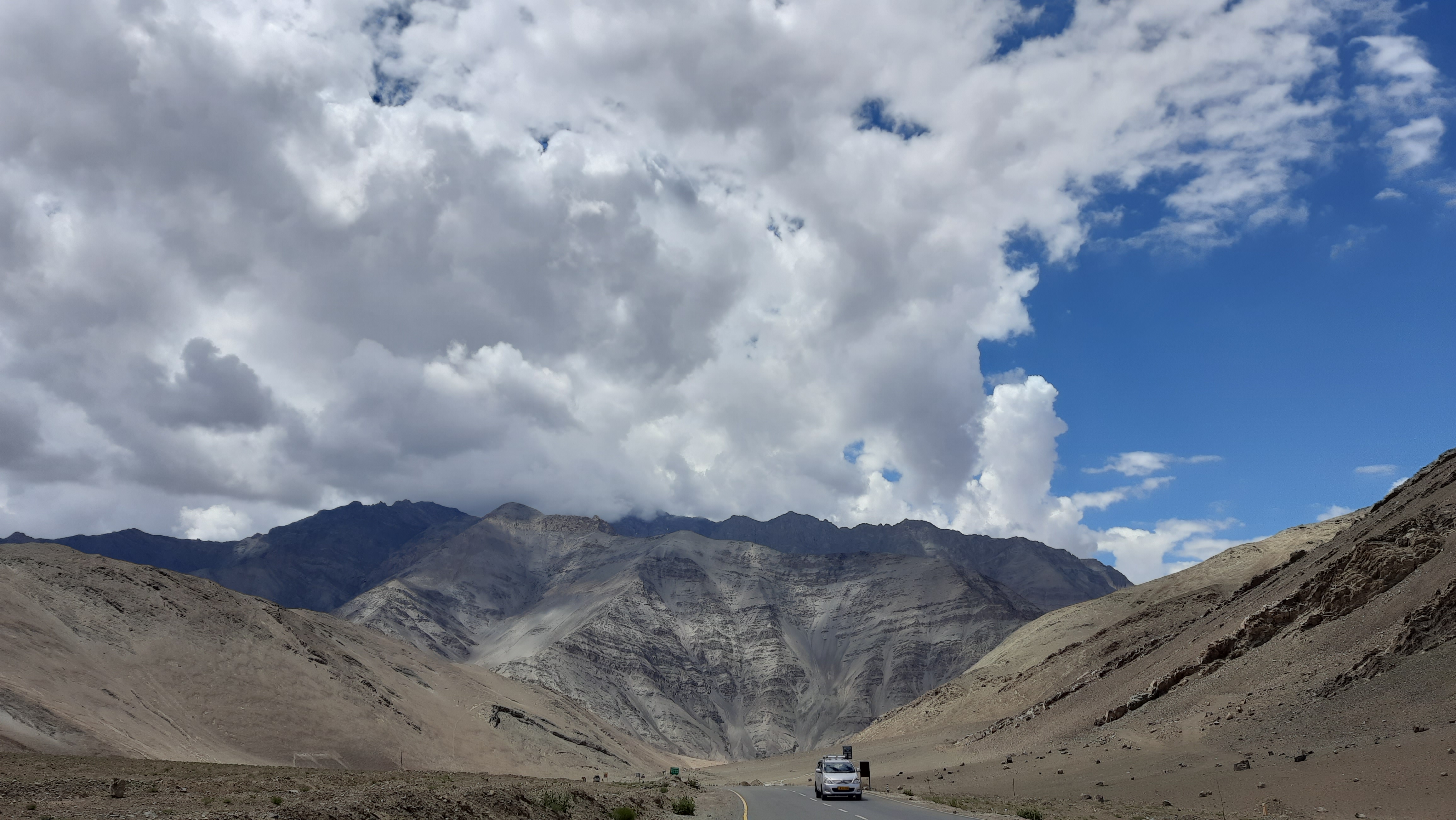
A little after quarter past eleven, we were at the famous Magnetic Hill. This location on the National Highway is famous, or should I say infamous, reputation for pulling vehicles up a slope and that too at 20 kmph!! It appears, every tourist to Leh, on their first visit will come here and 'gasp' at this phenomenon. Gasp, you will, not because of magnetism but because of the rarefied air. Let's take a few deep breaths and then investigate this astounding miracle!

Busting the Magnetic Hill Myth

According to the local myth vehicles parked in neutral with ignition switched off, will roll 'uphill' by themselves. There is painted box on the highway where you can park your vehicle and the feel it roll. It should roll from west to east, if it is going UP the slope. If you are that crazy type, you can even get off, pursue the runaway vehicle and hop on! Just that you should be able to run at 20 kmph, if the stories are to be believed. I wouldn't risk it because, suppose I did and ran after the vehicle at 20 kmph, at an altitude of around 11,500 feet (3500 metres), I would be on the ground rolling for breath in a few meters. I would be a victim of Acute Mountain Sickness and the vehicle would have rolled off the road at the end of the curve ahead. After all, I would have only had about 24 hours or slightly more to get acclimatised!

There are three explanations being bandied about to explain this extraordinary phenomenon. 

1. The first one is that the hill, that has this unique property, is believed to be a Gateway to Heaven and there existed a 'road' from top of the hill through which 'good' people went to heaven but 'bad' people wouldn't be able to. I'm only wondering; are all the cars filled with only 'good' people?! Maybe it is wormhole to another dimension. 

Personally, I think, with the current discord with my Gods, the Stairway to Heaven or more than likely the Road to Hell will be my option! (Please click the song names for some lovely music!) 

2. The second one attributes this phenomenon to a strong magnetic field emanating from the surrounding hills to the west that it pulls vehicles that are stationary. It is even said that planes avoid flying over this area due to magnetic interference. I am only wondering, how an airplane made predominantly of aluminum and composites, with less than 10% steel and flying between 35,000 to 40,000 above sea level will be affected by this. Starting to sound like Bermuda Triangle? Don't worry, no plane has crashed on the mountains here or disappeared through the 'wormhole' never to be seen again. I only have a simple question. Why didn't the coins in my pocket not fly out and get stuck on the hills? Are coins non-magnetic? Similarly, there will be so many small magnetic objects we carry on us. If a big 1 to 2 ton vehicle can be pulled, why not objects only weighing a few grams? A point to ponder.

3. The third explanation is that the obstruction of the horizon by the mountains creating an optical illusion that makes the road appear to be going upwards though it is actually going downwards. In any case, all three of us had good eyesight so we could see the road sloping from east to west. I feel, it is more of a case of 'been there, done that' for most travellers passing Magnetic Hill. A good yarn to spin after getting back home. 

We too joined the enthusiastic folk testing out the magnetism of the hill but I was only increasingly convinced that it is a hoax that has been fuelled up to have been made into a myth. Our car travelling from Leh was going downward on the slope. The point where the box for parking the vehicle seemed slightly level and further down the road slopes downwards again. Tsewangji parked our car in the designated spot and the car simply rolled downhill, not uphill!


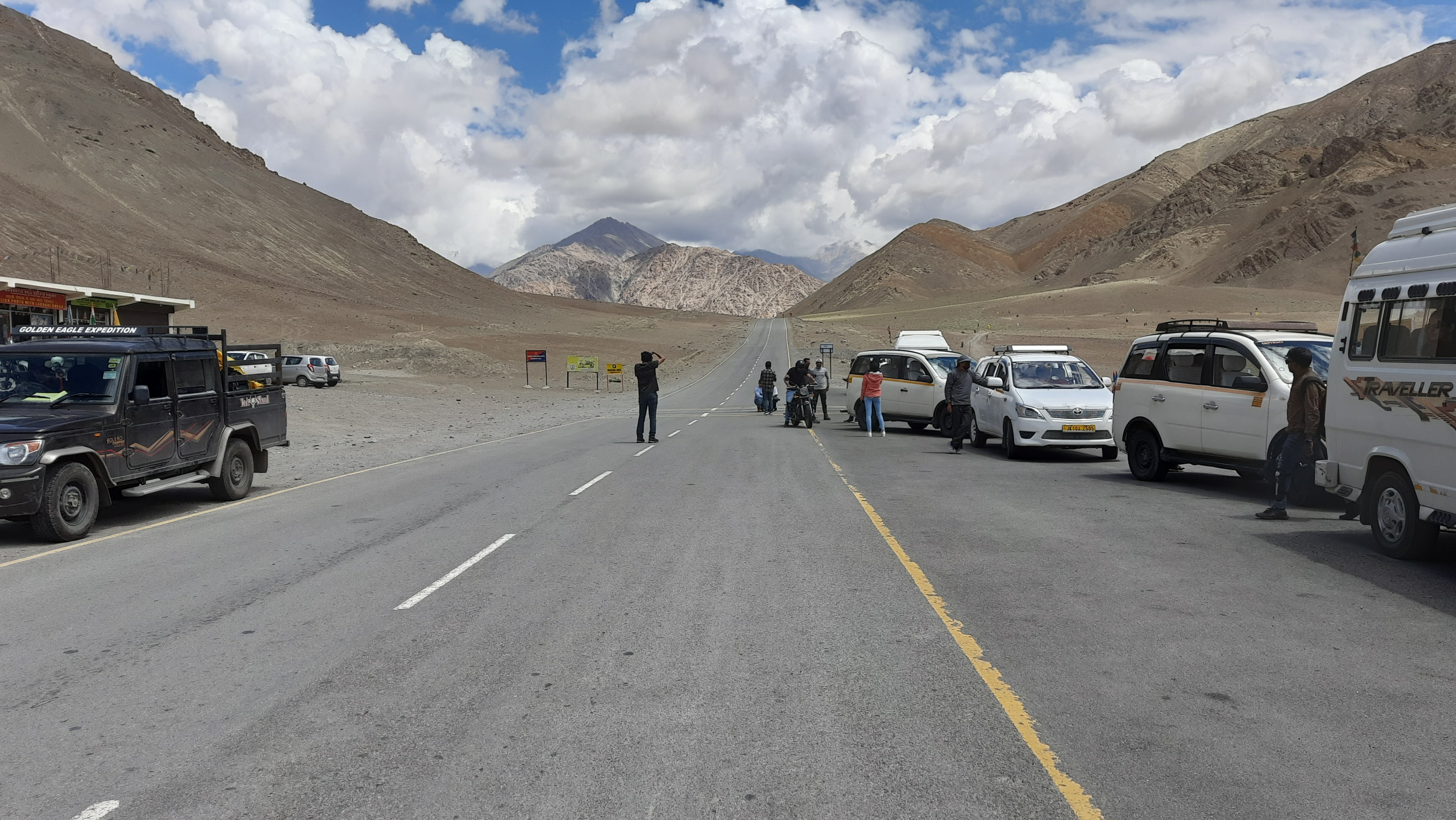

While we were standing there a truck came labouring its way across the slope. It the hills were truly magnetic on top of the slope (east) it should have gone up the slope effortlessly, aided by magnetism! It is hard to believe that sensible people fall for this trick. 


The road, without doubt is visibly sloping downwards from east to west and it would require really bad eyesight to induce yourself to see it any other way. There certainly is no optical illusion either. If you feel there is, do come to us. Both, my wife and I happen to be ophthalmologists!

The Confluence

After the disappointment of Magnetic Hill, we drove further down the highway to the Indus - Zanskar Sangam (Confluence). Not too far away from Magnetic Hill, it is a 10 or 15 minute drive depending on stops in between. As you cross the army area, the road swings right and below the road, on the left, you will get your first look at the Indus river flowing at the bottom of the valley.

Standing on the road, the Indus doesn't look very impressive with it's placid looking flow. The recent rains and fast melting snow, had made the Indus the colour of coffee. Our visions of clear blue water were definitely muddied. Further up after the next curve you will realise why the Indus flows placidly. 


It meets the Zanskar river headlong and almost a right angles. You can differentiate the waters of both rivers by their individual hues. The Indus is mostly the dirtier of the two, and Sangam more cleaner and blue, but this time both rivers had muddy water due to the heavy rainfall and Indus more so. 


The Sangam is a very impressive sight when viewed from top, standing on the edge of the  Leh - Srinagar highway.  Before the rains strike the rivers are a fraction of their width (see picture below) with the sandbanks exposed. (Pic Courtesy: Vargis Khan) 

The Indus river system is one of the world's largest. The source of the river is in Tibet, from where it flows north-west into through the Chinese occupied part of Ladakh, into India. The Zanskar joins it first, and then the Shyok beyond Nubra valley, in Pakistan occupied Kashmir. This north-west flowing river takes a south-west turn in Pakistan and many tributaries join it along the way. The five rivers of Punjab, the Jhelum, Chenab, Ravi, Beas and Sutlej join it before it flows south into the Arabian sea. (Pic Courtesy: burningcompass.com)


At Sangam the new road, along the edge of Zanskar, to Chilling is almost complete. It is from Chilling that the Chadar Trek (Link in name) starts. It is a deep winter trek of around 60 kilometres to be covered over a week or more. Temperatures can plunge to -20 degrees at night and it is not a trek for the faint hearted.  


There are two things you can do at the Sangam. Go to the cafeteria and refresh yourself and later, if mood, time and the crowd permits, go rafting on the river. Of course, don't forget the mandatory photographs before leaving back to Leh because it will be past noon by the time you finish the visit to the Confluence. You can explore the road to Chilling or beyond Nimmoo but it was getting too hot and it had been a tiring morning. The cafeteria didn't have anything to tempt us to go for an early lunch either so we would have to make a lunch stop on the way back. (More about food in Ladakh in a later post.)

We had one more stop before heading to Leh. That will be for a subsequent post. 


Wednesday, September 06, 2023

Ladakh & Life Lessons - Part 5: Of Piety or the Lack of it

17th July 2023, 9.30 AM - On the Srinagar-Leh Highway

Days begin early in the Himalayas. By 5.00 AM, dawn was breaking over the mountains across the Indus.

Since I had nothing better to do, I decided to laze around for another half hour. Tsewangji would come with the car only at 9.30 am so there was nothing else to do than just lie on the bed and contemplate on life. At half past five, I was getting a bit restless. I was getting bright outside though the skies weren't completely clear.

The sunlight, playing hide-and-seek with the clouds, would light up the mountain top for one moment, only to get blocked by the grey rain clouds immediately after. I hadn't slept well. I was expecting a cold night but I ended up kicking away the quilt and turning the fan in my direction! I wasn't feeling breathless either. It seemed, I was getting used to the weather very quickly. 

Used to getting up early, I decided that rolling around in bed wasn't serving any purpose. While researching Leh, I had a plan to do a spot of birding early in the morning but the congested part of the town didn't seem very ideal for a morning bird walk. Besides, the weather would keep the feathered chaps indoors anyway. So I stood at the window, watching the game, the clouds were playing with the sunlight, till it was time to go down for breakfast.

Tsewangji was right on time and as we left the hotel the skies were clearing and it was getting quite warm. For a typical tourist, the second day in Ladakh is also allocated for acclimatisation. That meant, we could explore places around Leh which were more or less at the same altitude. The travel agents have a set itinerary. You leave your hotel after breakfast and drive along the Leh - Kargil - Srinagar highway. The typical stops are at the Hall of Fame, Spituk Monastery, Indus view point(s), Gurudwara Pathar Sahib, Magnetic Hill and the Indus Sangam

The Hall of Fame, just outside the airport walls, about three kilometres outside Leh; is a war museum. It is built and maintained by the Indian Army, to honour those heroes who were martyred in the wars with Pakistan and China. You can take a guided tour with retired armed forces personnel giving you details of the exhibits and the wars that they are related to. There is also a light and sound show at 7.00 PM, but that is dependent on the weather. Ladakh being  the heart of 'disputed territory', you will see the presence of the brave men in uniform and their vehicles everywhere. Unfortunately, we had to skip it as it was not open on Mondays. 

Just after the walls of the airport end, is the turn off to the Spituk Gompa (Monastery). A 11th century monastery, built on a hillock overlooking the airport and Leh. 


Behind it, on the south, is the Indus river with a belt of green that contrasts with the hard baked brown earth that is seen all around. 


Since it was my first visit to a proper monastery, I was reluctant to explore the place. I wasn't sure if I could walk into any part of the monastery without permission. My camera was quite a handful, literally and it would be quite unwelcome. I decided that I would take in  the views instead. Spituk Gompa, in any case, offers a vantage point to see the airfield and the planes that land and take off. Even if you don't step into the temple, just being in the place gives a soothing feeling. 


The most exciting thing that happened was the IAF's Rafael. At first sight, it seemed to be headed straight for me but it was on some sort of a sortie over Leh. It disappeared towards the west without landing in the airfield.


After Spituk, as you drive further towards Kargil, the road follows the Indus. You can stop along the way for photo shoots. There are many army encampments along this road so be careful that you don't click photographs of sensitive areas. Further along the road is the Gurudwara Pathar Sahib. It is a place of worship for both Sikhs and Ladakhis. This place has a mythical story attached to it, linking the big rock (pathar) that is worshipped here and Guru Nanak. This is also built and run by the Indian army. We didn't stop there, as our plan wasn't inclined towards pilgrimages anyway. 

In any case, for the better or for the worse, my faith in the pantheon of Gods had eroded drastically because of my experiences in life over the last few years. Thought I don't claim to be an atheist, I have never been very pious at any time in my life.  Gods, all my life, have been friends to me. Not someone who you have to fear or respect but treat like any other buddy. It means, to me,  that we should not trouble them unnecessarily, asking for help by bribing them. No only that, while they didn't communicate with me about their needs, the intermediaries who spoke on their behalf; astrologers and priests, always put me off with their pompous attitudes and big demands on behalf of the Gods! I find their technique of making you do meaningless appeasement ceremonies very annoying and rarely take part enthusiastically.

My initial reluctance to travel to Ladakh was set aside for one other reason, the primary reason being the temptation to add a few 'lifers' to my birding list! As I was researching on Ladakh and its monasteries, another reason took root in my mind.  Buddhism and its uncomplicated way of looking at life, threw a spark inside me and suddenly I wanted to go. In fact, there were a few times that I even thought about getting 'lost' in Ladakh forever. I will elaborate in a later post about how my mind turned towards Buddha's teachings.

Having driven past the gurudwara, without stopping for blessings, we continued on to a place of mystery  further down the road, the Magnetic Hill (more about in the next post). I suspect that our driver, Tsewangji, being a pious man, wasn't very happy about our skipping that stop. On either side of the highway it was vast spaces of greyish brown crumbly earth. Loose rocks held together by something that like dust is the feature of this landscape. The colours were not exactly pleasing to the eye. Green was at a premium and found only on either side of the Indus and around human habitation. The predominant colour was brown; various shades of it, interspersed with grey and purple. In some places, little patches of green can be seen, but not grass or trees. Some sort of short shrubs with yellow or purple flowers.


It was getting very warm and we were soon throwing off our jackets and other warm clothing. It is a good place to mention a few points about the clothes you have to consider carrying. Ladakh is in the rain shadow region of the Himalayas but when it rains, it pours. Depending on the season your requirement of warm clothing will vary. When we went, it was summer but we were caught in the midst of a period of erratic weather. When it is sunny it is HOT, and very uncomfortably so. Your weather app will say it is between 18 - 20 degrees but it feels more like 35 and more. If you get in the shade or if it rains the temperature drops dramatically. You need to carry a set of layered clothing so that you can peel off layers if it gets warm and pull them on if it gets cold. Here is what you will require in summer. 

  1. Innermost layer of warm thermals, especially for evening and nights.
  2. Second layer of tee shirts or shirts according to your preference. Your trousers (no shorts) should also be able to keep you warm and try to carry quick drying ones in case you get caught in a sudden shower.  Cotton is the best choice of material but denim is not suggested as they dry very slowly.
  3. Third layer of a warm fleece jacket or sweater. In fact you can carry one sleeveless and a full sleeve one to use depending on the weather condition. 
  4. An outer padded shell jacket that should ideally be waterproof or at least water resistant. 
  5. A pair of gloves and few pairs woolen socks will help your hands and feet keep warm.
  6. For your head, you'll need a woolen beanie or balaclava for the cold nights and days and also a hat or cap to shade your eyes in the sunlight.
  7. A good pair of sunglasses or photochromatic lenses if you wear prescription glasses, to protect against UV rays.

 More information is available on the internet and you may have to add or subtract to the list depending on the season and current weather conditions.

The next stop will be at the Magnetic Hill.......

The link to previous post is here